AEO checklist
AEO checklist: how to get cited by AI search
By Simon Young
Answer Engine Optimisation (AEO) is the work of making your content, and your brand, easy for AI search tools such as ChatGPT, Perplexity and Google's AI Overviews to find, quote and name in their answers. You earn those citations by letting AI crawlers reach your pages, putting a direct answer at the top of each page, backing every claim with specific, sourced facts, and building enough independent mentions that an engine trusts you. This page turns that into a seven-step checklist.
Last updated 26 September 2026
Where this page fits
This is the practical companion to How AI actually decides who to recommend, which sets out the evidence, including what the original GEO paper did and did not show. If you want the vocabulary first, start with AEO vs GEO vs SEO: what the terms actually mean. At Question.marketing we treat GEO as part of Answer Engine Optimisation (AEO).
For the full method, from crawler access to measurement, read How to get recommended by ChatGPT and cited in Google's AI Overviews.
Search now happens inside the answer
For a growing share of questions, the answer arrives before anyone clicks. An AI engine reads several sources, writes one reply and credits a handful of them. In the US, fewer than a third of Google searches now send a click of any kind, according to SparkToro's June 2026 analysis of Similarweb data for January to April 2026.
That changes what "visible" means. Google says its AI features are rooted in its core Search ranking systems, so ranking still matters, but the prize is now the citation inside the answer, or better still, being the brand the answer names.
How an AI engine picks what to cite
Google's May 2026 guidance says its AI features in Search, AI Overviews and AI Mode, use two techniques: retrieval-augmented generation and query fan-out. In plain terms:
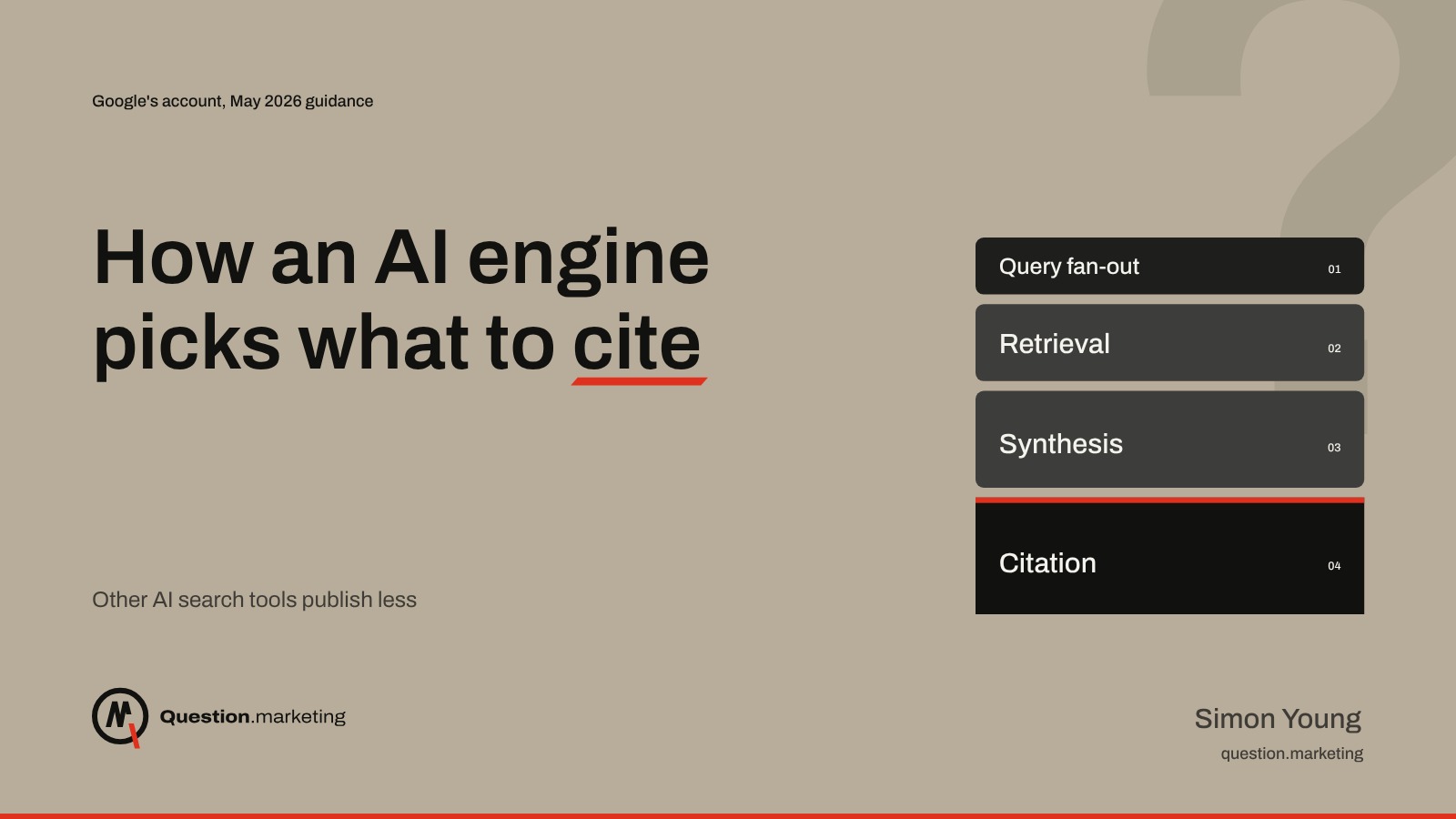
- Query fan-out. The model turns one question into several related searches. Google's own example: "how to fix a lawn that's full of weeds" can fan out into searches about herbicides, removing weeds without chemicals and preventing weeds.
- Retrieval. It retrieves relevant, up-to-date pages from the search index.
- Synthesis. It reviews the specific information in those pages and writes one answer.
- Citation. It links to the pages that support the answer.
Other AI search tools publish less about how they work, so treat this as Google's account rather than a universal rule.
Our advice: make each section of your page clear enough to be quoted on its own. Google also says there is no need to break content into tiny pieces for AI, so this is about clarity, not chopping pages up. There is also evidence that models decide which brands to name partly from what they learned in training, then look for sources to support that choice. Seer Interactive's March 2026 study of 362,188 AI responses calls this its leading hypothesis. We explain that research, and its limits, in How AI actually decides who to recommend.
The four content signals that matter most
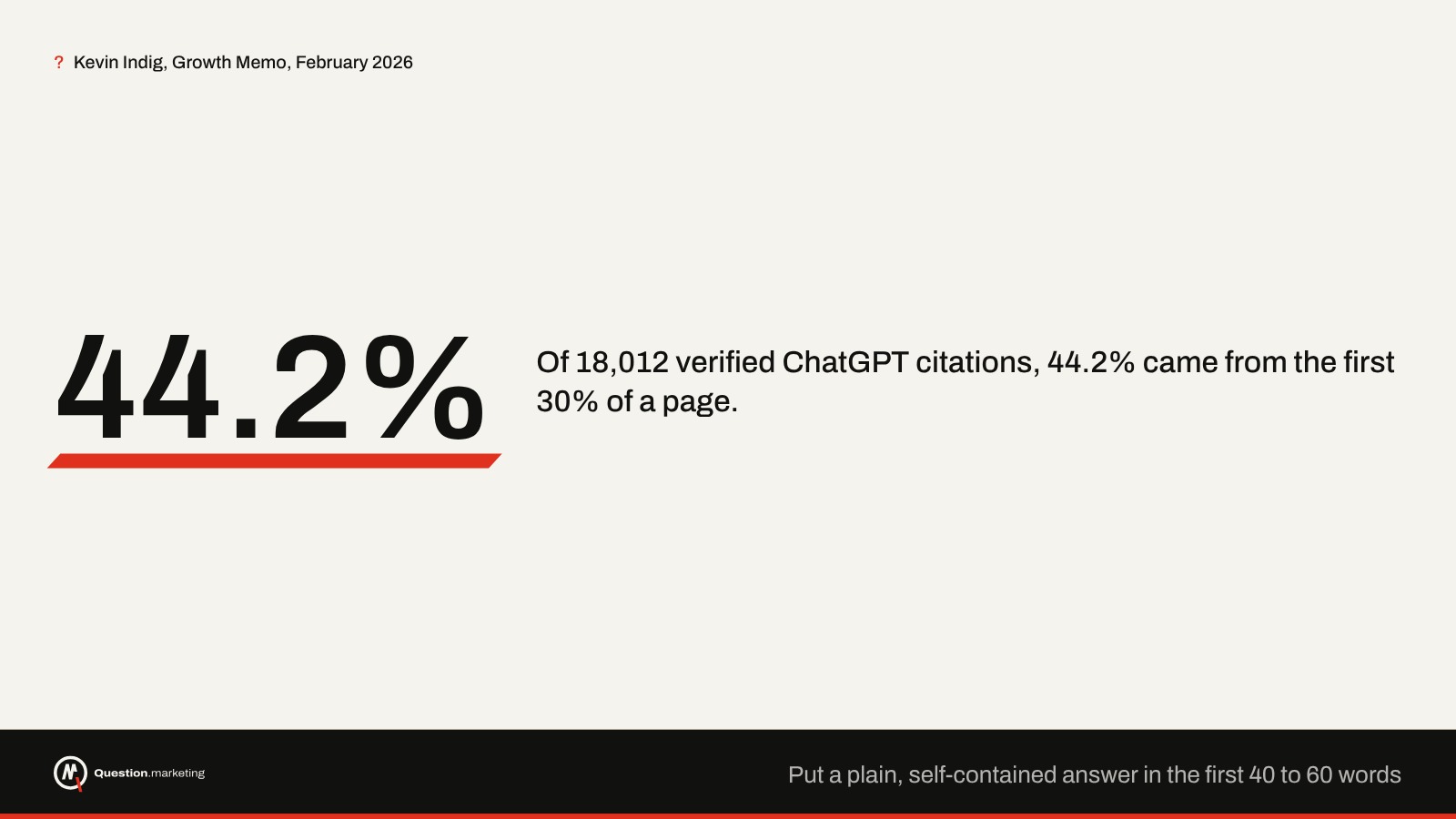
A direct answer, early. Kevin Indig's February 2026 Growth Memo analysis of 18,012 verified ChatGPT citations found 44.2% came from the first 30% of a page. Put a plain, self-contained answer in the first 40 to 60 words.
Fact density. Specific figures, named sources, dates and attributed quotes give an engine something worth lifting. The GEO paper by researchers from Princeton, IIT Delhi and others (Aggarwal et al., KDD 2024) found that adding citations, quotations and statistics lifted visibility in AI answers by up to 40%. That is a best case in a test set-up, not a guaranteed uplift.
Structured extractability. Descriptive headings, one idea per section, tables for comparisons and FAQs where they are genuinely useful. Google says structured data isn't required for its AI features and there is no special markup to add, though it still helps with rich results. Schema helps the machines read the page, but it doesn't make the page worth reading.
Entity authority. Clear bylines, consistent facts about your business everywhere they appear, and mentions on sites you do not control. Ahrefs' May 2025 study of 75,000 brands found branded web mentions correlated with brand visibility in Google's AI Overviews at 0.664, against 0.218 for backlinks.
Platform notes
- ChatGPT search uses OpenAI's OAI-SearchBot crawler. In a February 2025 test of 100 queries, Seer Interactive found 87% of SearchGPT citations matched Bing's top 20 results, so Bing Webmaster Tools is worth opening. Treat that overlap as indicative, not settled.
- Perplexity crawls with PerplexityBot, which it says is used to surface and link websites in its search results, not to train AI models.
- Google AI Overviews and AI Mode are rooted in Google's core Search ranking and quality systems, according to Google's May 2026 guidance. The Gemini app is a separate product.
- Claude fetches pages with Claude-User when someone asks it to, and indexes for search with Claude-SearchBot, according to Anthropic.
The fuller platform comparison is on How AI actually decides who to recommend.
The seven-step AEO checklist
1. Let the AI crawlers in
Check robots.txt, your CDN and any bot-protection settings. For AI search, the crawlers that matter are OAI-SearchBot (ChatGPT search), PerplexityBot, Claude-SearchBot, Bingbot and Googlebot, plus the fetchers that act when a user asks: ChatGPT-User, Claude-User and Perplexity-User. GPTBot and ClaudeBot collect training data, and Google-Extended controls Gemini training and grounding in the Gemini app but not Google Search, so treat those as a separate decision. Make sure your key content is in the HTML the server sends: Vercel's December 2024 analysis found that crawlers from OpenAI, Anthropic and Perplexity did not render JavaScript.
2. Answer first
Open every important page with a direct answer to the question it targets, in 40 to 60 words, before any background or scene-setting.
3. Replace adjectives with evidence
Swap "industry-leading" for the number that proves it. Name the source, give the date and attribute quotes to real people.
4. Structure every page for extraction
Use descriptive headings, keep one idea per section, put comparisons in tables and add FAQs where people genuinely ask those questions. Mark up the page with relevant schema such as Article, FAQPage, Organization and Person as part of normal SEO. Google says there is no special markup for its AI features.
5. Publish something only you have
Original data, first-party results, case evidence or expert commentary. Content that repeats what is already online gives an engine no reason to cite you. Google's own guidance says unique, non-commodity content is likely to influence your presence in its AI search features more than anything else in that guide.
6. Earn mentions away from your own site
Reviews, directories, trade press, podcasts, communities and partner sites. Keep your core facts identical everywhere so engines can corroborate them. Earn these rather than manufacture them: Google warns that seeking inauthentic mentions isn't as helpful as it might seem.
7. Refresh on a schedule
Review cornerstone pages on a regular schedule. Update facts, examples and figures, and change the visible "last updated" date only when the content has genuinely changed.
How to measure AI citations
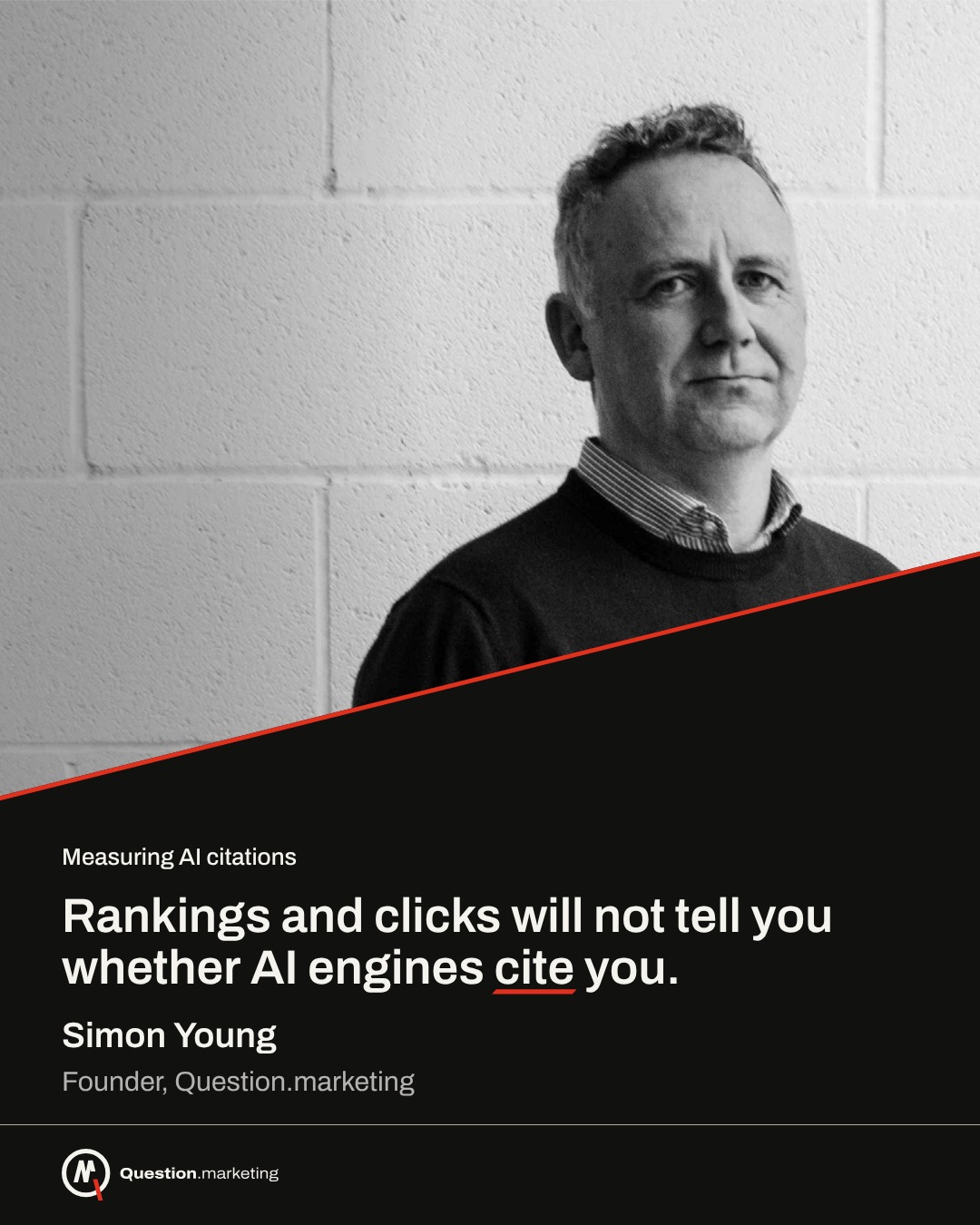
Rankings and clicks will not tell you whether AI engines cite you. Track three things instead.
- AI mention rate and share of voice. Run a fixed set of priority prompts across the main engines on a regular schedule, sample each prompt many times because AI answers vary, and record how often you are named or cited compared with competitors. We use 30 prompts, each sampled around 50 times per cycle.
- AI referral traffic. In GA4, create a custom channel group for referrers such as chatgpt.com, perplexity.ai, gemini.google.com, claude.ai and copilot.microsoft.com.
- Branded demand. Watch branded search and direct traffic too, because some people who see you named in an AI answer may come back later without a trackable referral.
Our measurement page explains how we do this with a stated margin of error, and the video Which tools track AI search share of voice and citations? compares the tools.
Related videos from the Video Transcript Library
- Answer engines vs search engines
- Proof: Google and ChatGPT are not reading the same internet
- Which tools track AI search share of voice and citations?
- The complete guide to AEO in 2026
Browse every video in the Video Transcript Library.
FAQ
What is Answer Engine Optimisation (AEO), and where does GEO fit?
AEO is the practice of making your content and brand easy for AI search tools such as ChatGPT, Perplexity and Google's AI Overviews to find, quote and name in their answers. GEO, generative engine optimisation, is the term from a 2023 research paper, GEO: Generative Engine Optimization, by Aggarwal and colleagues, later presented at KDD 2024. We treat GEO as part of AEO.
Is GEO different from AEO?
In practice the work overlaps almost entirely. GEO is the term the 2023 research paper used for improving how visible content is in AI-generated answers. We treat it as part of AEO.
How do AI search engines decide which sources to cite?
Google says its AI features turn a question into several related searches, retrieve relevant pages from its index, and write an answer with links to the pages that support it. Other engines publish less detail. Direct, specific, well-sourced passages give any engine more to work with.
What did the original GEO paper actually find?
The paper (Aggarwal et al., KDD 2024) found that adding citations, quotations and statistics lifted visibility in AI answers by up to 40%. That is a best case in a test set-up, not a guaranteed uplift. Keyword stuffing did not help, and results varied by subject area.
Where on a page should the answer go?
At the top. Put a direct, self-contained answer in the first 40 to 60 words. Kevin Indig's analysis of 18,012 verified ChatGPT citations found 44.2% came from the first 30% of a page.
Does schema markup help with AI citations?
Google says structured data isn't required for its AI features and there is no special markup to add, though it still helps with rich results. Add accurate Article, FAQPage, Organization and Person schema as part of normal SEO, and be wary of anyone who claims to know exactly how much it helps with AI citations.
Should I let AI crawlers access my site?
If you want to be cited, allow the search crawlers: OAI-SearchBot for ChatGPT search, PerplexityBot, Claude-SearchBot, Bingbot and Googlebot. GPTBot, ClaudeBot and Google-Extended govern AI training (and, for Google-Extended, grounding in the Gemini app), which is a separate decision. Make sure your main content does not depend on JavaScript to appear.
How do I measure whether AI is citing my brand?
Run a fixed set of priority prompts across the main AI engines on a schedule, sampling each one many times, and record how often you are named. Set up an AI referral channel in GA4, and watch branded search and direct traffic for lift.
How often should I update content for AI search?
Review cornerstone pages on a regular schedule and make real updates to facts and examples. Changing the date without changing the content does not count.
Sources
- Aggarwal, P., Murahari, V., Rajpurohit, T., Kalyan, A., Narasimhan, K. and Deshpande, A. (2023). GEO: Generative Engine Optimization. arXiv:2311.09735.
- Published version: Proceedings of the 30th ACM SIGKDD Conference on Knowledge Discovery and Data Mining (KDD 2024).
- GEO-bench code and data, from the paper's authors.
- Kevin Indig, Growth Memo, 16 February 2026 (18,012 verified ChatGPT citations).
- Write-up: Search Engine Land, 18 February 2026.
- Ahrefs, An Analysis of AI Overview Brand Visibility Factors (75K Brands Studied), 26 May 2025.
- SparkToro (Rand Fishkin), In 2026, Less than One Third of Google Searches Still Send a Click, June 2026.
- Google Search Central, Optimizing your website for generative AI features on Google Search, May 2026.
- Seer Interactive, LLM Ghost Citations, March 2026.
- Seer Interactive, 87% of SearchGPT Citations Match Bing's Top Results, February 2025.
- OpenAI, Overview of OpenAI crawlers.
- Anthropic, Does Anthropic crawl data from the web, and how can site owners block the crawler?
- Perplexity, Perplexity Crawlers.
- Google, List of Google's common crawlers (Google-Extended).
- Vercel, The rise of the AI crawler, 17 December 2024.
Further reading on Question.marketing: How AI actually decides who to recommend, AEO vs GEO vs SEO, Answer Engine Optimisation, How we measure AI visibility, Video Transcript Library.
Evidence from the library
Recorded posts from the library that bear on this page, each with the video and a full transcript.