The feed posts around those articles, oldest first. Every date is derived from LinkedIn's own post identifiers, which encode creation time. Where a permalink is still outstanding, it says so rather than being implied.
21 August 2019, the AEO feed post
1,197 days before ChatGPT, permalink outstanding
“SEO is dying! Do you know what AEO is? It's very quickly taking over from SEO. Has your agency talked to you about answer engines?...”
This is a feed post rather than a published article, and I have not yet recovered its permalink. The wording is almost identical to the published article six weeks later, which asks whether your SEO company has even mentioned AEO to you, so the credential on this site rests on that article, 4 October 2019, 1,153 days, which is fully linked and dated.
LINK TO POST, PERMALINK OUTSTANDING · Same argument, published and dated, in “AEO is your business ready?”, 4 October 2019
This is the one that matters, and not because of "SEO is dying." People have been saying that since 1999, and I'll come back to why that framing was a mistake.
It matters because of what sits next to it: AEO, answer engines, and the question of whether anyone's agency was discussing them.
In August 2019 the answer for almost everybody was no. There was no category. No platforms, no funded startups, no conference track, no Google guidance. The paper that introduced "generative engine optimisation" to the academic literature was still more than four years away.
Right: the term, the concept, and the fact that agencies weren't preparing clients.
Wrong: "dying" was too strong, and I was early enough that nobody could act on it. Being right too soon has a commercial cost.
26 December 2019, search has to change shape
26 December 2019
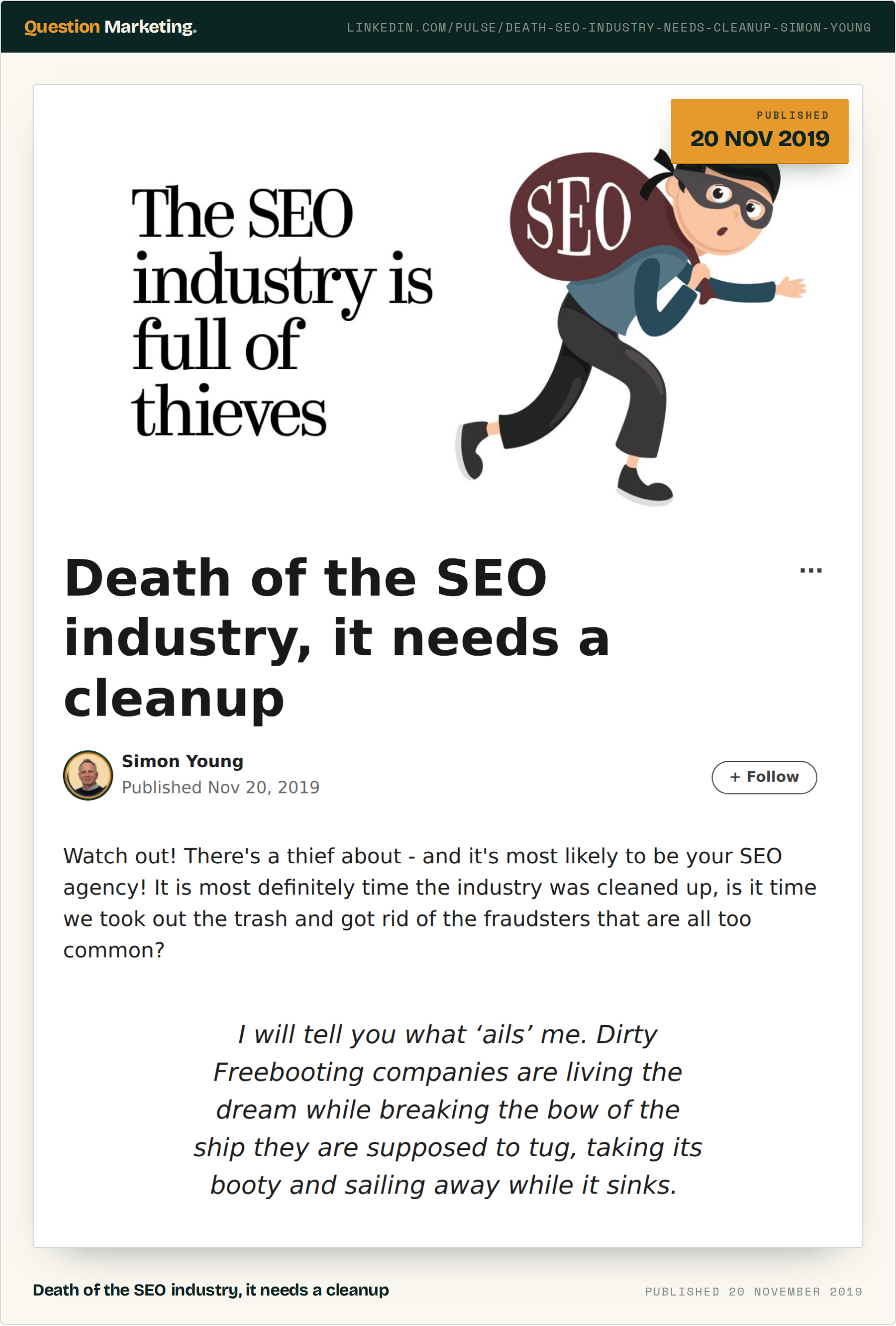
“The future of search engines isn't as simple as me searching for something online. Search needs to evolve...”
LINK, PERMALINK OUTSTANDING · Written up a month earlier in “Death of the SEO industry, it needs a cleanup”, 20 November 2019
Right: the structural point, that the interface itself would change, not just the ranking factors. Which is exactly what happened when answers replaced lists.
8 February 2020, questions as the unit of search
8 February 2020
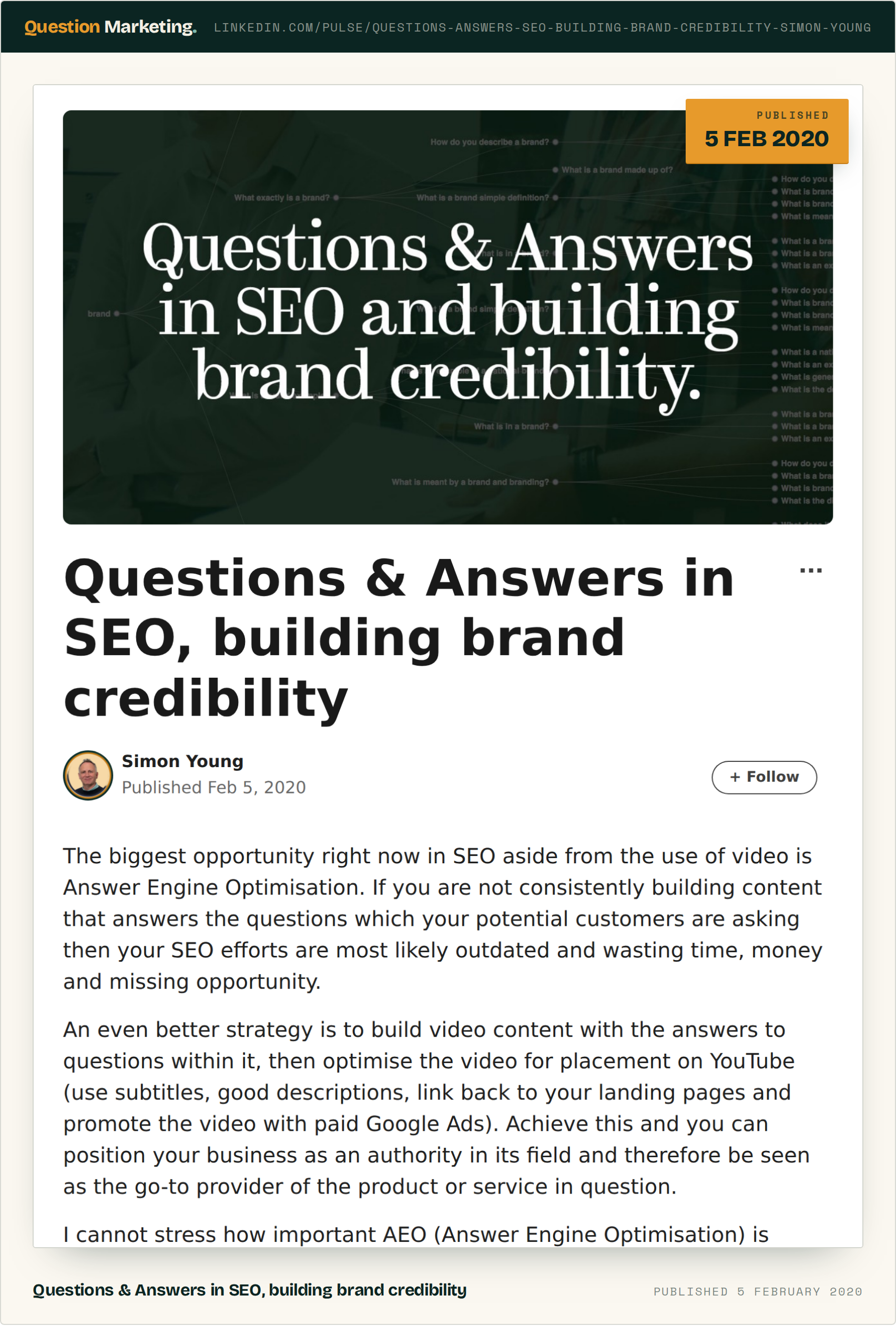
A post about a blog article “all about Q&A and how it helps with SEO... the biggest thing in SEO this year.”
LINK, PERMALINK OUTSTANDING · The article it points to is “Questions & Answers in SEO, building brand credibility”, 5 February 2020
Right: that the question, not the keyword, was becoming the unit of search. Six years later my company is called Question.Marketing, which is either consistency or stubbornness.
12 October 2020, the five-year call
12 October 2020
“SEO will be dead and forgotten in 5 years... Thoughts?”
I got this wrong, and it's the most useful entry on the page.
LINK · SCREENSHOT
Five years from October 2020 was October 2025. SEO is neither dead nor forgotten. Google's search revenue rose 17% year-on-year in Q2 2026 to $63.3 billion, its twelfth consecutive quarter of double-digit growth, and Google still holds around 90% of traditional search. I overshot badly.
But look at what did happen by that deadline. SparkToro's June 2026 research found fewer than one third of Google searches now send a click, an 8 percentage point fall in a single year, measured on a panel of sites run by professional marketers actively trying to grow traffic. The clicks went. The searches didn't.
So here's the correction, and it's the entire basis of how I work now: the practice of SEO is in fine health. The SEO business model, billing monthly for rankings and clicks, is what's finishing.
I collapsed those two things into one claim in 2020, and it made me sound like every other person shouting that SEO was dead. Getting the direction right and the framing wrong is normal in this work. I'd rather show you the correction than curate the hits.
2 December 2020, answer engines as strategy
2 December 2020
“The best SEO tactic for 2021 and beyond. Are you using Answer Engines as a strategy for SEO?”
LINK · SCREENSHOT
Right: treating answer engines as a strategic layer rather than a tactical add-on. That's the mainstream position now. Google's May 2026 guidance broadly agrees, it argues the work belongs inside SEO rather than beside it, which is a disagreement about labels, not substance.
14 December 2020, the video call
14 December 2020
“The future of SEO is NOT a traditional text-based search, do you agree? Video is wiping the floor with SEO...”
Half right, and worth showing you for the half that wasn't.
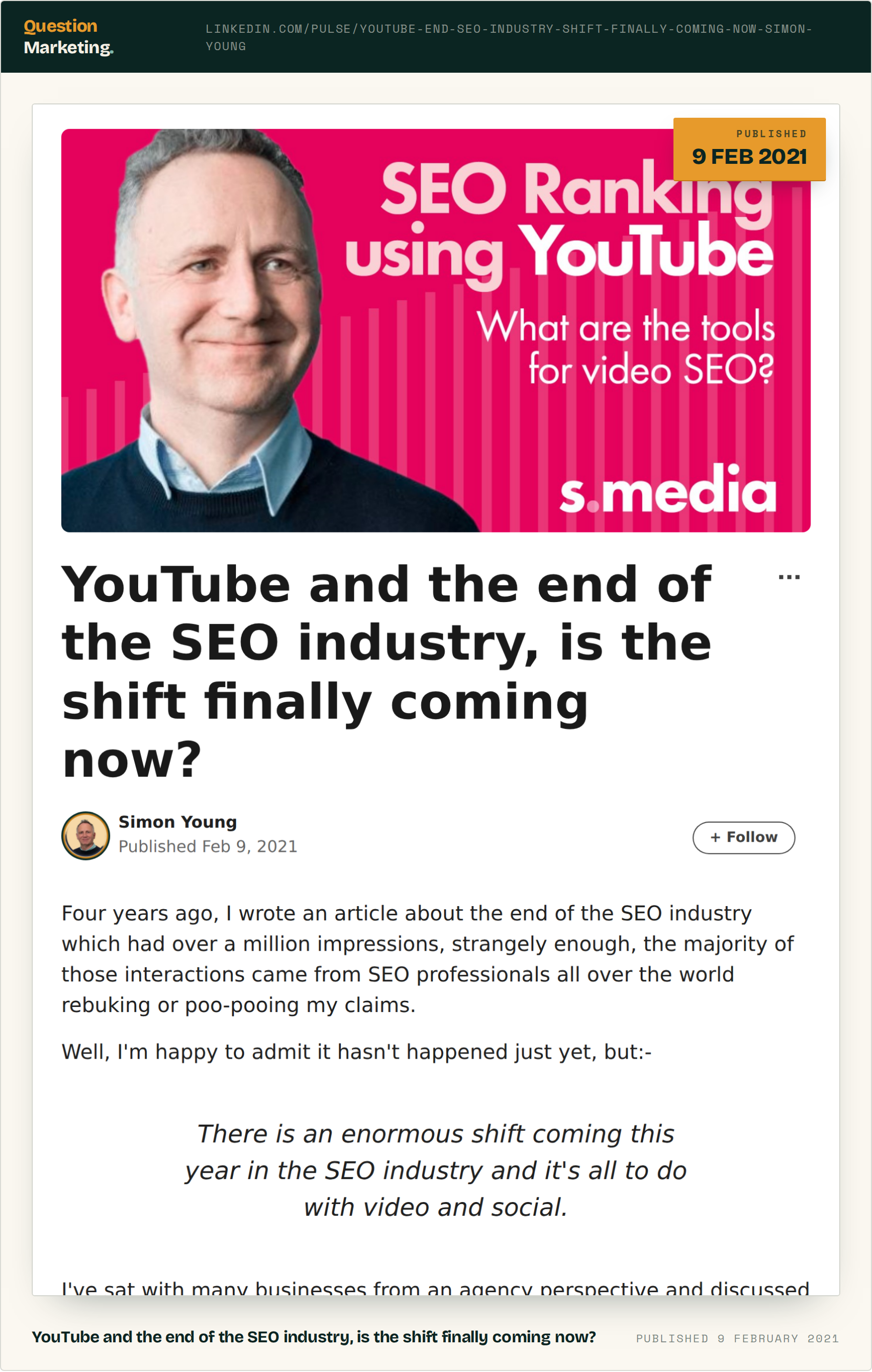
LINK, PERMALINK OUTSTANDING · I made the same argument at length two months later in “YouTube and the end of the SEO industry, is the shift finally coming now?”, 9 February 2021
The core intuition held: text-based, list-of-links search wasn't the end state. But I backed video as the successor, and it wasn't. Video grew enormously; search didn't become primarily visual. What actually displaced the list of links was the generated answer, which nobody, me included, saw arriving in the form it did.
What it taught me: being right that something will change is far easier than being right about what replaces it. It's why I now sell measurement rather than predictions, and why every number on this site carries a margin of error.
22 August 2024, for completeness
22 August 2024
“What are your thoughts on Google...”
LINK · SCREENSHOT
Post-ChatGPT, so this is commentary rather than prediction. Included because I'd rather show the whole record than the flattering slice of it.