

Voice search is when someone asks an AI assistant a question out loud and hears one answer back. Question.marketing helps UK businesses become that answer, as part of answer engine optimisation (AEO): clear spoken-length answers, consistent facts about who you are, independent corroboration and a monthly check of what the assistants actually say.
What changed in voice search?
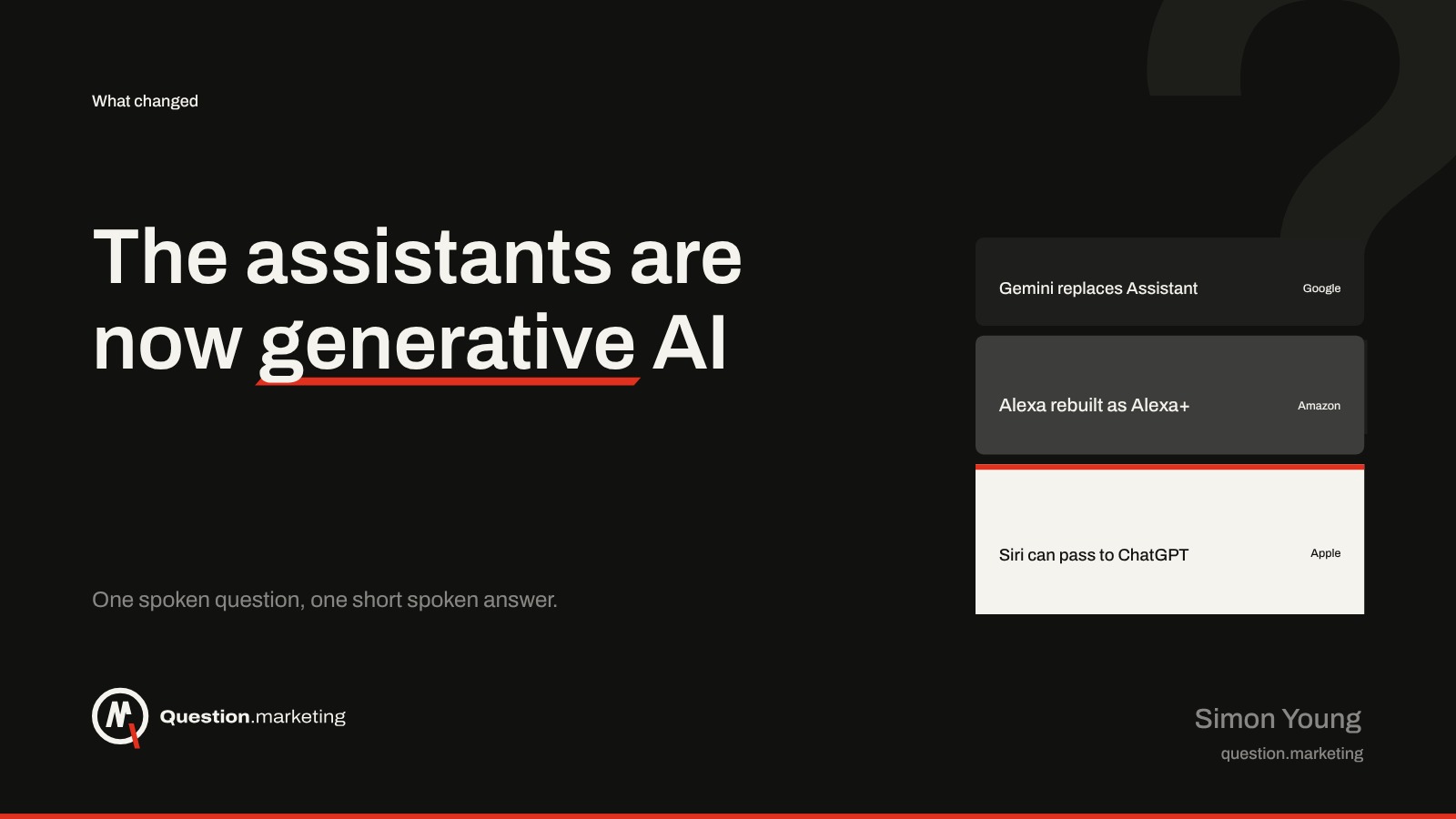
The assistants are now generative AI. Google is replacing Google Assistant with Gemini on phones and paired devices, Amazon has rebuilt Alexa as Alexa+, and Siri can pass questions to ChatGPT. Each one turns a spoken question into a short spoken answer, often naming one business.
What does Question.marketing do for voice search?
We find the questions your customers ask out loud, write answers built to be read aloud, align how you are described across the web, and measure who the assistants name each month. It is the spoken layer of our AEO work.

Start here
3 November 2026
Will AI recommend your business? Our conversation with Pola Ariel and Dr Jorge Raziel
Simon Young, Pola Ariel of Stay Branded and Dr Jorge Raziel on being cited vs chosen by AI, and why customers will just ask their phone.

- ChatGPT Business Hub for UK businesses: who can claim a ChatGPT profile in the UK, and what it means for spoken answers, 15 November 2026.
- AI assistants that phone businesses: what Muse, Gemini and Alice AI calling means for your phone line, 14 November 2026.
- Alexa, Siri and Gemini under UK radio rules: what the designation means for being found by voice, 13 November 2026.
- Alexa for Shopping reaches the UK: UK launch guide, 12 November 2026.
- Gemini screen automation reaches the UK: assistant comparison, 11 November 2026.
- Muse, dots and Siri AI: voice AI agents compared: assistant comparison, 10 November 2026.
- Voice answers are shorter, a 33-person study finds: news explainer, 9 November 2026.
- Alexa for Shopping adds 100+ ask-for actions: news explainer, 6 November 2026.
- OpenAI says 250 million use ChatGPT voice each week: news explainer, 5 November 2026.
- Siri AI opens to every app: what it means for voice search: news explainer, 4 November 2026.
- Who do AI assistants name for voice search? Our first voice answer audit: original data, 3 November 2026.
- Can you book a table by voice? Alexa+, Gemini, ChatGPT and Siri compared: assistant comparison, 2 November 2026.
- Voice search in the car: Siri, Gemini, ChatGPT and Claude compared: assistant comparison, 30 October 2026.
- Voice assistants now remember: what Siri's iOS 27.2 update means for being recommended: news analysis, 29 October 2026.
- Voice Search in 2026: How to Become the Answer That Gets Read Out: the full guide.
- Voice search FAQ: eleven short answers to the questions we are asked most.
- AIVS: the spoken recommendation layer of AEO: our field guide to measuring spoken recommendations.
- AEO measurement and how AI chooses.
Quick answers
What is voice search optimisation?
Voice search optimisation is making your content easy for voice assistants to find, read aloud and attribute, usually by giving short, direct answers to the questions people ask out loud. At Question.marketing we treat it as the spoken layer of answer engine optimisation (AEO).
Is voice search the same as AEO?
It overlaps. AEO covers visibility in any AI answer, on screen or spoken. Voice search is the spoken part, where the assistant usually has room for only one name.
How do I measure voice search visibility?
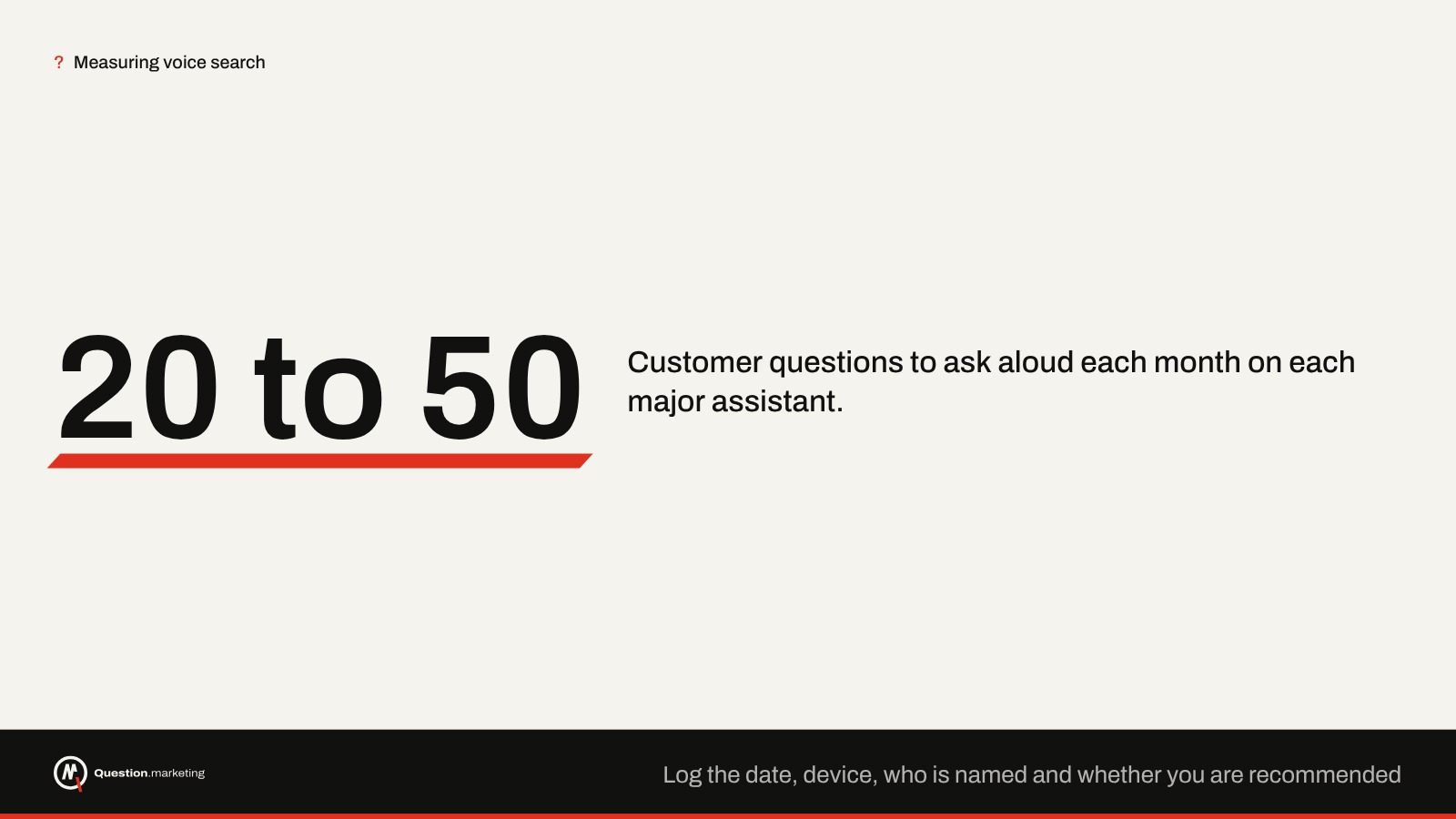
Ask a fixed set of 20 to 50 customer questions aloud each month on each major assistant, and log the date, the device, who is named and whether you are recommended. Keep the questions the same so the trend means something.