· 1,534 days before ChatGPT
SEO Companies, thief, fraud or ignorant? Are they worth it?
Date read from LinkedIn's structured data · no capture yet, open the live page
Answer Engine Optimisation
Answer engine optimisation is the work of making AI systems, ChatGPT, Google AI Overviews, Gemini, Claude, Perplexity, recommend your business when someone asks them for one. It is not a new discipline. It is search, thirty years on, with a different front door and a much harder measurement problem.

Simon Young, Founder
Thirty years in search. Publishing on AEO and answer engines since October 2019, 1,153 days before ChatGPT. The dated record →
Every figure on this page is sourced and dated. Where the research disagrees, we say so.
Last updated 26 September 2026
ChatGPT launched 1,153 days later.
That article is public, dated and linked below. So are others from 2019, 2020 and 2021, in which I wrote about answer engines as a strategy, about questions replacing keywords, and about search shifting from a list of links to a single answer. The academic paper that coined "generative engine optimisation" arrived in November 2023, over four years after I was already using the term AEO with clients.
Simon Young, Founder, writing this in 2019
· 1,534 days before ChatGPT
Date read from LinkedIn's structured data · no capture yet, open the live page
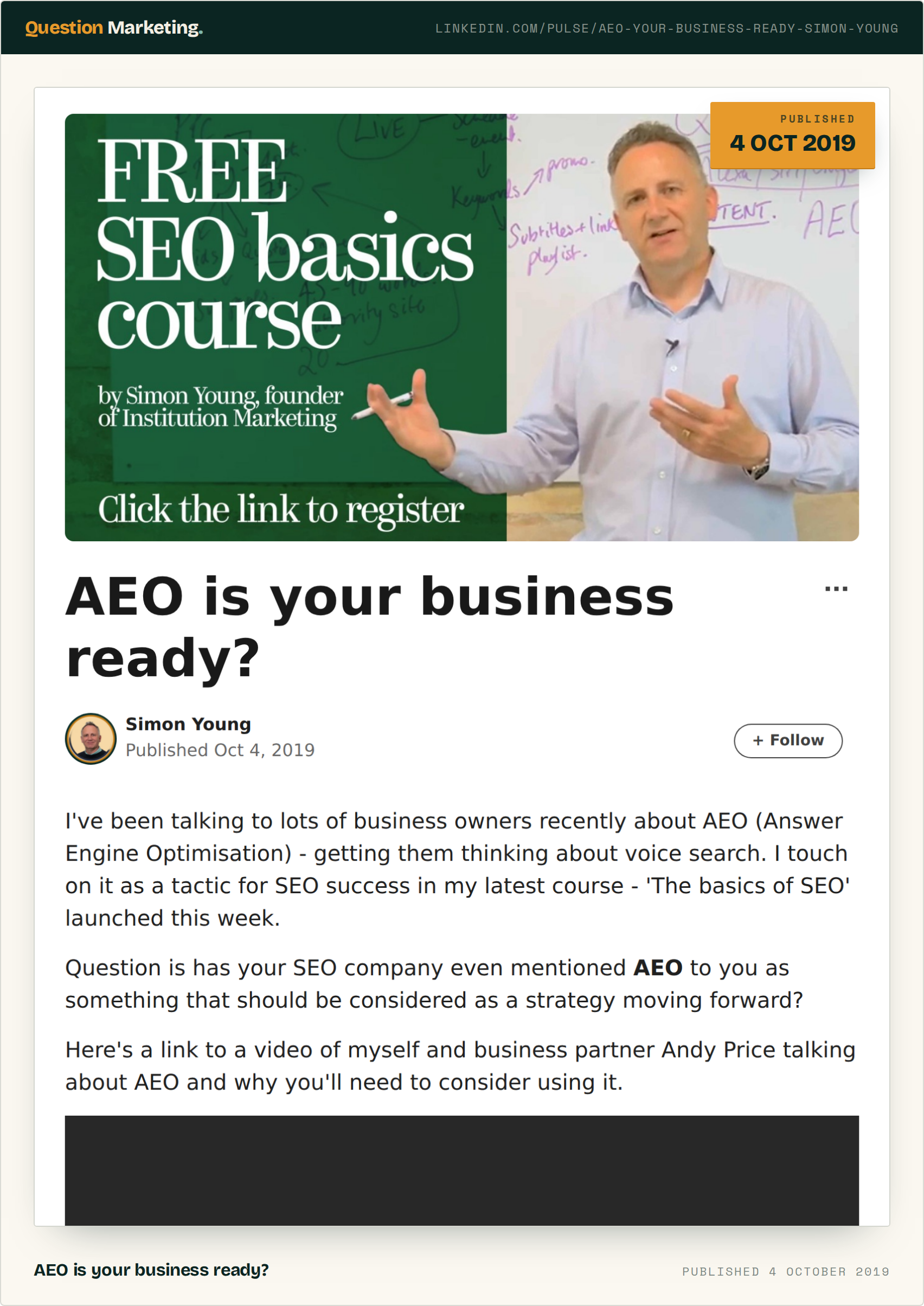
· 1,153 days before ChatGPT
Date read from LinkedIn's structured data · capture 12 August 2026
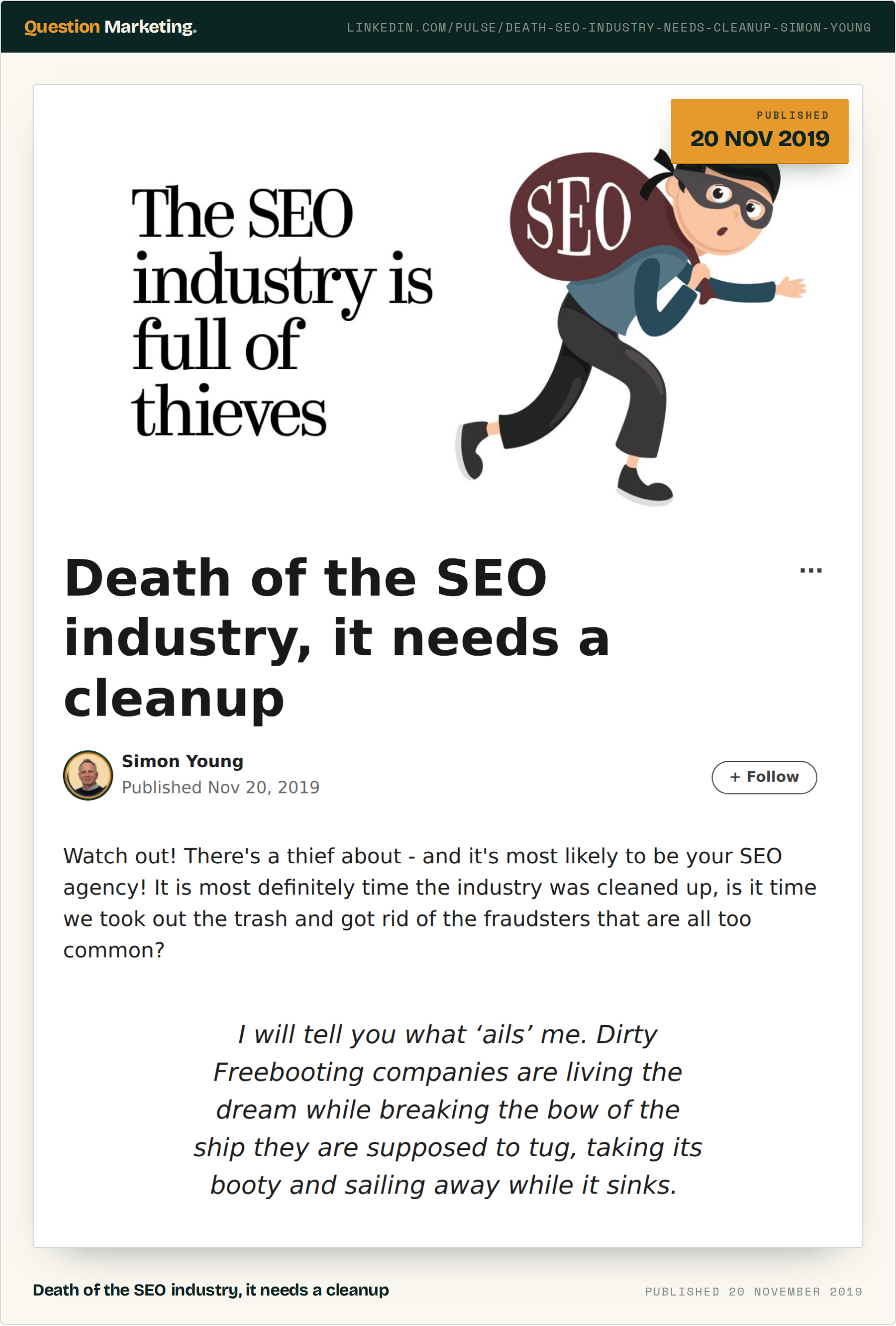
· 1,106 days before ChatGPT
Date read from LinkedIn's structured data · capture 12 August 2026
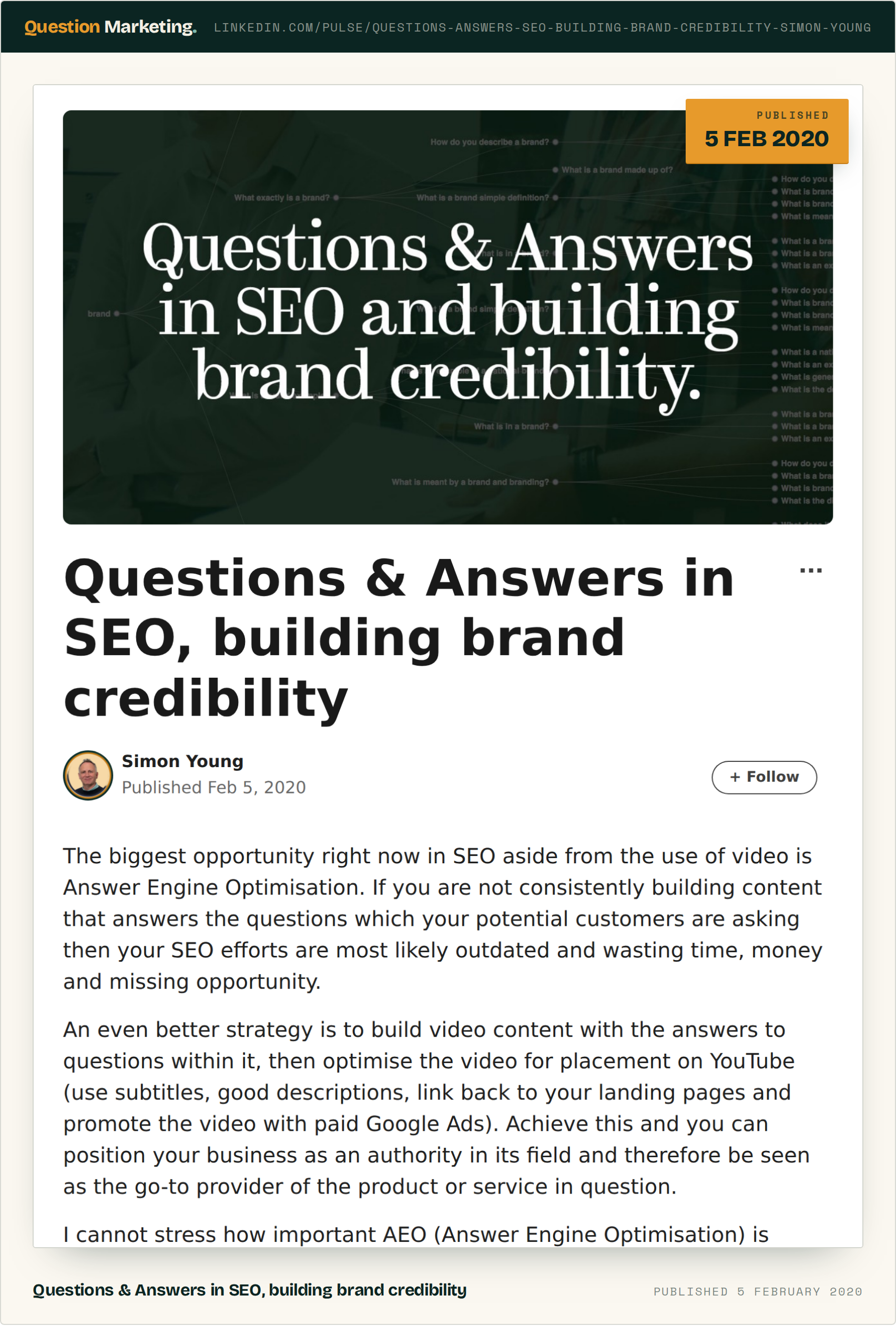
· 1,029 days before ChatGPT
Date read from LinkedIn's structured data · capture 12 August 2026
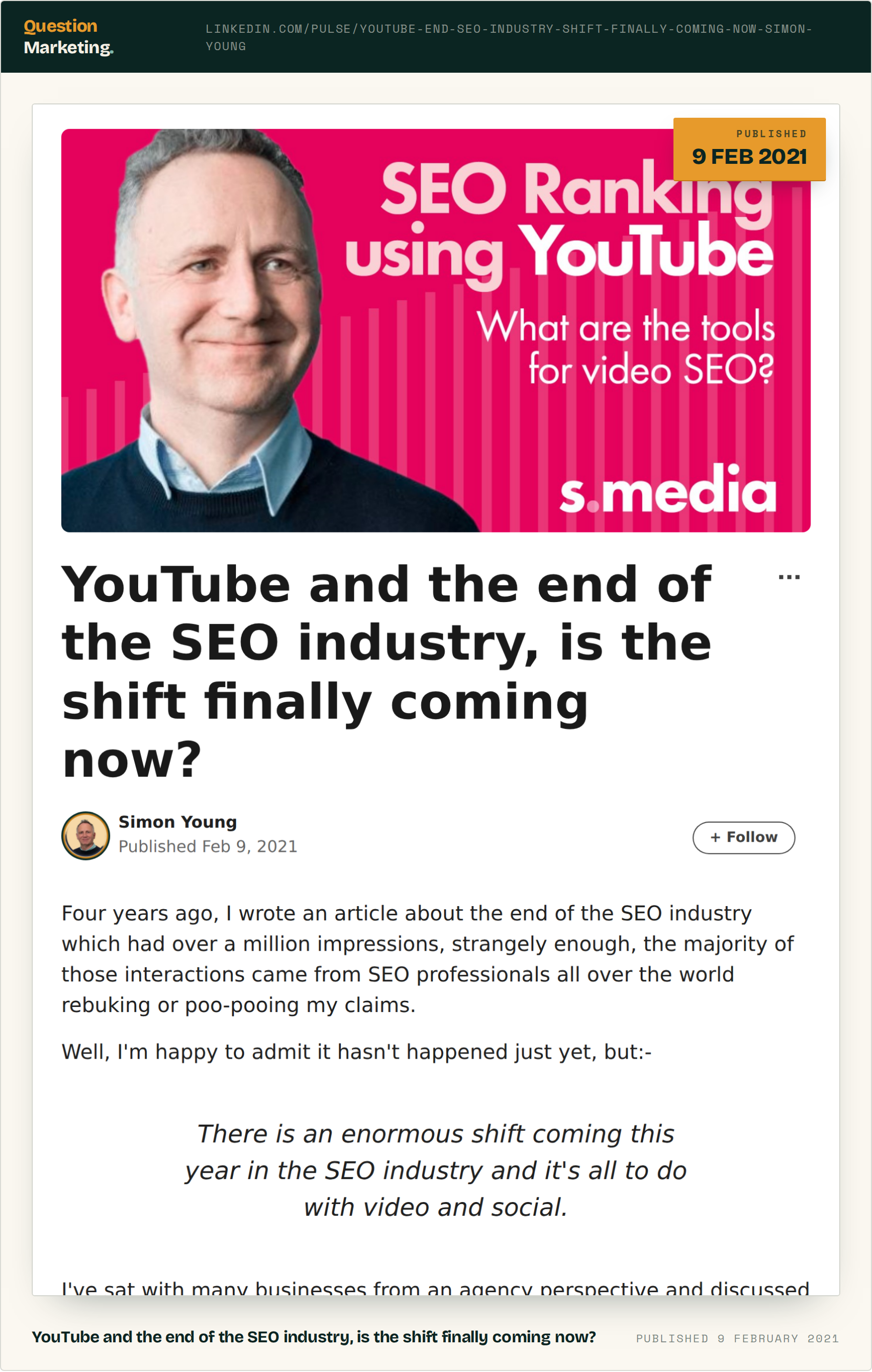
· 659 days before ChatGPT
Date read from LinkedIn's structured data · capture 12 August 2026
I've been in search for thirty years, and I've watched "SEO is dead" declared five times. Four of those were nonsense and I said so. I also got two of my own calls wrong, which are published alongside the rest, because a record with no failures in it isn't a record.
That's the useful part of thirty years. Not the war stories, the pattern recognition. I know which panics were real, because I was there for all of them.
In May 2026, Google published official guidance on optimising for its generative AI features. Its position: the AI features run on Google's core Search ranking and quality systems, standard SEO practice remains foundational, and the terms "AEO" and "GEO" are not necessary.
Google's John Mueller has gone further, noting publicly that the harder someone pushes urgency and new acronyms, the more likely they are simply producing spam and scamming people.
He is right, and most of this industry deserves that. I would rather say so than pretend it wasn't said.
Here is where Google's guidance stops being sufficient:
Google only speaks for Google. ChatGPT retrieves through Bing, Seer Interactive found 87% of SearchGPT citations matched Bing's top ten, against 56% correlation with Google's. Perplexity runs its own index of over 200 billion URLs and weights community sources heavily. A study across 55,936 queries and six LLM search engines found roughly 37% of the domains those engines cite never appear in traditional search results at all. Optimising for Google is necessary. It is not the whole surface.
"Do good SEO" is not an operating plan. It is not a measurement framework, a prioritised roadmap, or a report your board will accept. It's advice, and it's correct, and it doesn't tell a marketing director what to do on Monday.
The signal that actually drives AI recommendation isn't what SEO retainers were built to deliver. See below.
Contradiction Decoder, Google's guide against ChatGPT, Perplexity and Claude →
UK CMA publisher conduct requirement, the operator brief →
Every AI search visibility tool we could find, and what they cost →
How to get recommended by ChatGPT and cited in Google's AI Overviews, the definitive guide →
This is the finding that reorders everything, and almost nobody in this market is selling on it, because it makes their software less important.
Seer Interactive ran six behavioural tests across 362,188 AI responses in 2026. Their conclusion: the model chooses which brands to recommend from what it already learned in training, then goes looking for sources to support choices it has already made.
Their phrase for it is the one worth remembering:
the citation is the bibliography, not the brainstorm.
The supporting evidence lines up. In May 2025, Ahrefs studied 75,000 brands and found branded web mentions correlate 0.664 with brand visibility in Google's AI Overviews. Backlinks correlate 0.218, roughly a third as predictive. The three strongest signals were all off-site brand signals, not link metrics.
What that means in practice:
If a model has never meaningfully encountered your brand, no amount of page-level tidying will make it recommend you. You cannot schema your way into being known. The work is to become a brand the model has learned, and then make your pages easy to quote.
That first part is thirty-year-old work: entity clarity, genuine notability, presence in the sources these systems actually read, review consistency, category authority, digital PR. It is not a software feature. It cannot be automated, which is precisely why the funded platforms don't sell it.
A baseline with a stated margin of error, not a screenshot. We sample every tracked prompt around 50 times per cycle across 30 prompts, roughly 1,500 answers per source, every cycle. That gets a share-of-voice figure to roughly ±1 to 2 points. A single check carries a margin of error of ±9 to 13 points, which means most of the industry is reporting seven coin flips a week as a trend line.
Crawler access for the search and citation crawlers: OAI-SearchBot and ChatGPT-User for ChatGPT, PerplexityBot and Perplexity-User for Perplexity, Claude-SearchBot and Claude-User for Claude, plus Googlebot and Bingbot. GPTBot, ClaudeBot and Google-Extended control AI training (and, for Google-Extended, grounding in the Gemini app), so we treat those as a separate decision. Schema and structured data. Answer-first page structure: Kevin Indig's February 2026 Growth Memo analysis of 18,012 ChatGPT citations found 44.2% came from the first 30% of a page, so a claim buried in paragraph four may never get reached. Product and location data made machine-readable. Attribution plumbing so you can actually see the channel.
Content that repeats what's already on the web gets ignored. The GEO paper by researchers from Princeton, IIT Delhi and others (Aggarwal et al., KDD 2024) found that adding citations, quotations and statistics lifted visibility in AI answers by up to 40%. That is a best case in a test set-up, not a guaranteed uplift. Every page we publish for you carries at least one piece of proprietary data, original observation or first-party evidence. We cap volume deliberately, the public record of brands that scaled AI content is a rocket followed by a cliff.
The layer that actually moves recommendation, and the one no platform sells. Entity establishment and disambiguation. Digital PR aimed at the sources these systems retrieve from. Community and review presence. Category authority. This is the premium tier because it is the part that works.
In the transcript library. Every video we have published is written out in full as text, one page per video, grouped by subject, with no email address required.
That includes answer engine optimisation explained on camera in October 2020, the search and ranking material that led into it, and the complete free YouTube Ads course. If you want to check the dates on the claims made across this site, the transcripts are where they are written down.
Most agencies in this category show you a dashboard proving you're losing, then ask you to trust that they can fix it. We publish baselines, interventions and results in public, on a fixed cadence, with confidence intervals, and we publish the interventions that produced nothing.
The negative results are the point. Nobody fakes a failure.
Buyer intent is near-universal. Conductor surveyed 250+ digital leaders: 97% reported positive AEO impact in 2025, 94% planned to increase investment in 2026. Only 14% currently track AI search performance at all.
The visitors are better. ChatGPT referral traffic converts at 14.2 to 15.9% against Google organic at 1.76%, roughly nine times, per Seer Interactive and First Page Sage. Claude reaches 16.8%. The channel filters out browsers.
Being cited helps your existing search performance. Seer's study across 5.47 million queries found AI Overview citation correlates with 120% more organic clicks per impression and 41% more paid clicks. This is not a choice between SEO and AEO.
In local, the field is almost empty. SOCi's 2026 Local Visibility Index measured over 350,000 locations. Just 1.2% were recommended by ChatGPT, against 35.9% appearing in Google's local 3-pack. Gemini recommended 11%, Perplexity 7.4%. If you are a regional business, almost nobody in your market has done this work.
And the honest counterweight: AI referrals remain around 1% of total website traffic, growing roughly a point a month. Google's search revenue rose 17% year-on-year in Q2 2026 to $63.3 billion, reported on 22 July, its twelfth consecutive quarter of double-digit growth. This is a fast-growing, high-quality, still-small channel, not a replacement for everything you currently do. Anyone telling you otherwise is selling urgency.
You cannot make a sensible decision about this channel until you know where you actually stand in it, with a real margin of error attached.
The AI Visibility Audit: £495, credited in full against your first month if you start within 30 days
Full pricing is published. See all pricing →
Partly. The foundations are identical, crawlability, structured data, topical authority, genuine quality. What's different is the target and the measurement. You're optimising for systems that synthesise an answer rather than return a list, across several platforms that retrieve differently, and you're measuring citation and mention rather than rank and clicks. Google's position is that this is all still SEO. On mechanics, Google is right. On operating practice, the differences are real enough to need their own framework.
A lot of it is, and Google's John Mueller was right to say so. We've written the full sceptic's case, argued properly rather than knocked down. →
Possibly less than you'd think, and possibly more. Ahrefs found the overlap between Google's top ten and AI Overview citations fell from 76% in mid-2025 to 38% by March 2026, though BrightEdge found overlap rising over a comparable period, and seoClarity found 97% of AI Overviews cite at least one top-20 result. The studies genuinely disagree. What isn't disputed: strong Google rankings do not reliably translate into ChatGPT or Perplexity recommendation, because those systems don't use Google's index.
Technical retrievability and attribution: weeks. Content-driven citation gains: one to three months to become statistically visible, which is why margin of error matters. Brand-signal work: two to three quarters. Anyone promising faster is either lucky or lying, and you can't tell which until it's your money.
Around 1,500 sampled answers per source per cycle, Wilson confidence intervals, published margin of error. full methodology →
Published on our pricing page. →
The three newest posts, each with the video and a full written transcript.