When ChatGPT, Gemini or Google AI Mode answers a question about your industry, it often doesn't run one search. It runs several, and most businesses never see them. Those hidden searches, the query fan-out, decide who gets named. So if your AEO (answer engine optimisation, a term coined by Jason Barnard) reporting only asks "did we show up?", you're measuring the wrong end of the pipe.
Wil Reynolds at Seer Interactive published a sharp piece on this on 2 October 2026. Read it. His big point is right: you can be visible in an AI answer and still not be recommended, and the brands the machine already trusts get searched for by name.
This is our version for UK businesses. More on the fan-outs themselves, what they look like when a buyer in Sheffield or Leeds asks the question, and what a Doncaster firm can actually measure on a Monday morning. Our view hasn't changed: AEO leads, SEO follows. The fan-out is where you can see why.
What is a query fan-out, in plain English?
A query fan-out is the machine splitting your one question into several smaller searches, running them at once, then stitching the results into one answer. Nikola Todorovic, Director of Software Engineering at Google Search, described it on Google's Search Off the Record podcast (episode 109, "How AI Is Changing Google Search and SEO"): the system identifies additional queries, forks, and does the retrieval for them in parallel before combining what comes back (Search Engine Journal, 4 May 2026). Underneath, he said, the retrieval and ranking for AI Overviews is still "the old school". That's the AEO → SEO point in one sentence: the answer layer decides, and classic search does the fetching.
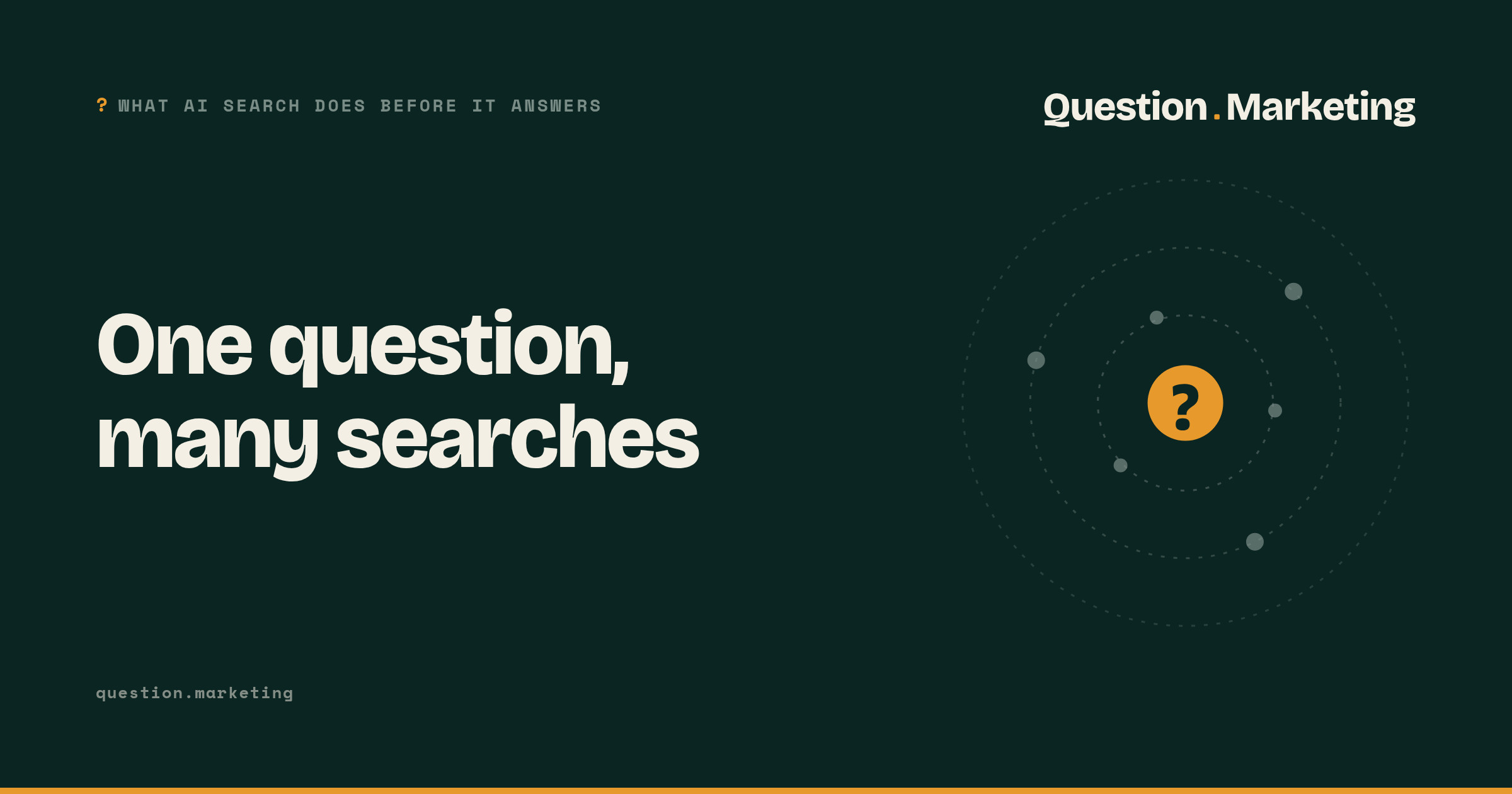
It's what you'd do yourself. Google something, read a bit, search again with a better question. The AI just does it faster and doesn't show its working.
Here's what that looks like for a UK B2B buyer. A finance director types:
"We're a food manufacturer in Yorkshire with a fixed energy contract ending next spring. Who should we talk to about renewing, and what should we watch out for?"
An illustrative fan-out for that prompt (the shape we typically see, not a single captured run):
- business energy broker Yorkshire food manufacturing
- fixed vs flexible business energy contract UK 2026
- non-commodity costs business electricity UK
- Ofgem rules business energy brokers commission
- energy broker reviews Trustpilot manufacturing
- best business energy consultants UK
Look at what's in there. A region. A sector. A regulator. A review platform. A "best" list. Your website may need to hold its own across most of those searches to be named, and only one of them is anything like the keyword your SEO agency is reporting on.
What does a local fan-out look like in Doncaster?
In our experience local prompts fan out wider, because the machine wants to check you exist, you're nearby, you're open and you're safe before it names you. Take a van driver stuck on the A1(M) at 9pm, who asks:
"My van's broken down on the A1(M) near Doncaster and it's 9pm. Who can recover it tonight, and roughly what will it cost?"
Local fan-out: 1 prompt, 6 searches, 1 answer (illustrative, not a captured run):
- 24 hour van recovery A1(M) Doncaster
- vehicle recovery near Doncaster open now
- AA van breakdown recovery non-member cost
- site:yell.com vehicle recovery Doncaster
- van recovery Doncaster reviews
- van recovery cost per mile UK
Six searches, one of them naming a national brand, one scoped to a single directory. A local recovery firm with a great website but no reviews, no Yell listing and no published prices fails three of the six before the answer is written. That's the gap a fan-out can show you and a rank tracker won't.
Which fan-out patterns should UK businesses watch for?
Four patterns keep turning up, and each one tells you something different about where you stand. The examples are illustrative UK versions; capture your own before you act on them.
| Pattern | What it looks like | What it tells you | UK example (illustrative) |
|---|---|---|---|
| Named entity | The machine searches for a brand or person by name | It may already know who it wants; you're competing for second place | "[competitor name] data recruitment reviews" when asked about data recruiters in London |
| Site-scoped | site: a domain it trusts | It wants one source's opinion, not the open web's | "site:which.co.uk heat pump installers" or "site:gov.uk business rates relief" |
| Proof and reputation | Reviews, awards, regulators, comparisons | It's checking you're real and safe before naming you | "SRA registered conveyancing solicitor Doncaster reviews", "Checkatrade roofer Rotherham" |
| Local qualifier | A town, county or region bolted on | Location is a filter, not a keyword; a pin in the wrong place drops you | "commercial cleaners Barnsley", "accountants near Meadowhall" |
The named-entity pattern is the one Seer flags hardest, and it's the one we'd worry about most. Reynolds shows ChatGPT naming ethical jeans brands in its fan-outs before it had read a page, and Banana Republic, which ranks in Google for "ethical jeans", wasn't one of them. If a fan-out names your competitor before it has read a single page, your content didn't lose that search. It was never entered into it.
One honest caveat on the site-scoped pattern. Dejan's capture of 196,692 OpenAI fan-outs from 1 March to 25 August 2026 found site: in 3.6% of them overall, falling to 0.14% in August once a newer model carried the traffic (Dejan). That was through the API with web search on. Promptwatch, sampling the ChatGPT app instead, reported a jump to 16.8% on 8 August, and Dejan's own data saw no such change that day. So it's real, it moves with every model release, and two careful datasets can disagree depending on where and how you look. Which is exactly why you measure it rather than assume it.
Can you be named and still lose the customer?
Yes. Seer calls it the anti-recommendation: your brand appears in the answer, but as the thing to look past. Their example is ChatGPT telling a traveller to look beyond Airbnb and VRBO.
The UK version is easy to find once you look for it. Ask about switching business bank accounts and the big high-street names get mentioned, often as the slow option to compare against. Ask about online estate agents and the national hybrids get named, sometimes next to a line about upfront fees whether you sell or not. Named. Visible. Not recommended.
Locally it's quieter and nastier. A Doncaster roofer gets mentioned with "some reviews mention delays". A Sheffield clinic gets listed "but check availability". Any dashboard that counts a mention as a win will score those as success.
So every mention we track gets one of three labels:
- Recommended: named as a good choice for this need
- Neutral: listed, no judgement
- Anti-recommended: named with a warning, or as the thing to avoid
Only the first one pays the bills.
Which AI visibility KPIs actually matter when the machine fans out?
Six. Seer's five are good; we've rebuilt them around the fan-out itself, because that's the bit you can see, measure and change.
| KPI | The question it answers | How to measure it | UK / local example (illustrative) |
|---|---|---|---|
| 1. Fan-out coverage | Of the sub-searches the machine runs, how many do we have a page that answers? | Capture fan-outs for your 10 to 30 money prompts. Tick each sub-search you'd win in a normal search. Report the % | Recruiter: 4 of 11 sub-searches covered, none on "IR35" or "Wakefield" |
| 2. Named in the fan-out | Does the machine search for us by name before it reads anything? | Count fan-outs that contain your brand vs each competitor's | Main competitor named in 6 of 10 runs for "data recruiters London"; you in 0 |
| 3. Recommendation share | When we're named, are we recommended, neutral or warned against? | Label every mention with the three labels above. Report recommended as a % of all prompts run | Named in 40% of answers, recommended in 15% |
| 4. Trusted-source mentions | Are the sources the fan-outs keep visiting talking about us? | List the domains that recur in your fan-outs. Track your mentions on each, monthly | Yorkshire Post, Insider Media, The Business Desk, your trade body, Which?, Checkatrade |
| 5. Momentum on repeat runs | Are we closer than last month, even if we're not winning yet? | Run each priority prompt 20 to 30 times a month. Report the hit rate with a margin of error | 3 of 30 runs in August, 7 of 30 in October |
| 6. Local consistency | Do the facts every local fan-out checks agree with each other? | Audit name, address, hours, service area and category across Google Business Profile, Apple, Bing, Yell, trade directories and your site | Same Doncaster address on all six; "recovery" not "towing" on two |
Two notes on the numbers.
Repeat runs matter because one run tells you almost nothing. AI answers vary from run to run, so treat each run as a yes or no and do the simple maths. With 30 runs and a hit rate between 10% and 30%, the standard 95% margin of error works out at roughly ±11 to ±16 points. That's our own arithmetic (a basic binomial margin), not a published benchmark, and it's why Reynolds suggests running your top prompts 10, 20 or 30 times a month. It also keeps you honest: 3 of 30 rising to 7 of 30 is the right direction, but on its own it isn't yet proof. Two or three more months of the same trend is.
Local matters because the gap is enormous. SOCi's 2026 Local Visibility Index, covering 350,000+ locations across 2,751 multi-location brands, found ChatGPT recommended 1.2% of them, against an average 35.9% appearing in Google's local 3-pack (Localogy on SOCi, 28 January 2026). The same report found locations ChatGPT recommended averaged 4.3 stars. Being on the map is not the same as being the answer.
How do you see your own fan-outs this week?
You don't need a platform to start. You need an hour and a spreadsheet.
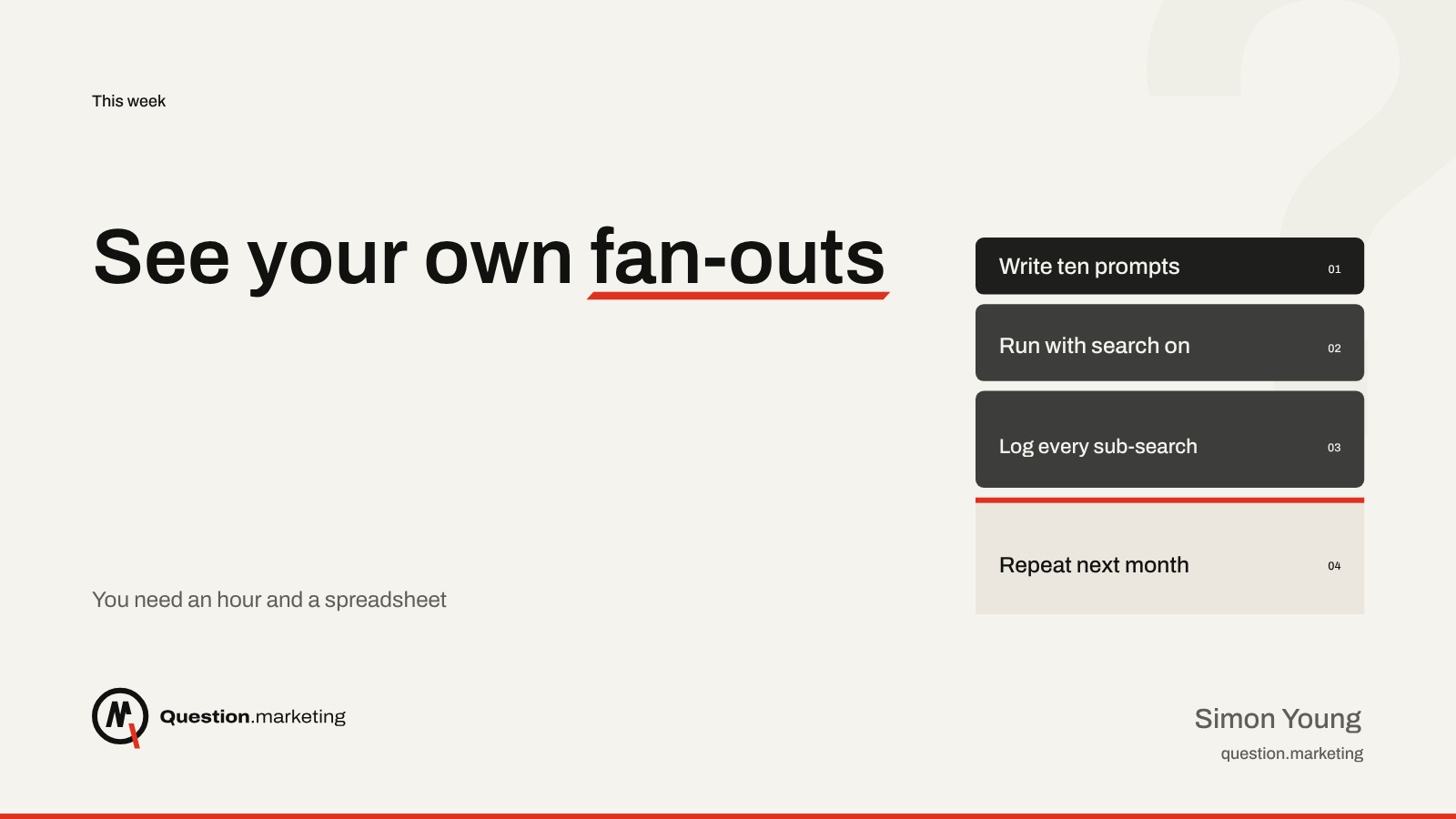
- Write ten prompts the way your customers talk. Not keywords. Full sentences, with the town, the sector and the worry in them. Listen back to your sales calls; you'll hear the questions.
- Run them in ChatGPT with search on. Use a fan-out extractor to see the hidden searches. Ann Smarty lists two free Chrome options, a bookmarklet from The SEO Pub and the ChatGPT Search Fan-out Helper extension (Practical Ecommerce, 23 June 2025). Both work only for ChatGPT's web searches, only in Chrome, and tools like these change, so check they still work before you rely on them.
- Log every sub-search. One row each: the prompt, the sub-search, which pattern it is, and the domains it pulled.
- Mark what you'd win. For each sub-search, do you have a page that answers it outright? That's KPI 1.
- Label the answer. Recommended, neutral or anti-recommended. That's KPI 3.
- Repeat next month, same prompts, same wording. Measure properly or don't bother.
The spreadsheet: copy these columns
One row per sub-search. One tab per month.
| Column | What goes in it |
|---|---|
| Date | The day you ran it |
| Engine | ChatGPT, AI Mode, Gemini, Copilot |
| Prompt ID | P01 to P10, so wording never drifts |
| Prompt | The full sentence, exactly as run |
| Run number | 1 to 30 |
| Sub-search | The hidden query, copied exactly |
| Pattern | Named entity, site-scoped, proof, local qualifier, other |
| Brands named in sub-search | Yours and competitors' |
| Domains pulled | The sources it read |
| Page that answers it | Your URL, or blank |
| Would we win it? | Yes / no |
| Named in answer? | Yes / no |
| Label | Recommended, neutral, anti-recommended |
| Notes | The exact wording of any warning |
The first run is usually humbling. That's the point. The gaps in your coverage column are your content plan for the next quarter, written by the machine that's choosing who to recommend.
What does this look like for a real business?
Here's a worked example, using the Doncaster recovery firm from earlier. The numbers are illustrative, to show how the KPIs fit together.
- Month one. Ten prompts, 30 runs each in ChatGPT. The firm wins 2 of the 6 local sub-searches (KPI 1), is named in 0 fan-outs (KPI 2), and is recommended in 1 of 30 runs on its main prompt (KPI 5). Google Business Profile says "towing", Yell says "recovery", and the site has no prices (KPI 6).
- What changes. One category everywhere. A Yell listing. A prices page that answers "how much per mile" outright. A routine for asking every happy customer for a review.
- Month three. Same prompts, same wording. Coverage is 5 of 6. It's recommended in more runs than in month one, and the margin of error says whether that's a trend yet or still noise.
Nothing in that list is a trick. It's making sure that when the machine goes looking, the facts it needs are there and agree with each other.
What will we do for clients?
- Capture fan-outs for your money prompts, across the engines your buyers actually use.
- Report all six KPIs monthly, with margins of error on repeat runs.
- Label every mention recommended, neutral or anti-recommended.
- Turn the gaps in your coverage column into a content plan built on what only you know.
And what we won't do: sell you a single screenshot as proof, report a mention as a win, or chase fan-outs by flooding low-barrier sites with thin posts.
What's the honest counterweight?
Let me be fair. Three things this framework can't do.

Fan-outs move. The patterns change with every model release, as the site: numbers above show. Dejan's API panel even saw the average number of fan-outs per searching response fall from about six in March 2026 to about one in August. A fan-out you captured in August is evidence, not a law. That's why the KPIs are trends over repeat runs, not one-off screenshots.
You only see some of them. The extractors work on ChatGPT in Chrome. Google hasn't said how many sub-queries a typical AI Mode prompt runs, and any figure you see quoted is a third-party estimate. Gemini, Claude and Copilot show you even less.
It's still a small channel. Conductor's 2026 benchmarks put AI referrals at 1.08% of total website traffic across 1,215 US enterprise customer domains, growing about 1% month on month on average, from data gathered May to September 2025 (Conductor). Growing, yes. A replacement for everything else you do, no. Anyone telling you otherwise is selling urgency. But the clicks aren't the whole story: the answer is where the shortlist gets made, and that's what these KPIs measure.
None of that is a reason to wait. It's a reason to measure carefully, so the numbers you take to the board survive the first awkward question.
Frequently asked questions
What is a query fan-out?
A query fan-out is when an AI search tool splits one question into several smaller searches, runs them in parallel and combines the results into one answer. Google's Nikola Todorovic has described AI Overviews working this way on top of Google's existing search systems.
Can I see the fan-out queries ChatGPT runs?
Partly. Free Chrome tools, such as The SEO Pub's bookmarklet and the ChatGPT Search Fan-out Helper extension, show the web searches ChatGPT runs. Google AI Mode, Gemini, Claude and Copilot show you far less.
What is an anti-recommendation?
It's when an AI answer names your brand but as the option to avoid or look past, for example with a warning about delays or fees. Visibility counts it as a mention. It isn't a win.
How many times should I run a prompt to measure AI visibility?
Run each priority prompt 20 to 30 times a month, with the same wording each time. With 30 runs and a hit rate of 10% to 30%, the simple margin of error is roughly ±11 to ±16 points, so look for trends over several months rather than one jump.
Is AI search traffic big enough to measure yet?
It's small but growing. Conductor's 2026 benchmarks put AI referrals at about 1% of website traffic. The bigger reason to measure is that the AI answer decides who makes the shortlist before anyone clicks.
Do local businesses need different AI visibility KPIs?
Yes. Local prompts check that you exist, are nearby, are open and are trusted, so consistent listings and reviews matter more. SOCi found ChatGPT recommended 1.2% of locations, against 35.9% appearing in Google's local 3-pack.
So, what is the machine searching for when your customer asks?
That's the question your reporting should answer first. Not "did we show up?" but "what did it go looking for, did it find us, and did it recommend us when it did?"
Try it tonight. Pick the one prompt your best customer would type, with your town in it. Run it with a fan-out extractor and count how many of the hidden searches you'd actually win.
How many did you get? Be honest.
Sources
- Wil Reynolds, Re-imagining AI Visibility KPIs in a Query Fan Out world, Seer Interactive, 2 October 2026
- Matt G. Southern, Google Shares Insight On Black Box AI Models In Search, Search Engine Journal, 4 May 2026, reporting Search Off the Record episode 109, How AI Is Changing Google Search and SEO, with Nikola Todorovic, Director of Software Engineering, Google Search
- Dan Petrovic, Our OpenAI fanout data shows no rise in site: operator use, Dejan, 25 August 2026 (data 1 March to 25 August 2026)
- Mike Boland, SOCi's LVI Report Reveals How AI Is Rewriting Local Search Visibility, Localogy, 28 January 2026
- Ann Smarty, How to Extract ChatGPT's Fan-Out Queries, Practical Ecommerce, 23 June 2025
- Conductor, The 2026 AEO / GEO Benchmarks Report (US data, May to September 2025)
Further reading on Question.marketing: How we measure AI visibility, How AI actually decides who to recommend, AEO checklist.