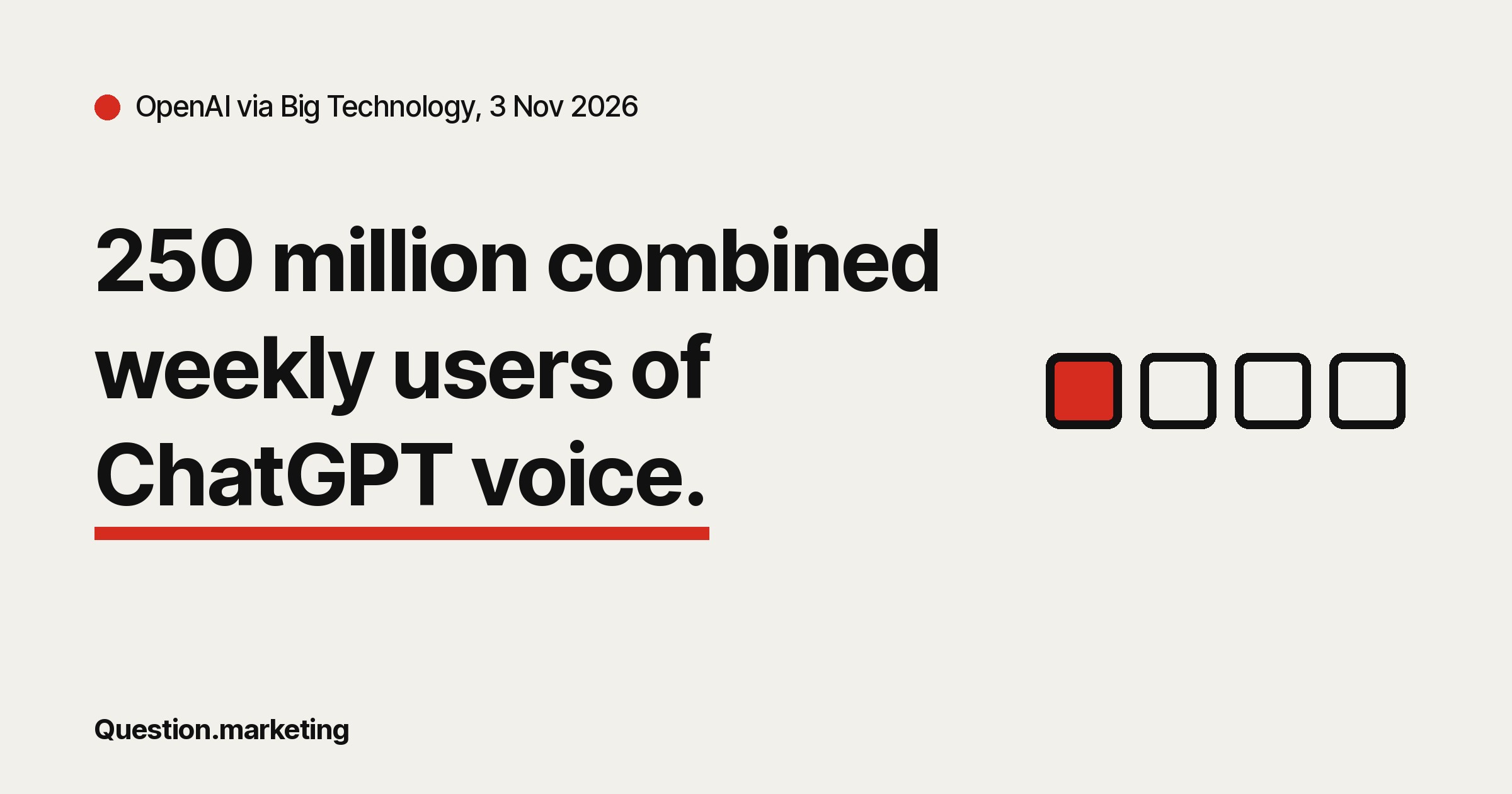
OpenAI's ChatGPT consumer product lead, Adam Fry, told Big Technology that ChatGPT's voice features (dictation plus spoken conversation) now have 250 million combined weekly active users. The figure is company-reported, published by Alex Kantrowitz on 3 November 2026, and it mixes two different behaviours. It is not the same as "250 million people doing voice search". For businesses that want to be named in a spoken answer, the useful question is still who the assistant names when someone asks out loud, and that is answer engine optimisation first: AEO to SEO, not SEO to AEO.
What did Adam Fry say?
That ChatGPT voice, counted as dictation and spoken conversation together, has 250 million combined weekly active users. Big Technology reported the figure after a fireside chat with Fry at an OpenAI-hosted dinner in New York on Monday 2 November 2026. The same interview put ChatGPT at 1.2 billion weekly active users, up from 1 billion in about 60 days, and said ChatGPT's volume of search-like queries is "roughly one-fifth the volume of queries of Google". That search comparison is OpenAI's own, not an audited market share figure.
What does the 250 million figure actually cover?
Dictation and spoken conversation, added together. Big Technology's wording is "between dictation and speaking with ChatGPT" and "combined weekly active users". Dictation is speaking to produce text. Spoken conversation is talking with ChatGPT out loud. Both count. So the headline number is not "250 million people asking for a business by voice", and it is not a count of voice search queries. It is OpenAI's own weekly active user figure for those two voice features combined.
Why does that matter for voice search?
Because a spoken answer usually names one business, not ten links. When someone talks to ChatGPT, Siri, Gemini or Alexa, they often hear a single reply. Being on page one of a results list is not the same job as being the name that reply uses. Our voice search overview for 2026 sets that out. The OpenAI figure shows how large the spoken interface has become inside one product. It does not tell you whether your business is the one that gets named.
How should a business respond?
Start from the questions customers ask out loud, then make the answers easy to confirm. Describe what you do in the same words on your own site and on trusted third-party sites. Keep your name easy to say. Treat search pages as support for the spoken answer, not the other way round. That is AEO to SEO, not SEO to AEO.
How do you know if you are being named?
Ask the same questions every month and log who is named. Our first voice answer audit, run on 2 November 2026, put fixed questions to Google UK, Gemini and Perplexity and recorded the replies. Limits are stated on that page: one UK account, one morning, ChatGPT not tested. The method still fits the OpenAI news. A weekly active user count shows scale. An audit shows whether your name is in the answer.
Is anyone else working on spoken answers this week?
Google Home, for reliability. On 3 November 2026 The Verge reported a Google Home update that reduces Gemini saying "Sorry, I didn't understand" when nobody had spoken to the device. T3 covered the same update. It is a small fix, but it is another reminder that spoken answers only work if people trust the reply they hear.
When someone asks ChatGPT out loud this week, is your name in the answer?
Quick answers
What did OpenAI say about ChatGPT voice users?
Adam Fry, ChatGPT consumer product lead, told Big Technology that ChatGPT's voice features have 250 million combined weekly active users. The figure covers dictation and spoken conversation together. It was published by Alex Kantrowitz on 3 November 2026 and is company-reported.
Does 250 million mean 250 million people doing voice search?
No. Big Technology reports it as dictation and speaking with ChatGPT combined. Dictation produces text. Spoken conversation is talking out loud. Neither number is a count of people asking for a business by voice, and OpenAI has not published a separate voice-search total in that interview.
How big is ChatGPT overall, according to the same interview?
Fry said ChatGPT went from 1 billion to 1.2 billion weekly active users in about 60 days. He also said ChatGPT's volume of search-like queries is roughly one-fifth of Google's. That search comparison is OpenAI's own, not an audited market share figure.
What should a business do about ChatGPT voice?
Describe your business clearly, in the words customers say out loud, on your own site and on trusted third-party sites. Aim to be the name a spoken answer uses. Treat classic search pages as support for that answer. AEO to SEO, not SEO to AEO.
How can you check whether assistants name your business?
Ask a fixed set of questions each month, on the same engines, and log who is named. Our first voice answer audit on 2 November 2026 did that for one UK account. Scale figures from OpenAI show how many people use voice. An audit shows whether your name is in the reply.
Sources
- Alex Kantrowitz, Big Technology, "OpenAI: ChatGPT Search Is About 20% of Google's, 250 Million People Speak With ChatGPT, and Chat Is Merging With Work" (3 November 2026): https://www.bigtechnology.com/p/openai-chatgpt-search-is-about-20
- AI Affairs write-up of the same Fry figures (3 November 2026): https://www.aiaffairs.com/news/chatgpt-1-2-billion-weekly-users-search-google-adam-fry/
- GPTOnline write-up of the Big Technology interview (3 November 2026): https://gptonline.ai/chatgpt-search-queries-one-fifth-google/
- Crypto Briefing report of a 250 million ChatGPT voice weekly figure (2 November 2026): https://cryptobriefing.com/openai-250-million-weekly-chatgpt-voice-users/
- Emma Roth, The Verge, "Google Home will stop telling you it's sorry when you haven't spoken to it" (3 November 2026): https://www.theverge.com/tech/1025243/google-home-will-stop-telling-you-its-sorry-when-you-havent-spoken-to-it
- Bethan Morgan, T3, "Google Home's new updates include smoother Gemini responses..." (3 November 2026): https://www.t3.com/home-living/smart-home/google-homes-new-updates-include-smoother-gemini-responses-nest-cam-improvements-and-better-matter-support