Insight
Answer engine optimisation glossary: the terms marketers need to know
Answer engine optimisation (AEO) is the work of getting your knowledge selected, quoted and attributed inside a machine-generated answer, rather than getting a link ranked on a page of links. Most of the vocabulary around it is new, borrowed from several fields, and used loosely even by people selling it. We have put the terms in plain English below, each with a one-line example of how it shows up in real work.
Where a definition depends on how we run the discipline, we say so. Where a number appears, it comes from a source we can point to.
What is an answer engine?
An answer engine is an AI assistant that responds to a question with a direct answer instead of a list of links. ChatGPT, Gemini, Claude, Perplexity and Copilot are the obvious examples.
In practice: a buyer asks ChatGPT which provider to shortlist, gets three names, and never opens a search results page.
Answer engines matter because the click has stopped, not the search. Around six in ten searches now end without anyone visiting a website. Several industries have already lost 30 to 40% of their clicks.
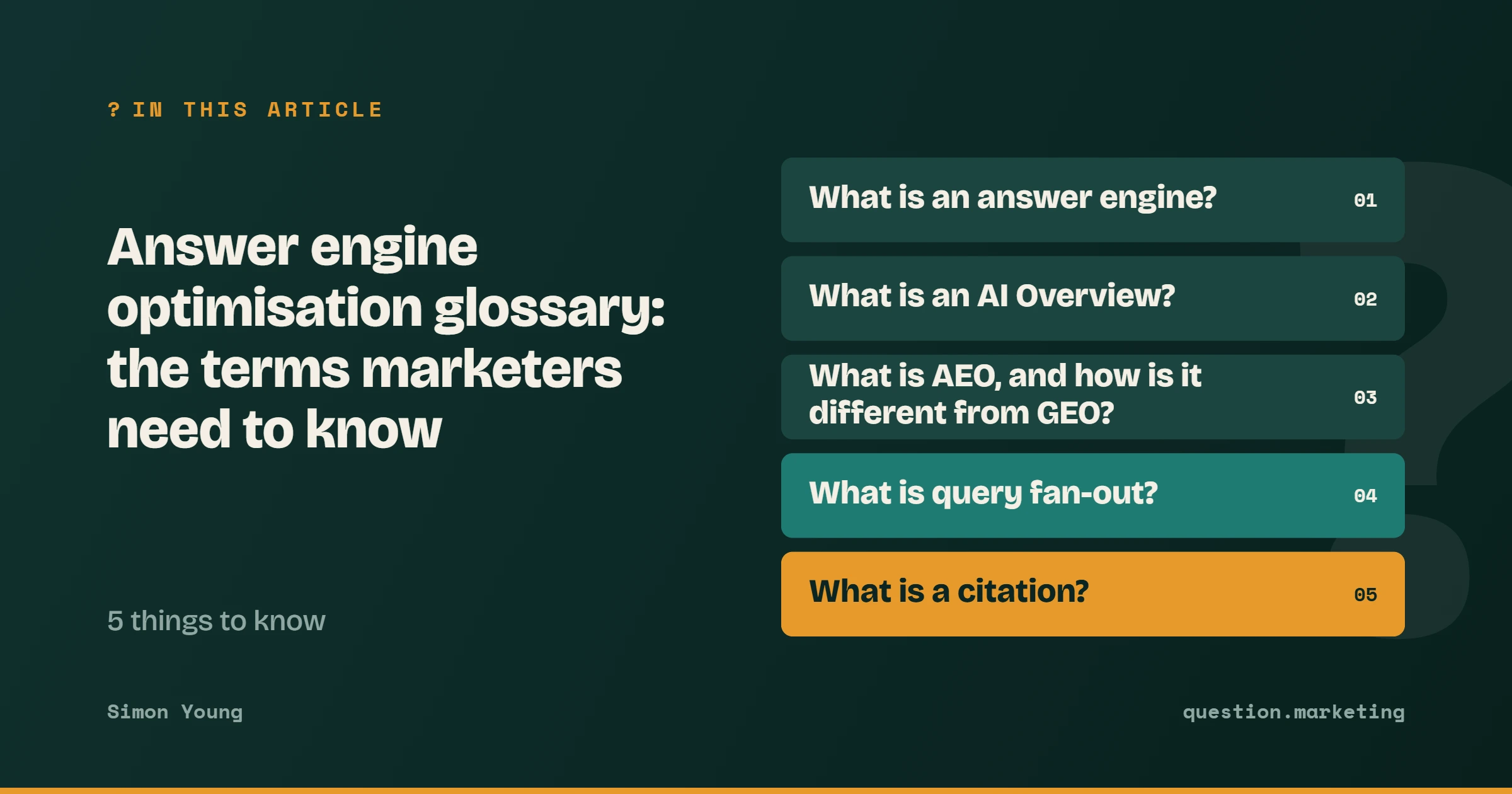
What is an AI Overview?
An AI Overview is the generated answer Google places at the top of its results page. Google's AI Overviews now appear on roughly half of all queries.
In practice: when an AI Overview appears, click-through on the top result falls by somewhere between a third and two thirds, depending on query type.
The result is a pattern we see constantly: rankings hold, impressions hold, and sessions collapse. That is why a rank report alone no longer tells you whether you are visible.
What is AEO, and how is it different from GEO?
AEO is the marketing layer of the AI-search world: being the trusted answer inside the chat window. GEO (Generative Engine Optimisation) is the mechanics, the plumbing that replaced SEO's plumbing.
In practice: deciding which questions your buyers ask and writing the answers is AEO. Making sure those answers can be crawled, retrieved and trusted by a model is GEO.
We use "AEO and GEO" when we mean both, and we do not use one as a synonym for the other. We also avoid "AI SEO", "LLMO" and "AIO". The term AEO was coined by Jason Barnard of Kalicube in January 2018, and the term GEO comes from an academic paper published in November 2023.
What is query fan-out?
Query fan-out is the process by which one question is expanded into several related questions that together cover a topic. The fan-out terminology is used across the industry, but the knowledge base we work from does not define the mechanism in technical detail, so we describe only how we use it ourselves.
In practice: one tracked prompt such as "What is answer engine optimisation (AEO)?" becomes a set of supporting articles, each answering one related question. This glossary is one of those articles.
What is a citation?
A citation is when an answer engine names your content as the source of what it says. It is the strongest form of visibility, because the model is crediting you rather than only mentioning you.
In practice: "cited as the source" is one of the measurements we report, alongside share of voice and prompts won. There is no "AI ranking position". There is being named, or not.
What earns a citation is content structured as self-contained, answer-first passages, with a complete standalone opening sentence under every heading that could be lifted out and quoted on its own.
What is a brand mention?
A brand mention is any appearance of your brand name across the web, whether or not it links to you. Models weigh these heavily.
In practice: an Ahrefs study of 75,000 brands found a 0.664 correlation between branded mentions and AI visibility, against 0.218 for backlinks.
Third-party corroboration is why we treat press, directories and professional bodies as part of AEO work rather than an optional extra.
What is share of voice?
Share of voice is the proportion of sampled AI answers in which your brand is named, measured against a defined set of prompts. Share of voice, prompts won and "cited as the source" make up the measurement language we use.
In practice: our reports use the same defined prompts every cycle, across every engine, with screenshot evidence of where the client appears and who appears instead.
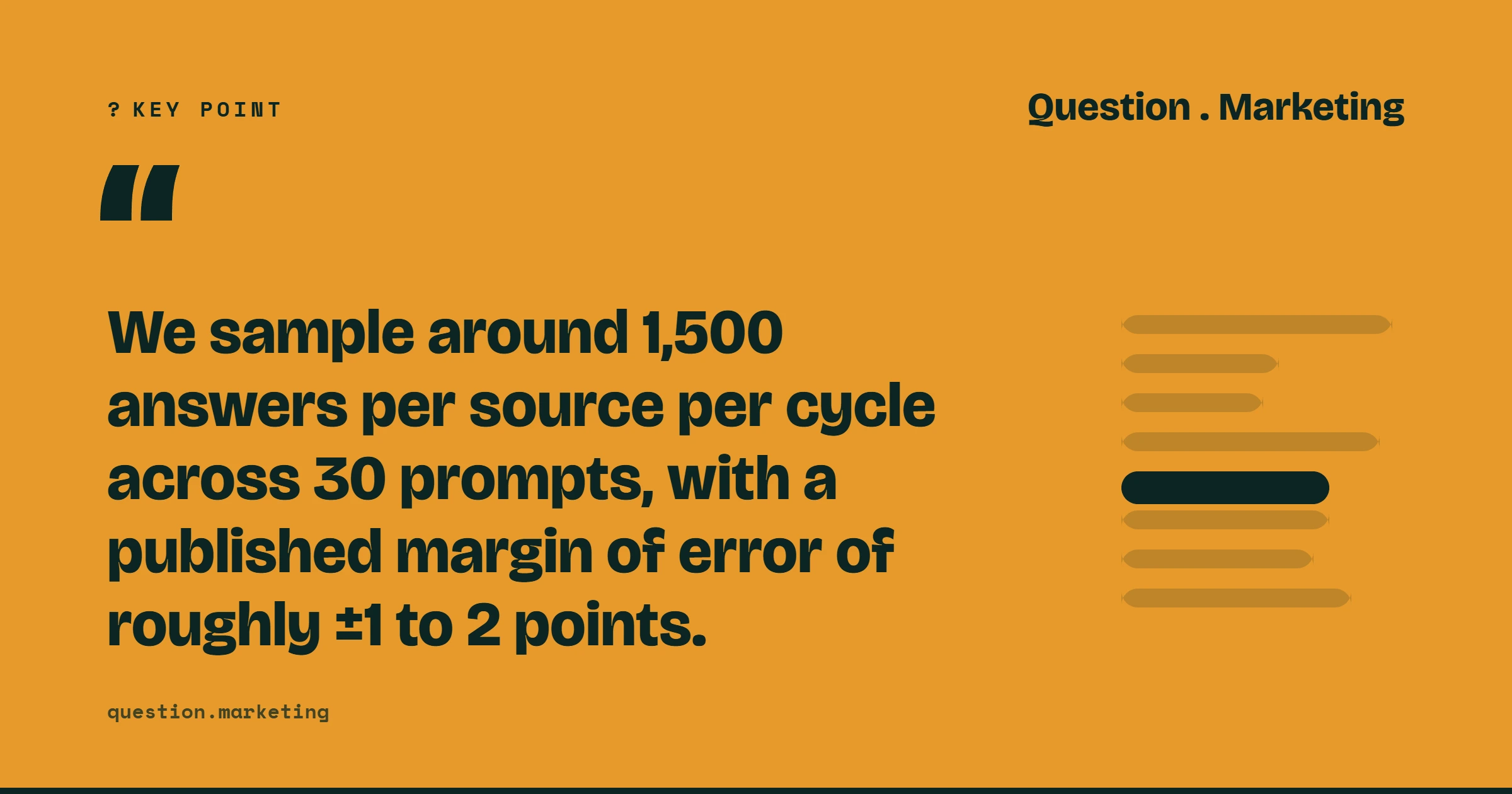
Sample size decides whether the number means anything. We sample around 1,500 answers per source per cycle across 30 prompts, with a published margin of error of roughly ±1 to 2 points. A single check carries ±9 to 13 points, which is why one screenshot proves nothing.
What is an entity?
An entity is a distinct, identifiable thing a model can recognise: a company, a person, a product. Entity consistency means your name, address, registration details, people and claims say the same thing everywhere a model can read them.
In practice: your website, your regulator's register, your directory listings, your review profiles and Companies House should all agree. Contradictions are the single most common reason a model stays vague about a provider.
Named people count as entities too. Models cite people as readily as brands, and in regulated sectors the named human carries most of the trust.
What is retrieval-augmented generation (RAG)?
Retrieval-augmented generation is a method where a model fetches current material and uses it to build its answer, rather than relying only on what it learned in training. The knowledge base we work from does not define RAG in technical depth, so we keep this to the working consequence.
In practice: if an answer engine can only retrieve your content when it can reach it, access becomes the first test. Many sites sit behind Cloudflare, and by default AI crawlers do not access the content behind it, so Cloudflare must be set to allow AI crawlers or you will never be listed.
What is a training cut-off?
A training cut-off is the date after which a model has learned nothing from its original training data. We have no source in our knowledge base that defines this term in detail, so we state only the working point: content published after a model's cut-off can only reach an answer if the engine retrieves it live. That is one more reason accessible, crawlable, text-based pages matter.
What is schema markup?
Schema markup is structured data added to a page so machines can read what the page is about. It supports indexing, but it is secondary to text-based companion pages on domains you control.
In practice: our receipts page uses VideoObject schema alongside embeds, with full transcripts held in the site library.
Schema is not a one-off setup. When we vet suppliers, "treats schema as a one-off" is a red flag.
What is llms.txt? llms.txt is a proposed file that tells language models which pages on a site matter. Our knowledge base does not cover it, so we make no claims here about how engines use it. Treat it as unproven until you have evidence from your own prompt tracking.
How do these terms fit together in practice?
The terms above describe one chain. An answer engine receives a question, fans it out, retrieves content it can access, recognises the entities involved, and chooses which sources to cite or mention. Share of voice is how you measure the result.
Four things have to happen for you to be listed: your content has to be accessible, it has to be found when the question is asked, it has to be structured so it can be lifted out, and it has to be trusted enough to be named.
The upside is real. People who research inside answer engines arrive pre-qualified, and we have found they convert four or five times more efficiently than people who searched and then visited three or four different websites.
Where to start with AEO
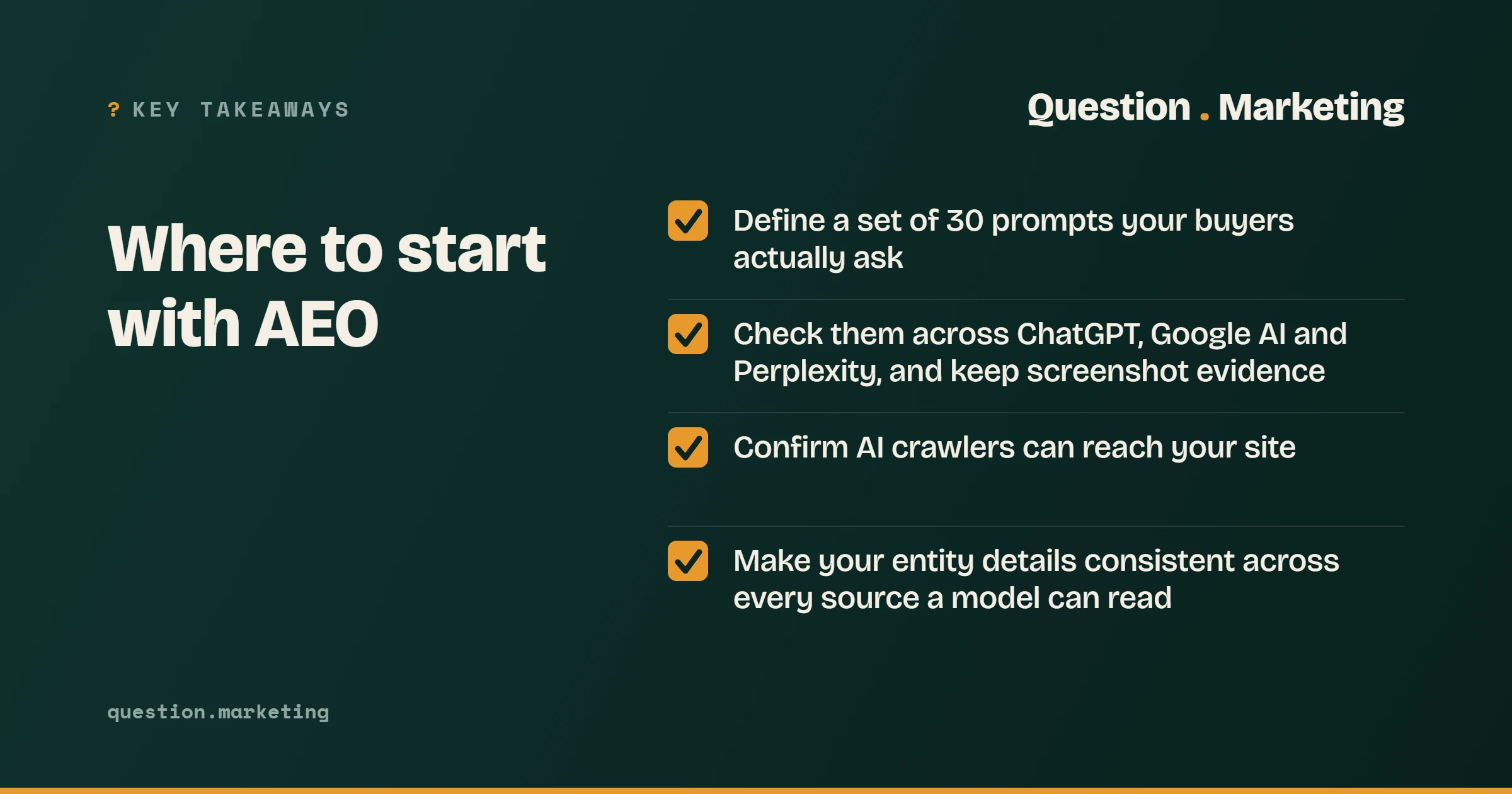
Start by measuring where you stand, then fix what the measurement shows.
- Define a set of 30 prompts your buyers actually ask.
- Check them across ChatGPT, Google AI and Perplexity, and keep screenshot evidence.
- Confirm AI crawlers can reach your site.
- Make your entity details consistent across every source a model can read.
- Add a "How did you hear about us?" field to enquiry forms, with individual AI engines listed, so attribution is possible.
If you want a baseline you can defend to a board, we run exactly this process and report the figure, the period and the margin. Get in touch and we will show you where your brand is named, and where a competitor is named instead.
For the bigger picture, read what answer engine optimisation is.