FAQ
Do AI visibility tools see the same answers real users see?
Most AI visibility tools do not show the exact answer a given user sees on their own screen. They give you a consistent, repeatable benchmark, which is what you need to track direction over time. The questions below cover where tool data and user screens diverge, how large the gap is, and how to use the numbers without being misled.
Why tool data and user screens differ
Tools and real users reach an answer engine in different ways, so the two views are never identical.
Do AI visibility tools see the same answers real users see?
No, a tool's output is a benchmark, not a replica of every user's screen. Real users bring a location, a history and personalisation to each query, while most tools query through APIs or clean sessions that carry none of that. A tool therefore shows you a controlled reading of how an engine responds, and your prospects each see their own version of it.
Why does the same question produce different answers?
Answer engines do not behave like a classic keyword ranking that returns the same list every time. In the older model, searching a phrase such as "recruitment in Manchester" ten times gave the same or very similar results. We are moving into a world where various answers are served until a truly trusted answer exists for a topic. The engines also draw on different sources, so Gemini may pull most of its content from Google while Claude may go elsewhere. Variation between engines, and between repeat runs on the same engine, is expected behaviour.
Is there a single "AI ranking position" a tool can report?
No. Share of voice, prompts won and "cited as the source" are the measurement language, and there is no AI ranking position: you are named or you are not. Any tool that reports a single position is compressing a variable answer into a number that the underlying system does not produce.
How accurate the numbers actually are
Accuracy depends on sample size, and a single check is the weakest form of evidence.
How reliable is a single check of an AI answer?
A single check carries a margin of roughly ±9 to 13 points, which is why one screenshot proves nothing. A screenshot of one answer is a single draw from a variable system. It can show that a brand appeared once, and it cannot show how often.
What does a reliable measurement look like?
We sample around 1,500 answers per source per cycle across 30 prompts, apply Wilson confidence intervals and publish a margin of error of roughly ±1 to 2 points. Every report runs the same defined prompts, every cycle, on every engine, with screenshot evidence of where the client appears and who appears instead. Client baselines state the figure, the period and the margin. A number without those three parts is an anecdote.
Do tools differ in quality?
Yes. The market is a wild west with hundreds of tools, and new ones are offered constantly, each claiming to measure everything. Established platforms such as Semrush and Ahrefs give some level of visibility, and Google Search Console indicates how many sessions you receive from AI, though all of this remains in its infancy. Treat every tool as an instrument with a stated sampling method, and ask for that method before trusting the output.
How to use tool data well
Because tools measure a consistent benchmark rather than every screen, the right use is trend tracking plus real-world confirmation.
What is tool data best used for?
Use it to track movement. Hold the prompt set, the engines and the cycle length constant, then compare share of voice from one cycle to the next. The consistency is the value. A tool that asks the same 30 prompts every month tells you whether you are gaining or losing ground, even if no single answer matches what one user saw.
How do we check results against real behaviour?
Add attribution tracking. It requires a "How did you hear about us?" enquiry field that lists the individual AI engines. Self-reported source data shows what prospects actually did, which a clean-session query cannot. Pair that with the AI session data in your analytics platform, and you have two independent views to set against the tool benchmark.
Does Question.marketing apply this to itself?
Yes. We run a monthly own-name visibility tracker with 22 defined prompts across claim, entity, shortlist, education and clinical categories, with screenshot evidence and first-answer counts. The baseline cycle ran on 7 September 2026, and the priority engines are ChatGPT, Google AI and Perplexity.
Should we stop tracking because the data is imperfect?
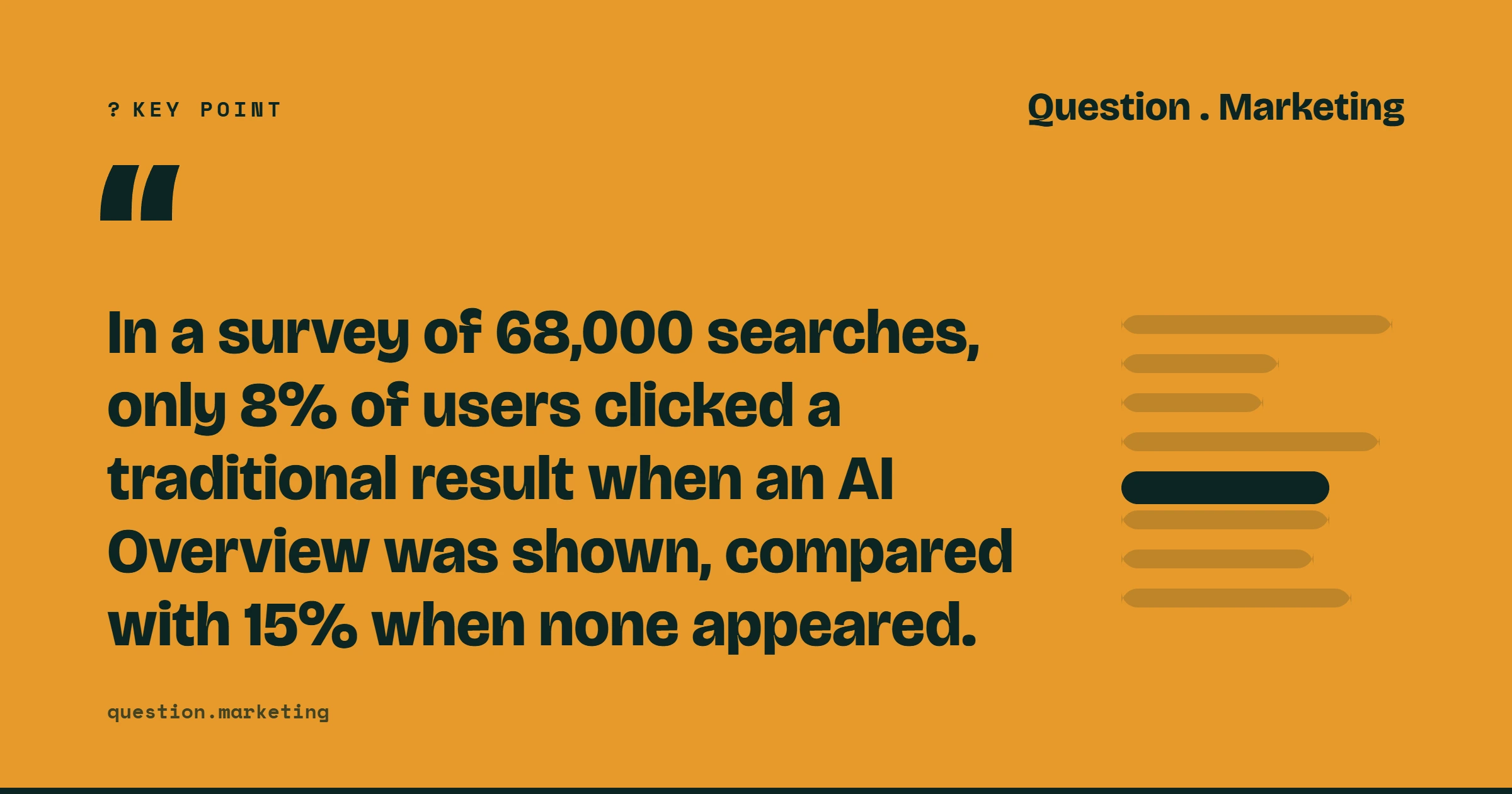
No. The shift away from clicks is measurable. In a survey of 68,000 searches, only 8% of users clicked a traditional result when an AI Overview was shown, compared with 15% when none appeared. With that much of the journey now ending inside the answer, you need a way to see whether your brand is named there, and an imperfect benchmark is far better than none.
Before you read any report
What should we check first?
Check that AI crawlers can reach your content at all. Roughly 22% of web traffic sits behind Cloudflare, and content behind a default WAF block is invisible to AI engines however well it is structured. If crawlers are blocked, a visibility report is measuring a problem you can fix in settings.
What is the practical takeaway?
Treat every tracker as a consistent benchmark for trends and not a copy of any individual's screen. Require a stated sample size, fixed prompts, named engines and a published margin of error. Confirm the direction with attribution data from real enquiries. Question.marketing designs and ships the content changes that move those numbers, because a dashboard can show you are absent from AI answers but someone still has to fix it.
To put numbers on it, read how we measure AI visibility.