FAQ
Does inconsistent business information hurt AI recommendations?
Yes. Inconsistent business information is one of the most common reasons an AI engine stays vague about a provider, and it is also one of the cheapest problems to fix. This FAQ explains how entity consistency works, where contradictions usually hide, and what to check first if ChatGPT, Gemini or Perplexity keeps naming your competitors instead of you.
Why entity consistency matters
Does inconsistent business information hurt AI recommendations?
Contradictions between sources are the single most common reason a model stays vague about a provider. Your name, address, registration details, people and claims must say the same thing everywhere a model can read them. That covers your site, regulators, directories, review platforms, professional bodies and Companies House. If one source says one thing and another says something different, the engine has no confident version of you to repeat.
What counts as "entity data"?
Entity data is the set of facts that identify your business as one distinct thing: name, address, registration details, people and claims. Services and prices belong in the same category, because they are claims a model can compare across sources. Treat every one of these as a fact that must read identically wherever it appears.
Why would an AI engine recommend a competitor over me?
The engine recommends the provider it can describe with the most confidence. Content that is answer-first, corroborated elsewhere and consistent across sources is what earns citation. A competitor with clean, matching data across the web gives the model less to doubt. Your business may be perfectly good, but a model that meets conflicting versions of you tends to hedge or leave you out.
Where the contradictions hide
Which sources should I check first?
Start with the places a model is most likely to read:
- Your own website
- Regulator listings
- Directories
- Review platforms
- Professional body profiles
- Companies House
 Compare name, address, registration details, named people and any claims about what you offer. Any line that differs between two of these is a contradiction worth fixing.
Does this only affect large brands?
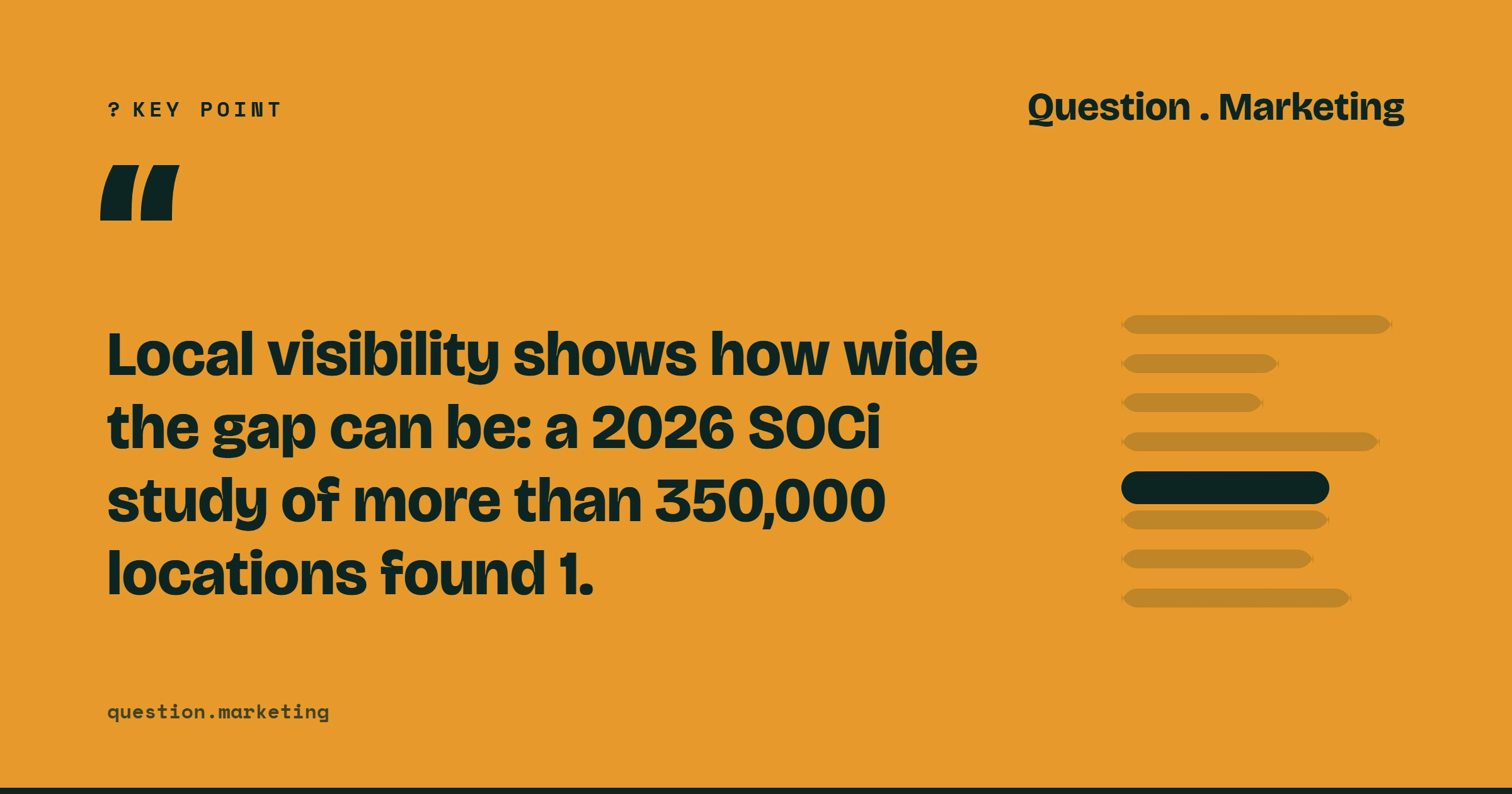
No. Any business a model can read about is exposed to the same problem. Local visibility shows how wide the gap can be: a 2026 SOCi study of more than 350,000 locations found 1.2% recommended by ChatGPT, versus 35.9% appearing in Google's 3-pack. Appearing in a familiar local listing does not carry over to being recommended by an answer engine, so local businesses cannot assume their existing presence is enough.
Should I fix my own website or the third-party listings first?
Fix both, but begin with an audit of what already exists. Models read your site alongside every outside source, so a perfect website does not cancel a contradicting directory entry. Choose one authoritative version of each fact, then bring every other listing into line with it.
Beyond consistency
Is consistent data enough to get recommended?
No. Consistency removes a reason for the model to doubt you, but it does not give the model a reason to choose you. Citation also depends on answer-first structure and question-shaped headings. Third-party corroboration matters as well: Ahrefs data on 75,000 brands shows a 0.664 correlation between branded mentions and visibility, versus 0.218 for backlinks. Consistent data is the cheapest fix, and it works best as the first step of a wider AEO programme.
Could something technical be hiding my content entirely?
Yes, and it should be your first check. Cloudflare's default settings block AI crawlers, and that block has been active since July 2025. Roughly 22% of web traffic sits behind Cloudflare, and content behind a default block is invisible to AI engines however well it is structured. Verify the scope of this before repeating the figures to anyone. Fix crawler access before you spend time on anything else.
Does the opening of a page matter for citation?
It matters a great deal. Zyppy's 2025 research found that 44.2% of LLM citations come from the first 30% of a page. Put your clearest, standalone statement of who you are and what you do at the top, using the same wording your listings use.
How do I know whether the fix worked?
Measure it against a defined prompt set, not a single check. We use around 1,500 sampled answers per source per cycle across 30 prompts, with Wilson confidence intervals and a published margin of error of roughly ±1 to 2 points. A single check carries ±9 to 13 points, which is why one screenshot proves nothing. Every report should show the same prompts, every cycle, every engine, with screenshot evidence of where you appear and who appears instead. Name the engines you tested, such as ChatGPT, Google AI and Perplexity, rather than claiming coverage of all AI search.
What should I do this week?
Run a consistency audit before anything else:
- Confirm your content is not blocked by a default Cloudflare rule.
- List every place your name, address, registration details, people and claims appear.
- Pick one correct version of each fact and correct every mismatch.
- Add a "How did you hear about us?" field to your enquiry form, with individual AI engines listed, so you can attribute enquiries.
- Re-run the same defined prompts each cycle and record the figure, the period and the margin.
If you want a practitioner to run the audit and ship the fixes, that is the work we do.
For the bigger picture, read what answer engine optimisation is.