FAQ
Why is my business invisible in AI answers?
When ChatGPT, Gemini or Perplexity answers a buyer's question and names your competitors instead of you, the cause is usually specific and fixable. We see the same handful of problems on audit after audit: content that AI crawlers cannot reach, details that contradict each other across the web, and pages that never answer the question a buyer actually typed. The questions below cover each cause and what to check first.
The first check: can AI engines reach your site?
Before anything about content quality matters, an AI engine has to be able to read your pages at all, so we start there.
Could my site be blocking AI crawlers?
Yes, and it is the first binary check on any audit we run. Cloudflare's default settings block AI crawlers, and that default block has been active since July 2025. Roughly 22% of web traffic sits behind Cloudflare, and content behind a default block is invisible to AI engines regardless of how well it is structured. Ask your developer or hosting provider to confirm what your firewall does with AI crawlers before you spend a pound on content. Verify the scope of your own setup rather than assuming it applies to you.
Does adding an llms.txt file fix visibility?
No. Cyrus Shepard's 2026 synthesis scores llms.txt at 2.0 out of 10, and his verdict is "It doesn't hurt. It isn't a service." Treat it as optional housekeeping, not a remedy for being absent from AI answers.
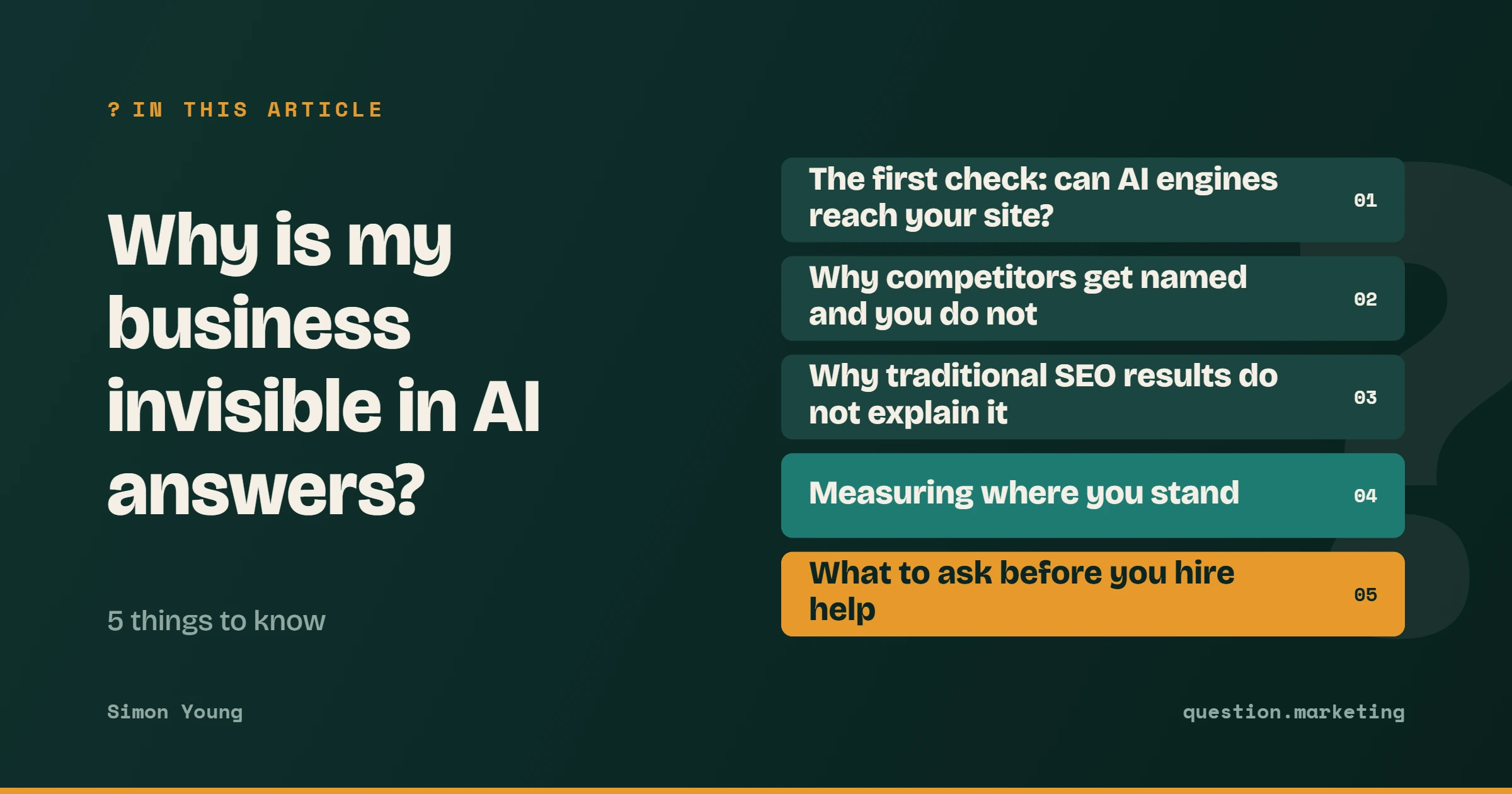
Why competitors get named and you do not
Once crawlers can reach you, the next question is why a model prefers someone else's content.
Why does ChatGPT recommend my competitors but not my business?
Usually because your content does not give a model a clear, self-contained answer to cite, and your business is not corroborated elsewhere on the web. LLMs retrieve and cite content structured as answer-first passages, with a complete standalone opening sentence under each heading. Thin or vague service pages give a model nothing to lift out and quote. A baseline audit shows which of the causes in this FAQ is holding you back.
How should my pages be structured so AI engines can cite them?
Put a complete, quotable answer directly under every heading, and phrase the headings as the questions your buyers type. Placement matters as well: Zyppy's 2025 research found that 44.2% of LLM citations come from the first 30% of a page. The opening of each page does most of the work, so state what the service is, who it is for and what makes it different in the first lines.
Do other websites mentioning my brand really matter?
Yes. Brand mentions across the web matter more than backlinks, according to an Ahrefs study of 75,000 brands that found a 0.664 correlation for branded mentions versus 0.218 for backlinks. If competitors are discussed on third-party sites, directories and professional bodies and you are not, a model has more to corroborate about them than about you.
Why do inconsistent business details hurt my visibility?
Contradictions are the single most common reason a model stays vague about a provider. Your name, address, registration details, people and claims need to say the same thing everywhere a model can read them: your own site, regulators, directories, review platforms, professional bodies and Companies House. Audit those listings side by side and correct every mismatch.
Do I need named people on my content?
Yes. Models cite people as readily as they cite brands, so anonymous bylines waste an opportunity. In regulated sectors the named human carries most of the trust. Attach a real expert to every substantive page.
Does publishing more AI-written content help?
No. Publishing original, proprietary knowledge earns AI citations, and AI-generated derivative content does not. Your own data, experience and opinions are what a model cannot find elsewhere. Princeton's GEO paper found that information gain drives citation, though the C-SEO Bench corrective shows the effect is smaller and more variable than the original paper suggested.
Why traditional SEO results do not explain it
Strong Google rankings do not guarantee a place in AI answers, and the two measures can diverge sharply.
I rank well on Google. Why am I still missing from AI answers?
Because ranking and being recommended are different outcomes. SOCi's 2026 study of more than 350,000 locations found that 1.2% were recommended by ChatGPT, versus 35.9% appearing in Google's 3-pack. Google's AI Overviews now appear on roughly half of all queries, and around six in ten searches end without anyone visiting a website. Rankings hold, impressions hold and sessions collapse, so the goal is to be named inside the answer.
Does it matter if a model cites me only after recommending someone else?
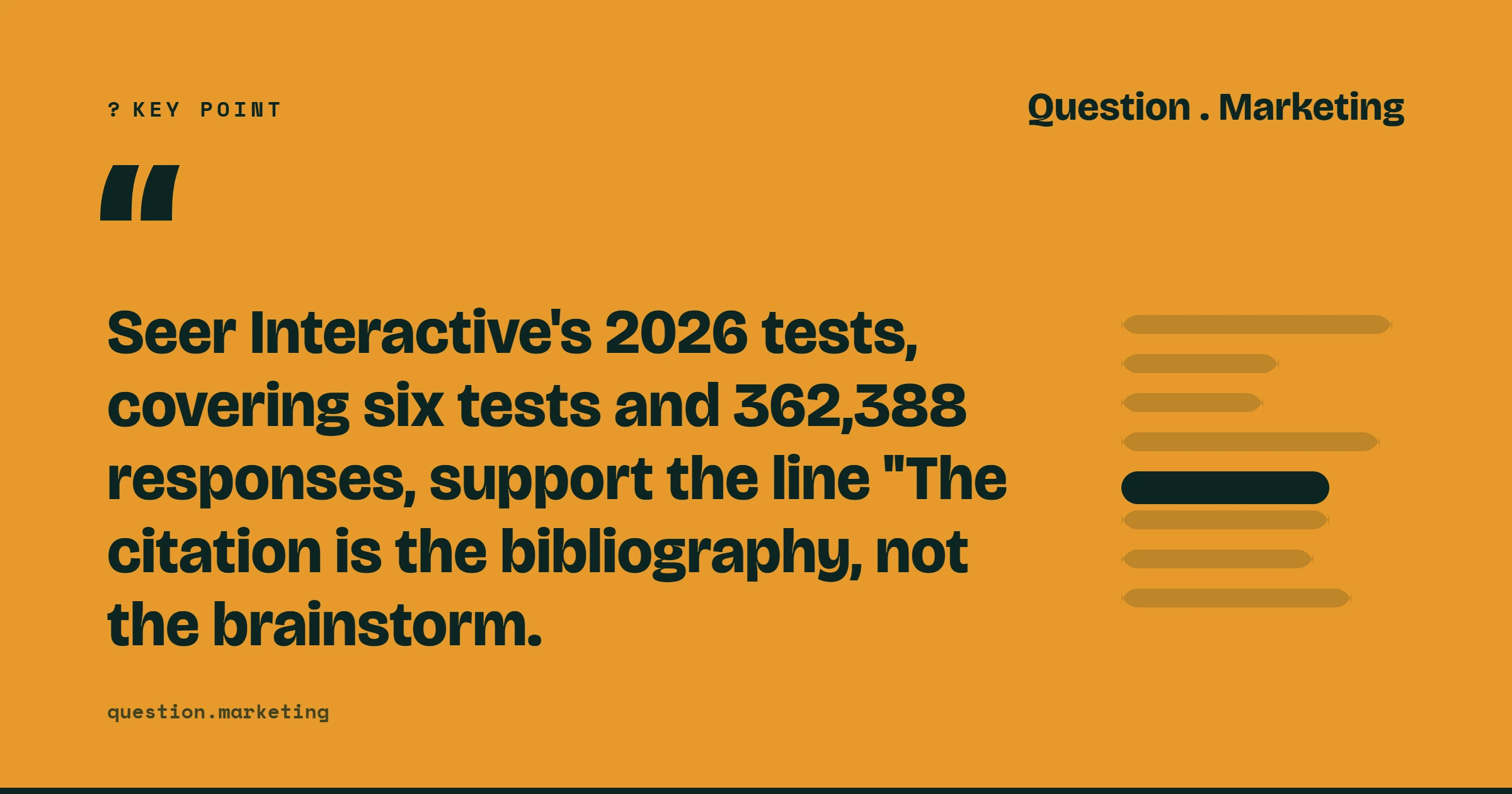
It does, because the recommendation happens first. Seer Interactive's 2026 tests, covering six tests and 362,388 responses, support the line "The citation is the bibliography, not the brainstorm." A model decides who to recommend and then lists sources, so a link in the footnotes does not replace being named in the answer.
Measuring where you stand
Fixing visibility starts with knowing your current position, and a single screenshot will not tell you.
How do I find out if I am really invisible?
Run a defined set of prompts across the engines on a repeating schedule. A single check carries a margin of ±9 to 13 points, which is why one screenshot proves nothing. Our own method samples around 1,500 answers per source per cycle across 30 prompts, with Wilson confidence intervals and a published margin of error of roughly ±1 to 2 points. Every report shows the same prompts each cycle, with screenshot evidence of where the client appears and who appears instead. Share of voice, prompts won and being "cited as the source" are the measures that count, because there is no AI ranking position, only being named or not.
How do I know whether AI visibility brings enquiries?
Add a "How did you hear about us?" field to your enquiry form and list the individual AI engines as options. AI referral traffic is still around 1% of total web traffic and growing roughly a point a month, according to two sources, Semrush and Conductor, which use different methods. Referral numbers alone will understate the effect, so self-reported attribution fills the gap.
Is the traffic from AI engines worth chasing?
The available figures suggest it converts well, though treat them with care. Seer and First Page Sage report that ChatGPT referrals convert at 14.2% to 15.9%, versus 1.76% for Google organic. Both sources are vendor-adjacent, so use the figures as a directional signal and not as a forecast.
What to ask before you hire help
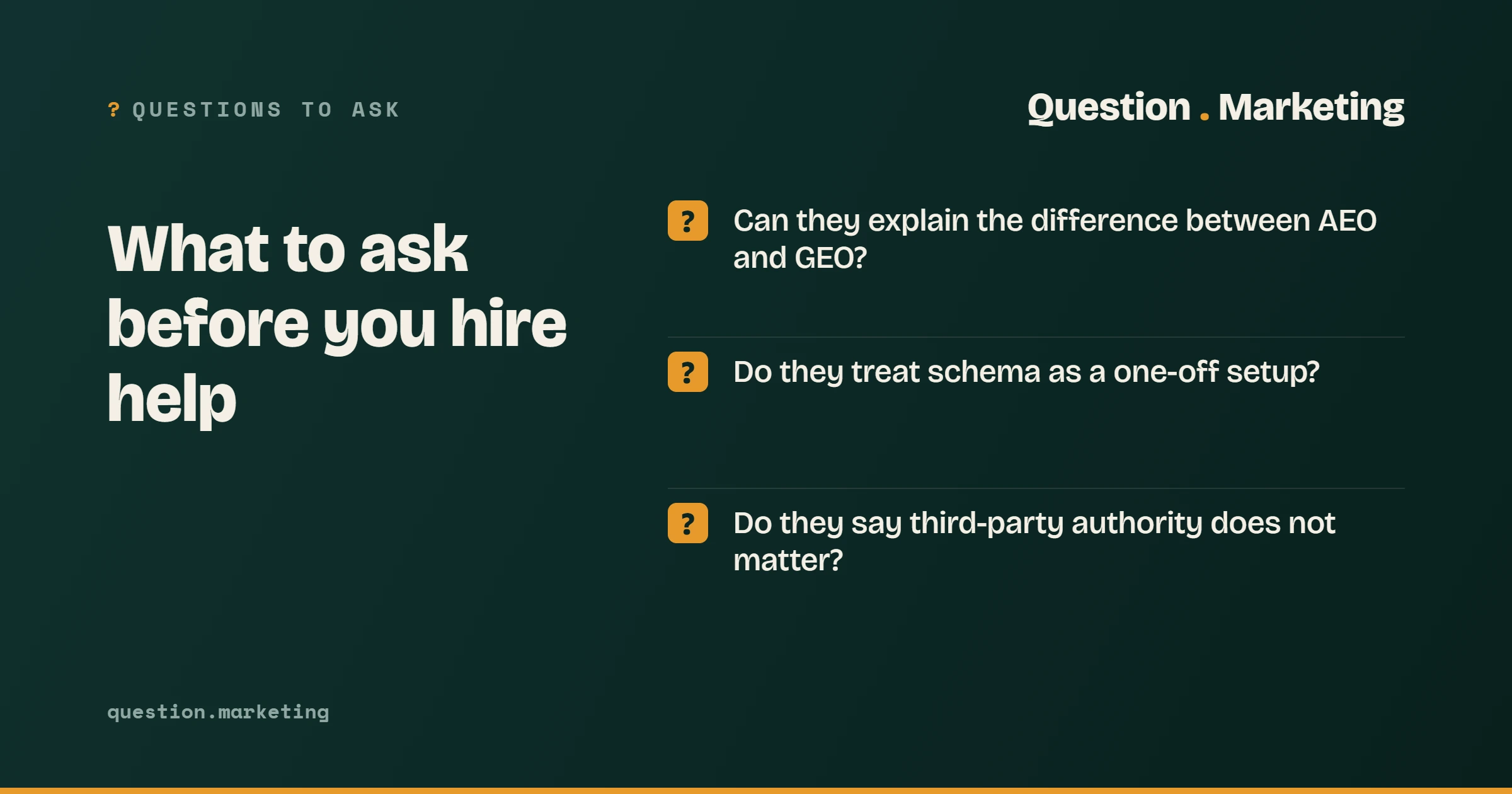
What should I ask an AEO supplier?
Ask these five questions of anyone who offers to fix this:
- Can they explain the difference between AEO and GEO?
- Can they produce screenshot evidence of multi-LLM citation tracking against a defined prompt set?
- Do they treat schema as a one-off setup? That answer is wrong.
- Do they say third-party authority does not matter? Usually that is because they cannot do it.
- In regulated sectors, will they publish claims with no named clinician or adviser, no review date and no regard for the regulator's advertising rules?
A credible supplier runs the same discipline on itself. We track our own name monthly across 22 defined prompts, with screenshot evidence and first-answer counts, and our baseline cycle ran on 7 September 2026. Our priority engines are ChatGPT, Google AI and Perplexity. If you want to know which cause is holding your business back, start with a baseline audit: crawler access first, then your content structure, entity consistency and third-party mentions, measured against a fixed prompt set.
For the bigger picture, read what answer engine optimisation is.