How-to guide
How to close the AI visibility gap with your top competitors
If ChatGPT names your competitors and leaves you out, the cause is almost always a coverage gap, not a ranking problem. This guide shows you how to measure that gap against two or three named competitors, find the sources feeding their mentions, build matching coverage, and re-measure every quarter.
AI answer engines do not rank pages in a numbered list. There is no "AI ranking position". There is being named, or not. The work below is about getting you named.
Prerequisites
Before you start, gather the following:
- Two or three named competitors who currently appear in AI answers where you do not.
- Access to ChatGPT, Google AI and Perplexity, which are the priority engines we track.
- A spreadsheet for logging answers, plus a way to capture screenshots.
- Admin access to your website, including your CDN or firewall settings.
- A "How did you hear about us?" field on your enquiry form, so you can attribute enquiries to individual AI engines later.
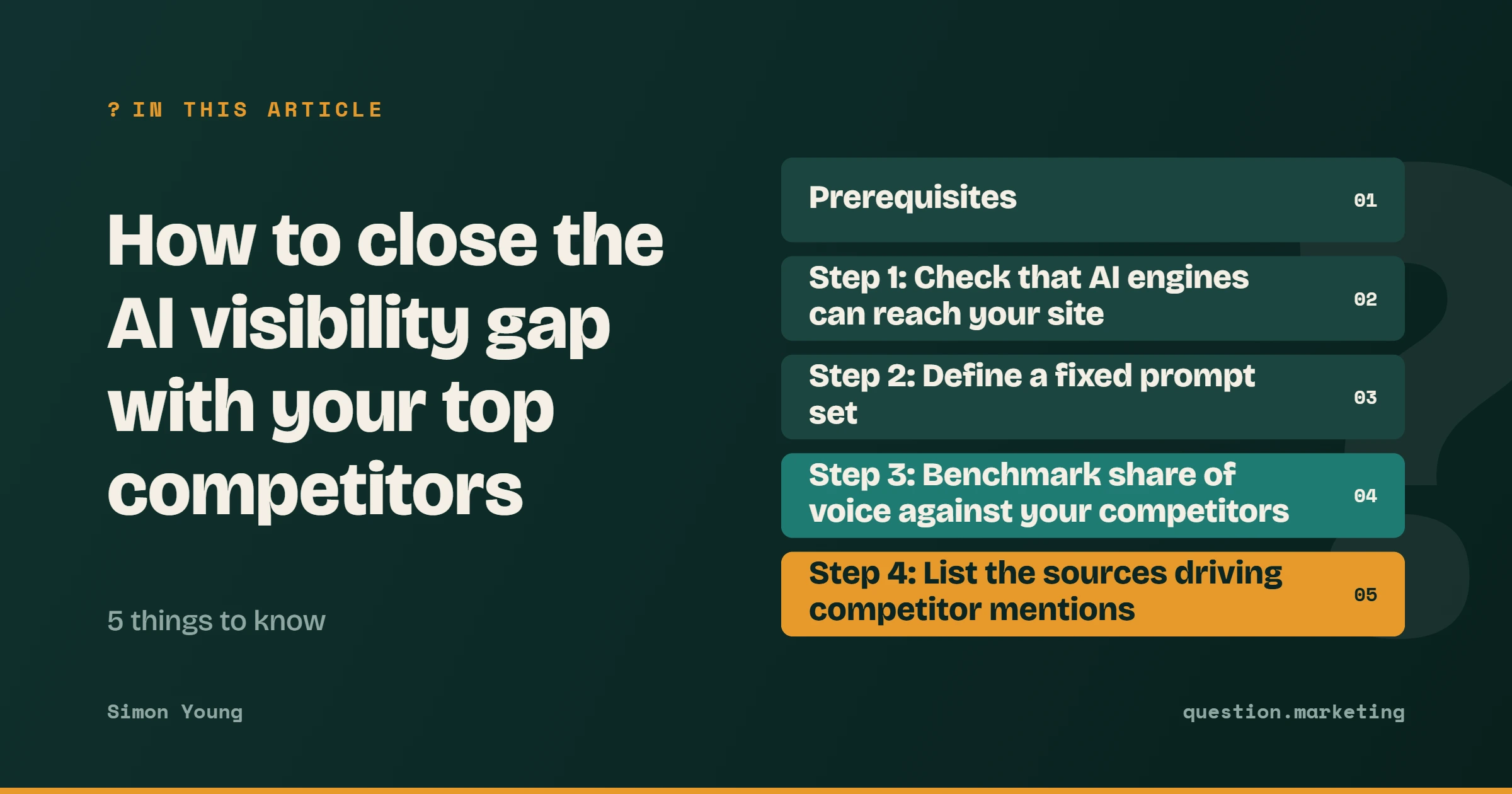
Step 1: Check that AI engines can reach your site
Start with the one binary check that can make every other step pointless. Cloudflare's default settings block AI crawlers. That default block has been active since July 2025, and defaults were tightened on 15 September 2026. Roughly 22% of web traffic sits behind Cloudflare.
Content behind a WAF default-block is invisible to AI engines regardless of how well it is structured. Verify the scope of these figures before you repeat them publicly. a. Find out whether your site sits behind Cloudflare or a similar firewall. b. Check whether AI crawlers are blocked by default. c. Fix access before you spend a single hour on content.
Step 2: Define a fixed prompt set
A benchmark only means something if you ask the same questions every time. Our own tracker uses 30 prompts for client work and 22 for our own-name tracking, spread across claim, entity, shortlist, education and clinical categories.
Build your own set around the questions your buyers actually type:
- Shortlist prompts: "Who are the best [your category] providers in [your area]?"
- Education prompts: "How do I choose a [your category] supplier?"
- Entity prompts: "What is [your brand] known for?"
- Claim prompts: the specific statements you want models to repeat about you.
Write the prompts down and do not change them between cycles. Every report should show the same defined prompts, every cycle, every engine.
Step 3: Benchmark share of voice against your competitors
Run each prompt on each engine and log who is named. Your three measures are share of voice, prompts won, and "cited as the source".
A single check proves very little. One check carries a margin of ±9 to 13 points, which is why one screenshot proves nothing. We sample around 1,500 answers per source per cycle, use Wilson confidence intervals and publish a margin of error of roughly ±1 to 2 points. You may not run that volume, so repeat each prompt several times and treat small differences as noise.
For every result, capture screenshot evidence of where you appear and who appears instead. State your baseline as the figure, the period and the margin.
Step 4: List the sources driving competitor mentions
Now work out why your competitors are named. For each answer where a competitor appears and you do not, record every source the engine cites or draws on: directories, review platforms, publications, professional bodies and the competitor's own pages.
Group the sources into types. You are looking for the pattern, because the pattern becomes your build list.
This step matters because third-party corroboration carries real weight. In an Ahrefs study of 75,000 brands, branded mentions correlated with AI visibility at 0.664, against 0.218 for backlinks. If your competitors are named across more of the web than you are, that is the gap to close.
Step 5: Fix your entity consistency
Before you build anything new, make sure what already exists agrees with itself. Name, address, registration details, people and claims must say the same thing everywhere a model can read them: your site, regulators, directories, review platforms, professional bodies and Companies House.
Contradictions are the single most common reason a model stays vague about a provider. Audit each location in your source list from Step 4 and correct every mismatch.
Step 6: Build matching coverage
With access fixed and entities consistent, build the coverage your competitors already have. Work through these asset types. a. Answer-shaped pages. Structure each page as a self-contained, answer-first passage. Put a complete standalone sentence under every heading, one that could be lifted out and quoted on its own. Write H2 headings as the question the reader actually typed. b. Position the answer early. Zyppy's 2025 research found that 44.2% of LLM citations come from the first 30% of a page, so the first 60 words are the whole game. c. Review profiles and directory listings. Claim and complete the profiles where your competitors are listed. These are the third-party sources models read to corroborate who you are. d. Expert commentary. Put named people on your content, not anonymous bylines. Models cite people as readily as brands, and in regulated sectors the named human carries most of the trust. e. Comparison content. Publish factual, evidence-led material that helps a buyer choose between providers, covering the education and shortlist prompts from Step 2. Keep it accurate and free of attacks on named rivals. f. Transcripts on your own domain. Video and audio are invisible to models unless the text lives on a domain you control. Publish full transcripts as pages on your own site. g. Original knowledge. Publish proprietary material that competitors cannot copy. Original, proprietary knowledge earns AI citations, and AI-generated derivative content does not. Cite the Princeton GEO paper's finding on information gain alongside the C-SEO Bench corrective, which shows the effect is smaller and more variable than the original paper suggested.
Build by content family and complete one family before starting the next.
Step 7: Re-measure every quarter
Run the identical prompt set on the identical engines and compare against your baseline, including the margin of error. Report share of voice, prompts won and "cited as the source".
Then connect the result to enquiries. Review the answers to your "How did you hear about us?" field, with individual AI engines listed as options. This tells you whether visibility is producing conversations, which a mention count cannot.
Keep expectations realistic. AI referrals are around 1% of web traffic, growing roughly a point a month. That is a fast-growing, still-small channel, not a replacement for everything else you do.
Tips and best practices
- Treat schema as ongoing work. Schema and embedded metadata support indexing, but text-based companion pages on controlled domains matter more. A supplier who treats schema as a one-off setup has it wrong.
- Do not spend time on llms.txt. Cyrus Shepard's 2026 synthesis scores it 2.0 out of 10: "It doesn't hurt. It isn't a service."
- Expect recommendation before citation. Seer Interactive's 2026 tests, covering 362,388 responses across six tests, support the point that the citation is the bibliography, not the brainstorm.
- Set local expectations carefully. SOCi's 2026 analysis of more than 350,000 locations found 1.2% recommended by ChatGPT, against 35.9% appearing in Google's 3-pack.
- Handle conversion claims with care. ChatGPT referrals are reported to convert at 14.2 to 15.9%, against 1.76% for Google organic, but those figures come from vendor-adjacent sources.
- Mind the rules in regulated sectors. Do not publish claims without a named clinician or adviser, a review date and regard for the regulator's advertising rules.
Troubleshooting
You still do not appear after building coverage. Recheck crawler access first. A firewall block makes every other fix invisible.
Your results swing between runs. Single checks carry a wide margin, so increase the number of repeats per prompt before drawing conclusions.
A model describes you vaguely or incorrectly. Look for contradictions between your site, directories and registries and correct them.
Competitors appear on sources you cannot access. Prioritise the source types you can influence, such as review profiles, directory listings and expert commentary, and build those first.
Summary
Closing the gap comes down to a repeatable loop. Confirm AI engines can reach your site, fix your entity consistency, benchmark a fixed prompt set against two or three named competitors, list the sources behind their mentions, and build matching coverage. Then re-measure every quarter with the same prompts, the same engines and a stated margin of error. Ask an AI about your industry. Does your name come up? If it does not, start at Step 1.
For where search fits now, read how AEO differs from SEO and GEO.