Interviews and one offs
Simon Young co-hosts The GEO Show: ChatGPT Business Hub (2026)
Simon Young co-hosts The GEO Show with Paris Childress on OpenAI's ChatGPT Business Hub, claimed profiles, agents, and whether a profile starts to act like a homepage. 14 November 2026.
Watch it
What does this video cover?
- 01Simon Young of Question.marketing is the regular Friday co-host of The GEO Show, hosted by Paris Childress. This is The GEO Show E92, not a Question.marketing episode.
- 02OpenAI announced Businesses in ChatGPT in beta on 10 November 2026, including the Business Hub.
- 03Eligible businesses where ChatGPT is available can claim a profile. Local stores and restaurants can currently claim only an existing US listing.
- 04Simon said he had signed up, been approved, and verified Question.marketing through DNS. He had not yet tried creating an agent from the UK.
- 05Brand Insights shows aggregated mentions, profile views, website clicks and discovery topics. It does not show the individual prompts people typed.
- 06The question of whether a claimed profile starts to act like a homepage was framed as a thought experiment, not a forecast that websites disappear.
Full transcript
This page is a co-host appearance record. Simon Young of Question.marketing is the regular Friday co-host on The GEO Show, hosted by Paris Childress. The episode is "ChatGPT Business Hub Is Here. Do You Still Need a Website?" (E92), recorded on 13 November 2026 and published on 14 November 2026. It is Paris's show, not a Question.marketing episode.
Watch and listen from the host's channels:
- YouTube
- The GEO Show page on GEOforge
- Transistor
- Apple Podcasts (show page)
- Spotify (show page)
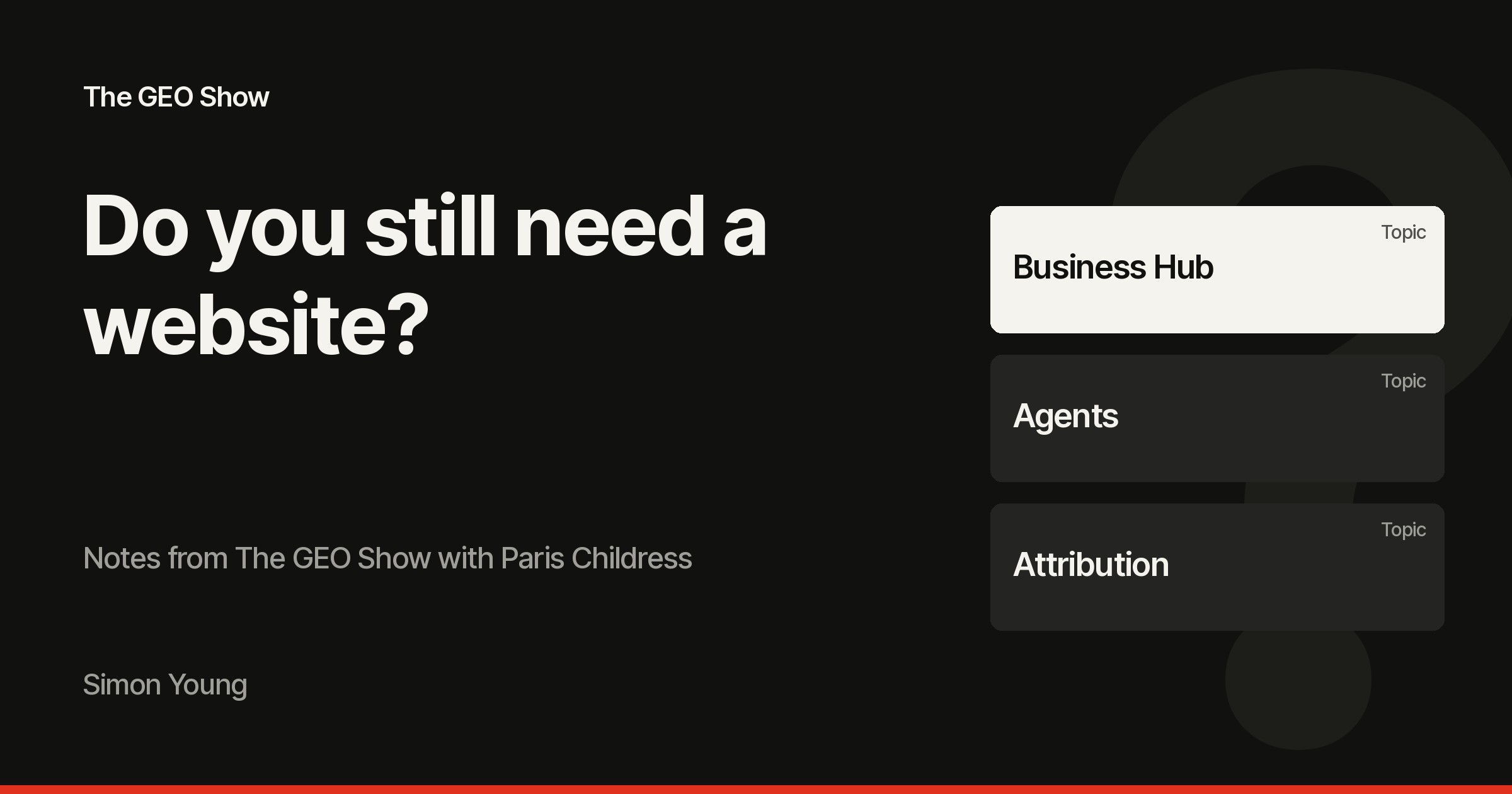
OpenAI opened Businesses in ChatGPT in beta on 10 November 2026. Eligible businesses where ChatGPT is available can claim a profile (local stores and restaurants can currently claim only an existing US listing), see how it gets mentioned, and, for some eligible US ecommerce and online-service businesses, launch a business agent that can chat and move someone toward a purchase inside the thread. Paris and I asked whether that claimed profile starts to do the job of an About page, or even a homepage. That last question is a thought experiment, not a forecast.
The first part of the recording also covers work that is still in draft, including a tools review that has not been published. That stretch is not repeated on this page. The official full transcript is on the GEOforge show page.
What did OpenAI launch with Businesses in ChatGPT?
On 10 November 2026 OpenAI announced Businesses in ChatGPT in beta. There are two parts. Business Hub lets an eligible business claim a profile, add details and product feeds, and see aggregated insights. Business Agents, for eligible US ecommerce and online-service businesses for now, can join a conversation and carry it toward a purchase. OpenAI says eligible businesses where ChatGPT is available can claim a profile. Local stores and restaurants can currently claim only an existing US listing.
Paris called it a mashup of Analytics, Search Console, Business Profile and a little of Shopping. On the episode I said I had already signed up, been approved, and verified Question.marketing through DNS (31:18 and 32:44). I had not yet tried creating an agent from the UK.
What does Brand Insights actually show?
Using OpenAI's announcement example, we walked through mentions, profile views, website clicks and discovery topics. Mentions are grouped into topics, not the individual prompts behind them. There is also an Agent Insights tab, which was not shown in the materials we reviewed. Paris's view is that prompt-level data is unlikely to appear.
Why claim a ChatGPT business profile now?
Paris argued that claiming the profile should now be at the top of a business's list. An unclaimed profile leaves the description of your business to everyone else. We also talked about fake claims, and why DNS verification is stronger than a phone call or SMS. I said I had already claimed Question.marketing off my DNS.
I compared the risk to fake Google Business profiles, where some businesses are now asked for photos of vehicles, equipment or premises. Trust and third-party citations, I argued, should be what validates a genuine business if someone tries to flood a category with empty listings.
Is a claimed profile the new website?
Paris asked whether this becomes the new website About Us page, or even the homepage, and whether ChatGPT will start paying more attention to the claimed profile than to your own site (36:09).
My answer was a thought experiment, not a forecast: "How do you serve your data into a surface in the future, and does it require a website? And I don't think it does. So we end up in a scenario where, yes, this becomes a web property, or not even a web property, an agentic property where you serve your knowledge from, or your data. You don't need a website at that point, right?" (36:24 to 36:56)
That is a view from the conversation, not a claim that websites vanish overnight.
I cannot remember the last time I clicked a blue link
Google's November 2026 core update had started on 10 November and was still rolling out when we recorded. Paris's point (18:16) was that organic search traffic is a weaker KPI on its own, and that many companies are still seeing strong lead generation even as traffic falls.
I said I had posted on LinkedIn that I cannot remember the last time I scrolled a page of results and clicked a blue link. Using Bing earlier that day, without AI Mode, "felt like I'd gone back into the '80s" (21:04 to 21:31).
What might change about clicks, leads and ads?
My first reaction to the Business Hub, after 30 years in marketing, was that bringing those tools into one place is a breath of fresh air, because you might finally get exact attribution and a targeted cost per acquisition, or sale (24:10 to 24:47).
If an agent can offer the product and the price, and the buyer completes the purchase there, I said I would pay for that all day long. You may not see the prompt it came from, but you can see the category (25:43 to 26:06).
Paris pictured a whole trip booked inside ChatGPT: flights, hotels, tickets, without hopping across ten websites. I took it one step further: agents talking to agents about whether a friend wants to come to the theatre on Wednesday night (26:47 to 27:30).
We also speculated about advertising moving from paying for clicks toward paying for leads or sales, and about a quality-score-like world where being cited and recommended could lower the cost of a lead. Nothing about pricing has been announced. Those lines are speculation.
Who was on this episode of The GEO Show?
- Paris Childress: host of The GEO Show, founder of Hop AI, co-founder of GEOforge. https://www.linkedin.com/in/parischildress
- Simon Young: Question.marketing, regular Friday co-host. https://www.linkedin.com/in/aeo/
Thanks to Paris for the Friday slot. Full episode on The GEO Show: https://www.youtube.com/watch?v=Gip9X7gOttY
FAQ
Is this a Question.marketing episode?
No. It is episode 92 of The GEO Show, hosted by Paris Childress. Simon Young is the regular Friday co-host. Question.marketing is not the publisher of the episode.
What is ChatGPT Business Hub?
It is the Business Hub inside OpenAI's Businesses in ChatGPT beta, announced on 10 November 2026. Eligible businesses where ChatGPT is available can claim a profile and see aggregated mentions, profile views, website clicks and discovery topics. Local stores and restaurants can currently claim only an existing US listing. Some eligible US ecommerce and online-service businesses can also create a business agent.
Has Simon claimed a ChatGPT business profile?
Yes. On the episode he said he had signed up, been approved, and verified Question.marketing through DNS (31:18 and 32:44). He had not yet tried creating an agent from the UK.
Do you still need a website?
That was the question in the title. Simon's answer on the show was a thought experiment: he is not sure a business will need a website if it can serve its knowledge from an agentic profile. It is not a forecast, and it is not a claim that websites disappear overnight.
Does Brand Insights show the prompts people typed?
No. Mentions are grouped into discovery topics. The individual prompts are not shown.
What was said on the episode?
The cleaned excerpt below runs from about 21:04 to the end of the episode. Speaker labels are from the official GEOforge transcript, with light spelling tidy only (ChatGPT, theatre). The opening of the recording, including unpublished work in draft, is not repeated here. For the official full transcript, use the GEOforge show page.
Paris Childress: Yeah.
Simon Young: I was using Bing today, and I'm like, "Where's the AI Mode?" I can't... Like, I had to go and click on links. It felt like I'd gone back into the '80s.
Paris Childress: Yeah, Bing actually allows you to turn off AI Mode if you want, which is interesting. Google hasn't done that, and probably, probably will never.
Simon Young: They can, can they?
Paris Childress: Yeah. Yeah. Well, Simon, let's get to the top story. We've been, we've been delaying this long enough. ChatGPT Business is here finally, and I, I know you've taken a look at it. I've taken a look at it. Uh, basically, it seems to be a, a mashup of sorts between Google Analytics, Google Search Console, Google Business Profile, and maybe, maybe even a little dash of Google Shopping in there too 'cause you can actually-- you can create product listings inside of that too. Uh, I think it is now the most important priority for every business right now to claim your ChatGPT Business profile. I, I think that this is now-- It's gotta be at the top of the list. Uh, it does a lot of things. It's reporting on mentions, and it's grouping those mentions into topics, which is very interesting. It's not showing prompts, and I'm sure it never will show prompts. It's also showing you traffic that you're getting, and you could-- maybe you could compare that to your GA4 referral traffic from ChatGPT and see if there's any difference. That to me is semi-interesting, but still, you know, we know the zero click is real, so traffic is, is gonna be misrepresented. A misrepresentation of the, the, the, the demand generation that actually occurs. And what I think is the most important and most interesting feature is create a business agent. And here I do have to-- I'm gonna pat myself on the back a little bit, Simon, because I've been forecasting this with you in many discussions for many weeks now. They're-- They are doing it basically. The advertising experience is going to be led by a agent, by a sponsored agent. So now ChatGPT inside of a Google profile gives you the ability to build and train a, an agent, and that agent will be brought in and introduced into conversations when appropriate, and it's going to be covering both organic conversations and paid sponsored conversations. So this is crossing over from organic and into paid, and I think it's one step closer to basically all of your entire journey from discovery to demand generation, to brand awareness, all the way through to consideration and purchase. All of that journey, the entire funnel happening inside of ChatGPT, including the final, final checkout. So what do you make of it, Simon? What are your-- What's your first, uh, first reaction to ChatGPT Business Hub?
Simon Young: I think you're excited. I'm.
Paris Childress: Yeah, clearly.
Simon Young: Somebody who's been in the marketing world for 30 years, like you s- ... This is a breath of fresh air. Because if you bring all of those tools into one place, surely you get to the point where you can actually give exact attribution, so you can actually then charge per, you know, targeted cost per acquisit- acquisition and, and, or sale. Um,.
Paris Childress: Yeah.
Simon Young: You know, people, people will argue, "Yeah, you could do that with Google." I don't think you could ever do completely end to end, um, because, you know, somebody Well, that customer that I was talking about earlier, was talking about, he lists his products onto Amazon.
Paris Childress: Mm-hmm.
Simon Young: He's never done any advertising on Amazon, but then he would see If he would run Meta Ads, he would see his Amazon sales pick up. Well, none of those Am- those Meta Ads were to products on Amazon, but that's what's happening. You know, f- first click attribution or the point at which people saw the product, they probably then came back or they said, "Well, I don't actually trust this particular re- retailer to ship it to me. I'm gonna go onto Amazon and order it there, because I know Jeff's gonna deliver it to my door tomorrow." But that aside, the point is, if an agent steps in and says, "I can deliver you this product, and here's the price,"
Paris Childress: Ja.
Simon Young: And the, uh, agent then we can tell where that Well, like you say, you probably don't get to see the prompt it came from, but the category,.
Paris Childress: Mm-hmm.
Simon Young: Through and you buy the product. would pay for that all day long.
Paris Childress: Yep. I think, I think users are gonna prefer to have their entire journey happening in one place without having to go off click- clicking away from ChatGPT to, to do, uh, frag- fragmented transactions. I'm, I'm thinking about a travel booking where you can use ChatGPT to plan your entire trip, uh, everything from flights, hotels, daily activities, and that's gonna require you purchasing flight tickets somewhere, purchasing a, a-- getting a hotel reservation somewhere else, and then pr- probably a handful of other things, uh, reservations for different shows, enter- entertainment or, um, uh, whatever that you're gonna do in your, in your destination place. And that might require like up to 10 different, you know, 10 different websites, and if all that happens inside of ChatGPT, that would be just wonderful. You can tell ChatGPT, you can tell your agent, "Okay, I approve the hotel. Do it. I approve these flights. Book them. I approve this itinerary. Go out and get the tickets for everything that's needed." And it'll just come back to you and say, "Yeah, your whole trip is ni- is tidied up in a nice bundle. You're, you're booked for everything. So here is your-"
Simon Young: Or take it, take it to the next level when you're going with a group of people and agents are talking to agents to make sure, you know, "Does Paris wanna come with us to the theatre on Wednesday night? Because, you know, I think that'd be... Oh, no, he's already seen that. He's been to that." You know, all this sort of stuff can go.
Paris Childress: Yeah, yeah. So I've pulled up, I've pulled up the screenshot on the announcement page here of the, the mock-up of their analytics dashboard. Now this is really bare bones and I think this is the very beginning starting point. But what do we see here? We've got, well f-first this is a ma- some fake brand called Colorful Clatter, but we're on the Brand Insights tab here at the top. But next to that tab you can see something called Agent Insights. Agent Insights. Now I haven't seen a screen for that, but we'll come back to that. Brand Insights we can see this is for the brand profile. We can see mentions. Now does mentions mean that you're in the answer or does that mean that you're a citation or both? We don't really know yet. I think mentions does mean that you're in the conversation as a brand. Uh, profile views, that means that someone probably, um, clicked on your, on your brand name which opened up, o-opened up that side panel and showed a profile the same way that Google search results sometimes show a business, a Google business profile on the right, on the right side. And then we've got website clicks, and website clicks, uh, we've, we've talked about. And then down here, which I think is more interesting, is this pie chart of discovery topics. So here we can see topics, broad topics, kids activities, gifts for kids, et cetera. And then we have the mentions and we have the topic share. So, uh, a question I wanna put to you, Simon, is, is this going to replace the, the third-party tools? Do we need, uh, do we need any prompt tracking tools now that we have this?
Simon Young: Well, I think the, the tools like GeoForge will plug into these.
Paris Childress: Mm-hmm.
Simon Young: Each surface, in theory, requires its own reporting, right?
Paris Childress: Ja.
Simon Young: I had this exact discussion with one of the other major, um, reporting tools, and I think that they then have to move into, well, how do we then get you, get you mentioned and then show your visibility across multiple surfaces?
Paris Childress: Mm-hmm.
Simon Young: No, I don't think on its own... See, the...
Paris Childress: Mm-hmm.
Simon Young: I'm, like, the interesting thing for me is also if I search "OpenAI business," uh, on Google right now, there, there is an ad there for OpenAI Help Center, how to set up your business on ChatGPT.
Paris Childress: Mm-hmm.
Simon Young: What, what point do Google go, "Well, you can't do that"? well, if they did that, that would be the, it would, it, it'd be news across the whole industry and would've been clamorous. It bus- business, business model But have you, have you, you signed up as a partner agency then already?
Paris Childress: No, I haven't. I actually haven't had the time yet, but I'm going to do it.
Simon Young: Have, right?
Paris Childress: You've done it?
Simon Young: Signed up. I don't, I don't know what it gets me, but.
Paris Childress: Yeah.
Simon Young: I've been approved.
Paris Childress: Yeah.
Simon Young: I've got a huge workspace with lots of different tabs and stuff I haven't had a chance to explore yet, but it does look really, really interesting.
Paris Childress: So Simon, you're, you're in the UK. Did you have access to the agent? Could you set up an agent?
Simon Young: Oh, I don't know. I haven't tried that.
Paris Childress: 'Cause I've heard that that's US only, but I, uh, that I, I think that the whole, the rollout of these business profiles are global to set, to claim your business, but I think the agent, the agent creation is US only right now. Uh, just wanted to verify.
Simon Young: See, people are saying obviously that Claude Duet is only right? Unless I'm,.
Paris Childress: I think so for now. I c- I can't get my hands on Claude Duet yet. I've, uh, I've applied w- weeks ago.
Simon Young: But the same functionality exists within the Claude desktop app as long as you prompt it correctly. So it will.
Paris Childress: Yeah.
Simon Young: Like it's Duet,.
Paris Childress: Yeah, it's...
Simon Young: Duet at this point.
Paris Childress: Yeah, that's correct. It's a harness. I mean, Duet is just a harness after all. Um, but in any case, uh, I, I haven't done the profile yet, but did you verify that with a DNS record or with a phone call or with an SMS?
Simon Young: What my, my business?
Paris Childress: You verified, you, you, you, you claimed question marketing, right?
Simon Young: Off my DNS, yeah.
Paris Childress: Oh, okay. Yeah. 'Cause I think, uh, I was just curious how you, how you verified your identity because there is a lot of also chatter about fraudulent profiles, about people that would go in and, uh, and they would claim a business that's not theirs in order to, to do harm or to, you know, all, all sorts of bad things can come of that. And, uh, just...
Simon Young: That's,.
Paris Childress: Hmm.
Simon Young: Doing that. No, sorry, they would, you...
Paris Childress: No, Google's... Yeah. So...
Simon Young: I, I step back and say that is definitely not the case, right? Let's.
Paris Childress: Yeah. No, I think that there's... I mean, I, I, I guess it's a secure process because you have to, you have to validate it with, with a phone num- with a phone number. I guess the phone number is pretty secure. You can get a phone call or you can get an SMS. That's the way Google My Business works, too. You, you get a pho- a physical phone call or you get an SMS with a code, and you have to type that code in. But the DNS is clearly the best way.
Simon Young: But nowadays for Google Business places, one of my clients, they made him take a photograph of his vehicles and his eq- equipment.
Paris Childress: Mm-hmm.
Simon Young: His actual physical pre- premises, because it must be that prevalent that people are creating all fake profiles.
Paris Childress: Ah.
Simon Young: There will be, there will be a scenario that it'll be more than just a phone call,.
Paris Childress: Yeah. Mm-hmm.
Simon Young: Is, I could put up a website right now with a dodgy phone number on it and make it look like a client site, and therefore claim.
Paris Childress: Yeah.
Simon Young: And, and then when two businesses are listed, which one's... "Well, my.
Paris Childress: Yeah.
Simon Young: I was first."
Paris Childress: Yeah. And what about this scenario, Simon? What if I, let's say, if I wasn't in the competitive space of, uh, GEO, if I was in a not very competitive space, what if I went out and, and just purchased 20 or 50 websites, and so I have access to all the DNS, uh, the, the domain name servers of all these places, and I just created a bunch of fake businesses behind these websites just so I could crowd out the category, and then I fill them all up with content.
Simon Young: I, I don't think there's anything stopping you doing that at.
Paris Childress: I mean, it's the same thing people used to do with like an exact match domain in SEO. Um.
Simon Young: Yeah, and, and exact match domain is huge still.
Paris Childress: It is.
Simon Young: A treat.
Paris Childress: I think it does, yeah. I mean, I'm, I'm not trying to give anybody any ideas out there, but I think that there is, there is a potential here for, for fraud or manipulation if... So either I can try to claim your business and I might have access to your phone, or I might be able to get through that validation step, and then I can, I can take control over your business profile and-- or I could just go out and generate dozens of them.
Simon Young: Ah, but then let's go into the deeper where we actually believe this goes because citation or trust should then be the, the, the validation of a genuine business, right?
Paris Childress: Yeah.
Simon Young: If, you know, the, the, the, the AI could quite easily say, "Well, this business gets no traffic,.
Paris Childress: Mm-hmm.
Simon Young: Any third part, so we'll ignore it." Maybe that's the case. Maybe you do have to have a level of, know, actual citation from other third parties to... I know you could try and manipulate that, but it would be far harder.
Paris Childress: Yeah. Let, let me pose another, uh, interesting, uh, thought experiment. Is this the new website About Us page or even homepage? Will ChatGPT start paying more attention to this than to your own website?
Simon Young: Well, I had, again, that exact conversation with someone else this week around, you know, what, what is an MCP or what is... How do you serve your data into a surface in the future,.
Paris Childress: Mm-hmm.
Simon Young: It require a website? And I don't think it does. So, you know, we end up in a scenario where, where yes, this becomes a web property, or not even a web property, uh, an agentic property where you, you serve your knowledge from, or your data. don't need a website at that point, right?
Paris Childress: Probably not. I mean, because this is a business profile, but it also has an agent, and you train the agent with instructions and knowledge about your business. It, it's basically re- it's the new knowledge hub because the agent then is gonna be the one that goes out and joins conversations and presents your business to, to users. And then you can see here this nice, uh, this nice clean profile on the right. Um, and s- you see the two CTA buttons? It says Start Chat or View Website. So I mean, which one of those do you think m- most people are gonna click on? And by the way, the.
Simon Young: You pro-.
Paris Childress: Start Chat is the one that's, that's darker and much bolder, as you can see.
Simon Young: Well, you, you, you, yeah, but surely you are trained now to use the bottom at the, the bu- the, the ask anything at the bottom.
Paris Childress: Yeah, because you're, you're already midway through a chat. I mean, you can see ... Well, this is an example of, uh, maybe best toys, best toy stores for creative play. Maybe that's your first prompt, but you might be several turns into a prompt, deep into a conversation, and because of the nature of the conversation, it's time for ChatGPT to say, "Well, I'm gonna present you with a business now. I think I have a solution. What do you wanna do? Do you wanna just ... Let's just keep the chat going, and I can start chat, which means I'm gonna bring, uh, I'm gonna bring this business' agent into the conversation, or do you wanna visit the website?" I mean, why would you wanna then leave ChatGPT? But just keep chatting.
Simon Young: Well, maybe, um, OpenAI, they then say, "Here is the new web, as in the one we have cleaned and got rid of all the crap out of,"
Paris Childress: Yeah.
Simon Young: Our websites or our knowledge bases or whatever we want to call them,.
Paris Childress: Mm-hmm.
Simon Young: They form a whole new searchable.
Paris Childress: This is ChatGPT-- This, this, this might be OpenAI's index that people keep talking about. It might be this. Because imagine if you have hundreds of... Well, yeah, at some point, if you don't claim your business, you're, you're invisible. I mean, if you don't do this, then you're, you're, you're out of the game, basically. So every business has to do this. You're gonna have hundreds of millions of business websites getting verified probably in j-just in the next few weeks. And that, that actually just represents a cleaner version of the, of the web that's gonna be a tiny fraction of the size of Google's index, but it's gonna be much, much higher quality. And as you can see here.
Simon Young: When the web started, people were, you know, domain squatting. So what's stopping people doing that here? Like with an, with an agent going in then, like you've just said, go in, create a profile in the name of.
Paris Childress: Yeah. I mean, that's,.
Simon Young: Are, are they.
Paris Childress: That's my earlier point. Yeah, I can go out... Uh, maybe I'm a domain squatter and I, I already own 100 different domains, and I've just been sitting on them. Well, now I'd like to create, uh, ChatGPT business profiles for all of them. So what do I need? I- maybe I need a physical address. Did you have to put a physical address?
Simon Young: I said yes.
Paris Childress: Okay.
Simon Young: Don't... Obviously it's not done, it's not done anything in terms of, like Google would send you a physical postcard.
Paris Childress: Yeah.
Simon Young: In the good old days. I don't know, they d- they don't do that now. I presume they get round that with the take a photograph of the premises.
Paris Childress: Mm-hmm.
Simon Young: Outside of it with your vehicles or whatever, right? To prove that... I think that's how it's done now. But,.
Paris Childress: Yeah.
Simon Young: Think this is that clever yet.
Paris Childress: Mm-hmm. Yeah. And I suppose anyone could still drive by a business and take, take a photo of it. I mean, um, yeah, but this, this could be.
Simon Young: Yeah.
Paris Childress: Yeah. This, this could be...
Simon Young: Ideas.
Paris Childress: Yeah. Th- this, this could really be ChatGPT's new index, uh, that so that they can stop having to go out and do the search retrieval and the query fan-outs. Because think about this, Simon, once Google switches on AI Mode as the default, then all the other LLMs that rely on, on, uh, on real-time search retrieval and query fan-out, that game is over because there's nothing to-- There's no more, there's no more traditional SERP left. There's no more links to, to crawl. There's no more s- snippets. So if-- Imagine if Google turned on AI Mode as the default today. What is it? About twenty percent of ChatGPT prompts result in a real-time search on Google, and then that doesn't happen because there's, there's just AI Mode there now. So imagine the risk to OpenAI that a- any day now, at any point, and it's looming, that Google is gonna flip that switch to AI Mode. Google default is gonna be AI Mode, and then twenty percent of their prompts basically will now have to rely on their training data, which is outdated in some cases, and it is just gonna r- lead to a massive decline in quality of their responses.
Simon Young: But could you imagine what would happen in terms of industry overnight if Google did that? it would explode.
Paris Childress: Knell of SEO for sure at that point. There is no SEO if there's no, if there's no rankings and no links. But, um, yeah, that's a, you know, that's a whole nother conversation.
Simon Young: 'Cause we've talked about it at length, right? you believe it's gonna do it? That they will at some point Well, it's now, they're chasing OpenAI, right? They're... Do.
Paris Childress: Yeah.
Simon Young: Full, you know... Well, when they see a product like this, got to be going, "We need to provide the whole match," you know, "We need to be the best and.
Paris Childress: Mm-hmm.
Simon Young: Be copying and following," right?
Paris Childress: Yeah.
Simon Young: See how, I don't see how they can produce anything. you could take, know, all of the ex- all the business tools that are available within Google. They are quite disparate.
Paris Childress: Mm-hmm.
Simon Young: You know. You might have Search Console and Analytics and, you know, business places and all, all of this, and then your YouTube channel. There's all sorts of stuff going on, right? And.
Paris Childress: Yeah.
Simon Young: Your Gmail. It's just a mess, right? Really. But when you see a tool where it's all in one place and you just say, "Well, can you do this?" And it does it, which is what we're all doing with agents at the moment, and they then give you the tools to do it all in one... They have to do it. Like, if they... got... They've got... That's gotta be the topic of discussion around the Google boardroom.
Paris Childress: Yeah.
Simon Young: Single minute of every day at the moment.
Paris Childress: Yeah. Just have a look at this, um... I, I just clicked over to the agent view, and I have this on the screen, and wait till it loops back through. So here we're starting again. The user says, "I need quick healthy dinners for my family this week." Organic discussion. Here are some ideas, and now here's a business, Heirloom Grocery, chat with us, get started. Okay, what should I buy for dinner? And now I'm not going to the website anymore, and here we are. And now I'm gonna click to buy. Which is easiest for busy weeknight? Okay. So now I'm, I'm browsing, and then I'm chatting a little bit, and then I'm browsing again, then I'm chatting a little bit. Tell me your budget and diet pre-- Now, the video stops there, but we didn't see the full picture because the last remaining step here, I'll just go to the end of it W- where are we? The last remaining step here is gonna be just b- a buy button. I mean, why would you... This is great. I don't... If I go to heirloomgrocery.com, that experience is gonna be much worse than this. Why would I ever do that?
Simon Young: But imagine.
Paris Childress: Just gonna be a buy button on these.
Simon Young: "Oh," it says, "Simon, our chef, can show you how to cook this. There's a video of him making this dish," right?
Paris Childress: Yeah.
Simon Young: "Oh, when are you intending having this?" "On, oh, I'm having it Tuesday night." "Well, um, shall I remind you on Tuesday and show you the recipe and...
Paris Childress: Yeah, I know.
Simon Young: I order all the ingredients and..." Wow.
Paris Childress: Yep. Yep Well, so what, what is Google's move?
Simon Young: We can even imagine it, like where it's g- yeah. Ask, you know, where does Google, where, how does Google respond to this?
Paris Childress: Because this is way ahead. E- even if Google, let's say Google says, "All right, screw it, we're gonna go to AI Mode now," this is still way better than AI Mode in Google. I mean, Go- Google doesn't have, uh... I mean, maybe Google can convert the Google Business Profiles into this perhaps, and just say, "All right, we already have hundreds of millions of claimed businesses, and we're just gonna allow them to now build agents inside of them," just like what's happening here.
Simon Young: Go. Do it. That, that's surely they've said that. They've done, that's what they've gotta do, right?
Paris Childress: Uh, yeah, uh, they have to. I mean, they have to respond somehow to this. Yeah.
Simon Young: Well, so if it's tit- if it's tit for tat, as in, right, they're sat there going, "Well, OpenAI are doing this. It's amazing. We must do this and do it better." And you've then said, "Well, what if we just take all the existing Google My Business profiles and we say, 'Right, your Business if that's what we're gonna still call it, "now exists within AI Mode, and you've got an agent. You need to claim it and tray- and train it."
Paris Childress: Yeah.
Simon Young: That would, that would clean the listings, wouldn't it? Because everyone then will panic and say, "Well, I must train my agent. If I don't, I'm out of business." Because you've got at the mo- Like the Google B- the Google Business places advertising horrendous experience for, for advertisers at the moment because a lot of them don't understand how to do it. Probably 90%... And I'm making this number up, I don't know the answer to this, but I would imagine 90%-plus of local businesses, yes, they've got a listing, but they do nothing with it, right? They, they don't populate it. They don't feed it with pictures and videos. They don't do their reviews through it.
Paris Childress: Yeah.
Simon Young: There's a handful of businesses that do it properly, and then the, probably the top 3 or 4% are the ones that are actively Google Business places, local ads, getting leads from it, getting phone calls and inquiries, etc., right? If you open that up suddenly to every single business must get their business profile, then they've got the opportunity to build their agent, and their agent is then talking to them saying, "Simon, you could have had five inquiries this week because we've handed them off to other people. Well, do you want, do you want a couple of test inquiries? Do you want your.
Paris Childress: Mm-hmm.
Simon Young: I'm gonna go, "Yes, please." Well, and then Google says, "Well, um, Simon, those phone calls would've cost you £7, right? Do you want more of them?" "Yes, please."
Paris Childress: Yeah.
Simon Young: Now selling to me as well as getting me involved.
Paris Childress: Yeah. Yeah. That's, uh-- So Goo-Google actually does have, they have some moves here because they have, uh, th-th-- just that their, their data is still a little bit fragmented, but the core, this core experience is Google, is a Google Business Profile, basically. And a Google Business Profile has everything that this ChatGPT business profile has except for the agent. So they add the agent, and that kind of leads them into the same experience where the agent can then be a part of the advertising, you know, experience. And, um, and then you just have, you have to bring in some of the data from Search Console. Hmm?
Simon Young: Imagine what we've just come up with in the scenario where it now, it energizes people to advertise and fight over the, the leads. Because at the moment, you're having to rely on a local business either have an agency or do it themselves,.
Paris Childress: Mm-hmm.
Simon Young: We could r- wipe the slate clean, and if Sundar is listening, right, he could be saying, "Right, if we get all these millions and millions of businesses up, give them an agent, and tell them, 'Here's some free leads,' right? We'll.
Paris Childress: Mm-hmm.
Simon Young: This going." And now I'm hooked because I'm... the agent is saying to me, "Right, do you want the business? It, it, it's sat there. Um,.
Paris Childress: Yeah.
Simon Young: So I would be buying the leads rather than having to hope.
Paris Childress: Per click. Mm-hmm.
Simon Young: Up.
Paris Childress: Yeah. Well, when you, when you d-- allow a business to, to either buy leads directly or pay, uh, a revenue share, basically commission out of a sale, you're just removing all the risk for, for the business, which means they're gonna pile into this.
Simon Young: Yeah.
Paris Childress: I think that's how ChatGPT will be the first one out, and ChatGPT will destroy cost per click advertising because why would I pay for a click on Google when I can just pay twenty percent out of every sale on ChatGPT? And if ChatGPT gives me enough volume, I'm happy and I'm-- and there's no more risk. Or if I'm willing to pay, ChatGPT is gonna certainly validate these leads. I'm gonna get only quality leads, and they'll sell me leads at a, I don't know, eighty dollars a lead. Why would I still pay per click or pay per impression even worse?
Simon Young: The biggest problem has been with Google Ads all the way through 25 years of me doing it, always getting an ROI out of the back end that you can justify because people are like, "Well, I've... I'm paying two, three, four, five pounds a click more," right? I've.
Paris Childress: Mm-hmm.
Simon Young: I've done campaigns with, uh, finance houses where they're paying 25, 30, 40 pounds a click, right? Those campaigns need to be pretty tight, but whenever you... If you can then go, "Well, leads will cost you X," and they're guaranteed and people turn up on meetings and/or you've made a sale for.
Paris Childress: Yeah.
Simon Young: Percentage, like you say, that's game over.
Paris Childress: Yeah. So then what are we gonna do as marketers? Are we just gonna help companies train their agents, their business agents? What else is, what else is left for us to do, really? I mean, that's the game, huh? You just have to have a better agent than the, than your competitor.
Simon Young: Yeah, but you also need to be recommended.
Paris Childress: Yeah, you still have to do the offsite work. That's, that's true. Yeah. You have to, you still have to send out those emails and do the PR and get into those listicles.
Simon Young: So, so, so in Google Ads, there is a quality score, right? So we know that your ad converts at a higher rate,.
Paris Childress: Mm-hmm.
Simon Young: Stand- stay on your page longer, all of these things in you getting a cheaper cost per click.
Paris Childress: Yeah.
Simon Young: You are, you're a trusted advertiser, you deliver, serve up, people don't have to go off onto other sites,.
Paris Childress: Yeah, it's all about the user experience. Yeah.
Simon Young: Right. So, so where we then move into is if you are a trusted advertiser, if you're cited, recommended, all of these things, you probably get offered a cheaper cost per acquisition or a cheaper cost per lead.
Paris Childress: Yeah.
Simon Young: It will convert, and it will be served,.
Paris Childress: Mm-hmm.
Simon Young: No bad experience. And that gets rid of all the... you've got bad reviews on Trustpilot or G2, on Trustmary, or any of these other platforms, your, your costs are going up, so you have to work hard to.
Paris Childress: Mm-hmm.
Simon Young: Sure that your reviews are good, your trust... The, the whole... It's so good.
Paris Childress: Yeah. It's, it's a stroke-- It's, it's really a master stroke here by OpenAI. I, I love it. And I'm just thinking, yeah, we, we now are gonna probably spend more time optimizing a business's, uh, ChatGPT business profile than we are for their own website, actually. And, um, and we're gonna be poring over this data about... Uh, 'cause w- I'll, I'll, I'll go back to... I, I, I removed the screen share, but it wasn't shown. There was another tab. There was the business profile analytics, and there was another tab next to it, which is your agent analytics. And just think about... Now, there's no screenshot for that, but that button was there. What's behind that button? Agent analytics. How many conversations has your agent been brought into? How many were positive, negative? How many resulted in a sale? Recommendations for improving your agent. All that stuff. That, that's the new ad platform, basically. That's where advertisers... Yeah, just make your agent better to deliver better experiences, and therefore, you're gonna get more, more business out of it.
Simon Young: Well, we were g- we were getting asked if we were on crack or mushrooms six months ago talking about could the web disappear,.
Paris Childress: Yeah.
Simon Young: Genuinely looks like it's going to.
Paris Childress: Yeah. It kind of reminds me of how, what Facebook did, I don't know, 10 years or 12 years ago, when a- at some point in time, it was an, an absolute necessity to build a Facebook page for your business because it was just such valuable real estate. This is how you would get found on Facebook, and I think this is a kind of a similar thing now where, uh... 'Cause back then Facebook was saying, "Hey, if you're a small business and you can't maintain a website, no problem, just come to Facebook. Give us some photos. Give us, you know, give us a, a good description. Claim it, and you're good to go." And all the c- all the experiences are consistent, and the users prefer this anyway to a website. And I think this is kind of the newer version of it, basically, where OpenAI is saying, "Hey, we're gonna, we're gonna distill this, this web, th- this, this massive web down to just the, the businesses that verify themselves, and we're gonna give the right incentives for those businesses to give us all their information that's important about their business, including an agent with instructions about how to sell this business to users and how to sell their products and services. And then that's, that's our new index, that Google has its index. This is our new index." So when any.
Simon Young: So what about, what about social media though then? Do we then start having our social interactions within that platform as well?
Paris Childress: I don't know. Um, I think, uh, I still think social media is, is still where people wanna interact with other people, basically. So if you wanna interact with s- with your friends, your family, or with other people and see human-made content, hopefully, uh, that's social media. If you just wanna be entertained or inspired, um, I think that's social media. And then if you want to actually solve problems, get answers to questions, and buy stuff, you go to ChatGPT because you're gonna interact with agents that are gonna take care of you, and that's the two different mind frames. And why would you then go to an internet with websites? W- what's the third thing? What else do you need? I mean, I wanna, I just wanna chill out, I wanna be entertained, and I wanna, and I wanna interact with other people: social media. I wanna actually get shit done and buy shit, I'm going, I'm going to AI. But w- what-- Is there a third thing where I would go to a website? I'm not... I can't think of any. Yeah.
Simon Young: No. And, and maintaining a website is pretty difficult, right, for most people.
Paris Childress: Yeah.
Simon Young: And, and look at all those... So here's the other thing. So that scenario where we're talking about all these m- millions of businesses that have Google Business places but they haven't either claimed them or updated them, etc.,.
Paris Childress: Mm-hmm.
Simon Young: Well, suddenly they've got a great online presence that they can update with their voice, and they can just train their agent and, "Oh, you've been out today, Simon. Did y- who did you meet? Did you take some photos? Um, what can you tell us about your industry?" It start.
Paris Childress: Yeah.
Simon Young: You know, like your tool, it interviews you does a cracking job and produces loads of content. Surely.
Paris Childress: Mm-hmm.
Simon Young: Then start talking to you and.
Paris Childress: Ja.
Simon Young: The clamor, the clamor at the moment is to learn as much as they can, isn't it? And how we work and how.
Paris Childress: Yeah.
Simon Young: Work.
Paris Childress: Yeah. Well, just, just imagine this, this scenario where you go into your Google... Uh, sorry, you go into your ChatGPT business profile and it says, "We have, from all the conversations where we've recommended you, and we've seen what people are asking about your business, we have all these different claims that we want you to verify because we couldn't find these claims in your business profile information or your agent instructions. So we, we couldn't con- we couldn't confirm this to the user. So here's five questions. 'Simon, are you open on weekends?' Uh, 'Simon, do you still do SEO audits?'" Or whatever. And you just go through multiple choice questions, and every time you go into your business profile, you, you, you get served a questionnaire, just like what Grok Bot does, basically. "Give me the final decision. Is it you want A, B, or C?" And it just gives you this every time, so you just ke- continuously refine and give more information, more context, because ChatGPT has the prompts to have the conversations that say, "Hey, people are-- We brought you into this conversation, and then the user asked this, and we didn't have, we didn't have an answer because you didn't provide the answer. So what's, what's your answer to this?" "Oh, my answer is this. We don't do that. We do do that." And then that just happens over and over and over, and suddenly your business profile actually becomes much richer than your website because that's how you, uh, you know, that's the equivalent of updating your website. You don't do that anymore. You just go into the Google business profile, and you just answer a bunch of questions every time that it serves you up.
Simon Young: What's made me chuckle is, um, imagine this scenario, right? So prior to the car being invented, imagine a two- couple of guys sat there talking about, there's gonna be these, you know, these things that you could get into, and they'll have an engine. You don't need any horses, and all this sort of stuff, right? that's what, best part of 100 years ago or more, right? But imagine now where, where somebody watches us chatting in years' time, and this conversation feels like these guys were, like, ahead of whatever that next thing is, like, we'll feel like dinosaurs.
Paris Childress: Yeah. And Simon, if you and I are kicking around these ideas, uh, imagine what's happening inside of OpenAI. I mean, clearly they're where we are or much further ahead, basically. I think they imagine that the whole internet, as we know it, just turns into a, a big, a big database, a big training database, and the experience that people have with the web moves entirely into, into ChatGPT, entirely. And.
Simon Young: Personalized as well.
Paris Childress: Yeah.
Simon Young: You know, that's, that's what you c- Google could never do. You know, if you and.
Paris Childress: Mm-hmm.
Simon Young: And we made the s- the same search, we would typically get the same answer,.
Paris Childress: Yeah.
Simon Young: Thing is where it has to go.
Paris Childress: Mm-hmm.
Simon Young: It should, it should be looking at, you know, another 100 54-year-old English guys who are... how we search together and what we look at and, you know, if it could find another hundred of me, um, who are also interested in golf and fishing and have got kids at university and enjoy nice food and wine but, you know, don't do this and do this sort of stuff, where it really has to go, is to complete personalization.
Paris Childress: Yeah.
Simon Young: But.
Paris Childress: Yep.
Simon Young: Must have... You know, talking about what imagining sat down inside OpenAI and how they envisage the future of the web, or maybe it's not called the web anymore. Um, but surely that's all mapped out to an extent or do you think they're winging it? You know, like surely they've got it on a roadmap because it's important to have a step of we're gonna do this, we think they'll do that, we'll then do this. There's.
Paris Childress: Yeah, just game theory.
Simon Young: Yeah.
Paris Childress: Yeah. I mean, I would love to be a f- a fly on the wall in a, in a game theory, in the game theory, uh, rooms of these strategists trying to predict, well, yeah, what, what is Google's answer now to, to the business hub, uh, to ChatGPT's business hub? And does that accelerate their timeline for AI Mode in any way? Does that make them-- force them to revamp entirely the Google Business Profile product by merging in, uh, business agents and merging in, uh, Google Search Console data and GA data into that, and may- maybe even shopping, a shopping feed or something? I, I don't know. I mean, I think they have to be talking about it because OpenAI has effectively merged at least three of Google's products here: Search Console, M- Google Business Profile, and, and Google Shopping f- a- a- and the shopping feed, the Merchant Center. I think it's a.
Simon Young: And, and got rid of, got rid of cost, cost per click, got rid of s- traditional search ads.
Paris Childress: Yeah. Yeah, that's, that's coming.
Simon Young: We should, what we should both do after we've had this conversation, and this is recorded and uploaded, we should take the conversation and give it to Google, to Claude, to OpenAI, to Perplexity, to Copi- give it to all of the services and ask them that exact question. Based on the discussion that we've had today, how is Google able to react to what is- what OpenAI has done.
Paris Childress: Mm-hmm.
Simon Young: To do?
Paris Childress: Yeah. Mm-hmm. Interesting stuff. Well, Simon, we, uh...
Simon Young: Would be fascinating.
Paris Childress: Yeah. That, that's one, that's one that I would give to Fable. I would, I would actually burn my Fable 5.2 limited credits on that, on that question, actually. Is that Fable... Have you tried Fable 5.2 yet?
Simon Young: I, I use it most of the time.
Paris Childress: Go-- 'cause it, the deadline is November 16th before they make you pay for extra usage only for that. But it's included in our plans, uh, up until, uh, at least where, where I'm sitting, I don't know, our, our organization, uh, it said November 16th is when they will move it out of the plans and into, uh, extra, extra usage. So I'm trying to do as much as I can, and I did this, uh, AI, this SaaS AI visibility index work in Fable, and it's, uh, it's fantastic. You know? Great, Simon. Well, we, uh, might have set another record here, but we're well over the hour mark. We probably should wrap it up and, uh, just start prepping for our weekends. So.
Simon Young: Absolutely.
Paris Childress: Yeah. Great, a great chatting with you as always. Uh, it was a, it was a massive week here with this announcement, and I think we're gonna have a lot to talk about because I'm, I'm gonna claim my business. I'm gonna-- we're both gonna start seeing data, and then we can compare that to data we see in GeoForge. And, uh, I think the ability to triangulate data now is just getting bigger and bigger, and I think that's still a reason why people would hire us and hire agencies is because s- ChatGPT, uh, is still one AI. It is the biggest one, but there still are multiple AIs, and you still need to also look at your data from Google Search Console, and you need to triangulate in some, in some way possible. Um, Google, Google Search Console is, is not showing, not showing you how many times you're mentioned, but they are showing you how many times you're cited. Maybe that'll change, but, um, right now we basically have, we have a very fragmented analytics environment, and that means that, uh, that bodes well for guys, guys like us, I think, to try to basically pull together a fragmented data, data space and create a cohesive story All right, Simon.
Simon Young: Well, look,.
Paris Childress: Final words? Okay.
Simon Young: Final words, watch this space. Talk, s- talk to you next Friday.
Paris Childress: Yep. All right, Simon. Take care.
Simon Young: See you soon.
Paris Childress: All right.
Where does this fit?
For where search fits now, read how AEO differs from SEO and GEO.
More from the library
- Interviews and one offsWill AI Recommend Your Business? AEO ExplainedPublished
- Interviews and one offsSimon Young on The GEO Show: local AI search, reviews and voice, with James DooleyPublished
- Interviews and one offsThe death of the web? Simon Young on SEOPRESSO with Björn Darko (2026)Published
- Interviews and one offsHow Do Dental Practices Generate Leads? | Nicki Rowland and Simon YoungPublished
This entry is part of a dated archive, what we said, when we said it. For what works in AI search today, start with AEO at Question.marketing. For why the dates matter, see the receipts.
Where next?
The library holds every video we have published. The AEO pages explain the method behind them, what it costs and what the evidence actually supports.