FAQ
Does schema markup help ChatGPT understand my business?
Schema markup is structured data added to your pages that labels who you are and what you offer in a format machines read without guessing. This FAQ covers what schema does for ChatGPT and other answer engines, where it sits among the signals that earn a citation, and what to check before you spend time on it.
What schema does and does not do
Does schema markup help ChatGPT understand my business?
Schema markup gives machines an unambiguous summary of your business, and that reduces the chance of an AI engine misreading your key facts. Types such as Organization, LocalBusiness, Service and FAQPage state your name, services and questions in a labelled format. Schema is not a guarantee of recommendation. Our sources describe schema and embedded metadata as support for indexing that sits behind text-based pages on domains you control.
Is schema the main reason a business gets recommended by ChatGPT?
Schema is a supporting signal, not the main driver. The primary levers for earning a citation are answer-first passages, question-shaped headings, entity consistency, third-party corroboration, named people and original knowledge. Schema supports indexing but ranks as secondary to those text-based levers. Fix those first, then add schema to reinforce them.
What is the difference between schema and answer-first content?
Schema labels a page for machines, while answer-first content gives the model something worth lifting. The structure that earns citations is a complete standalone sentence under every heading that could be quoted on its own. Schema can tell an engine that a question and answer exist on the page. Without a clear answer written into the text, the markup has nothing useful to point at.
How schema fits with answer engines
Why does marking up questions and answers matter?
Marking up questions and answers tells an engine that this is your question and this is your answer. If an engine cannot pull the answer out of a page, you have no chance of being featured in an answer engine. Unless content is formatted as a question followed by its answer, with the markup around it, it is unlikely to be found. That is the case for FAQPage markup on pages that carry genuine questions and direct answers.
Is schema a new idea for AI search?
Structured markup predates ChatGPT, because Google has had its own structured language for years and very few SEO people used it. The work was manual and slow, which is why many websites never applied it correctly. Answer engines grew out of that world of featured snippets, people also ask and voice assistants. What has changed is that AI engines now sit in front of the click, so the quality of your markup and your answers matters more.
Where should the answer sit on the page?
Put the question as your heading and the answer directly below it, near the top of the page. The model prefers content in the top third of the page. Zyppy 2025 found that 44.2% of LLM citations come from the first 30% of a page. Schema should describe content that already sits in that position.
What to check before you invest in schema
What is the first check on any audit?
The first check is whether AI crawlers can reach your site at all. Cloudflare's default settings block AI crawlers, and content behind a WAF default-block is invisible to AI engines regardless of how well it is structured. Roughly 22% of web traffic sits behind Cloudflare. Perfect schema on a blocked page does nothing, so verify access before you touch markup.
Should schema be treated as a one-off setup?
No. When vetting an AEO supplier, treating schema as a one-off setup is a red flag. Your services, people, questions and review dates change, and the markup must change with them. Build a review cycle into your content process so the structured data keeps matching the visible text.
What else must match the schema?
Your schema must agree with everything else a model can read about you. Name, address, registration details, people and claims must say the same thing across your site, regulators, directories, review platforms, professional bodies and Companies House. Contradictions are the most common reason a model stays vague about a provider. Schema is one more place where your facts must line up, so write it from the same verified details you use everywhere else.
Does an llms.txt file replace schema?
No. Cyrus Shepard's 2026 synthesis scores llms.txt at 2.0 out of 10, summed up as "It doesn't hurt. It isn't a service". Put your effort into crawler access, answer-first pages and consistent entity facts instead.
Getting results
What gets a business named by ChatGPT beyond schema?
Third-party corroboration carries more weight than most on-page work. An Ahrefs study of 75,000 brands found a 0.664 correlation for branded mentions against 0.218 for backlinks. Named people also matter, because models cite people as readily as brands. Original, proprietary knowledge drives citation too, although the C-SEO Bench corrective shows that effect is smaller and more variable than the original Princeton GEO paper suggested.
How do I know whether my changes worked?
Measure being named, not ranking position. Share of voice, prompts won and "cited as the source" are the measurement language, and there is no AI ranking position. A single check carries a margin of roughly ±9 to 13 points, so one screenshot proves nothing. Track the same defined prompts every cycle across every engine, and ask new enquirers "How did you hear about us?" with individual AI engines listed.
What should I do next?
Work through these steps in order:
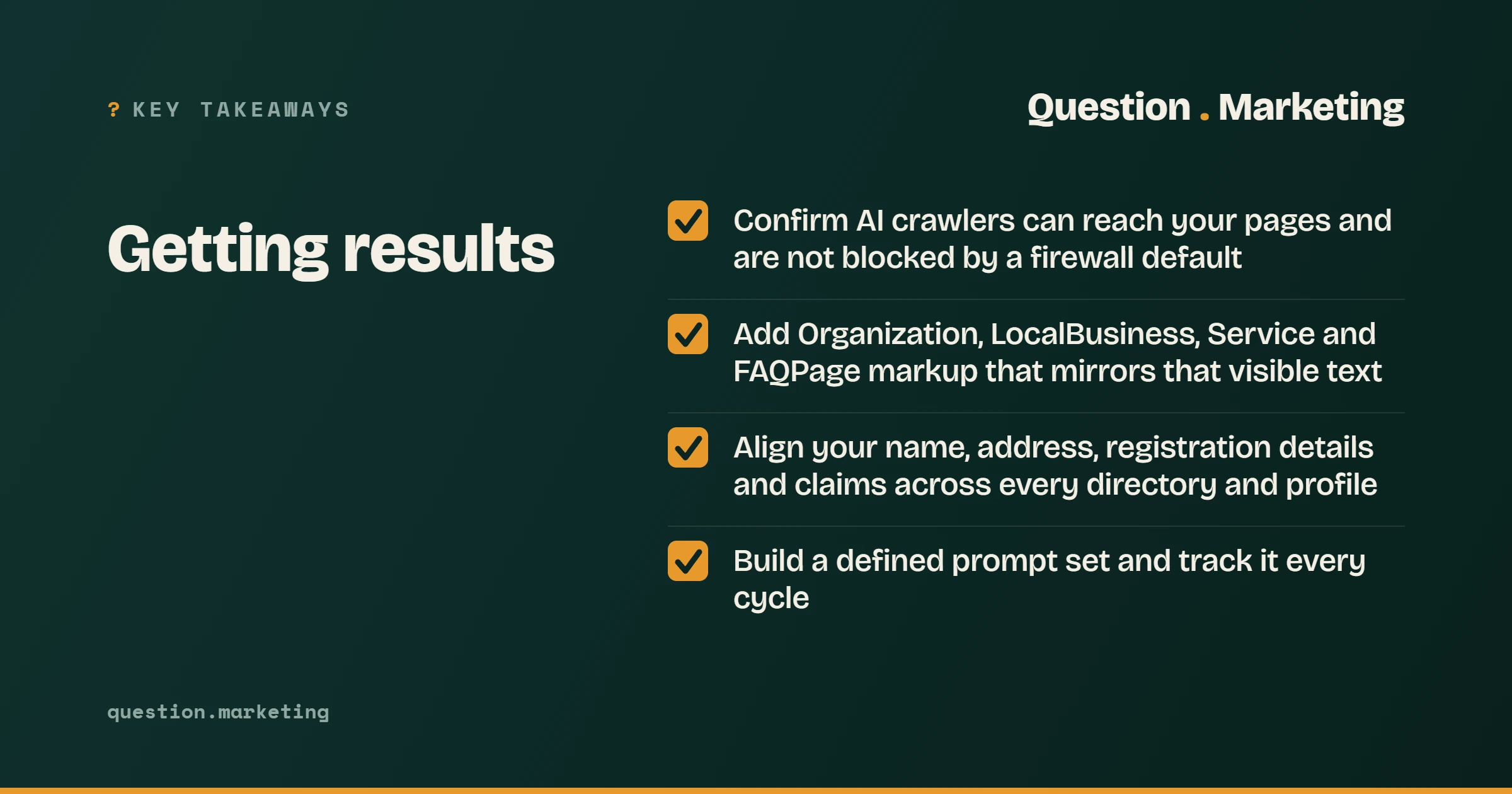
- Confirm AI crawlers can reach your pages and are not blocked by a firewall default.
- Rewrite key pages so a complete, standalone answer sits under a question-shaped heading near the top.
- Add Organization, LocalBusiness, Service and FAQPage markup that mirrors that visible text.
- Align your name, address, registration details and claims across every directory and profile.
- Build a defined prompt set and track it every cycle.
For the bigger picture, read what answer engine optimisation is.