FAQ
How often should you check your AI visibility?
Most businesses should check their AI visibility once a month and re-run a fuller baseline each quarter. This FAQ explains why that rhythm works, what a check should contain, and what you can and cannot conclude from a single result. We built it around the question "How do I check whether ChatGPT recommends my business?", because the follow-up is always how often to look.
Why monthly is the right rhythm
How often should I check my AI visibility?
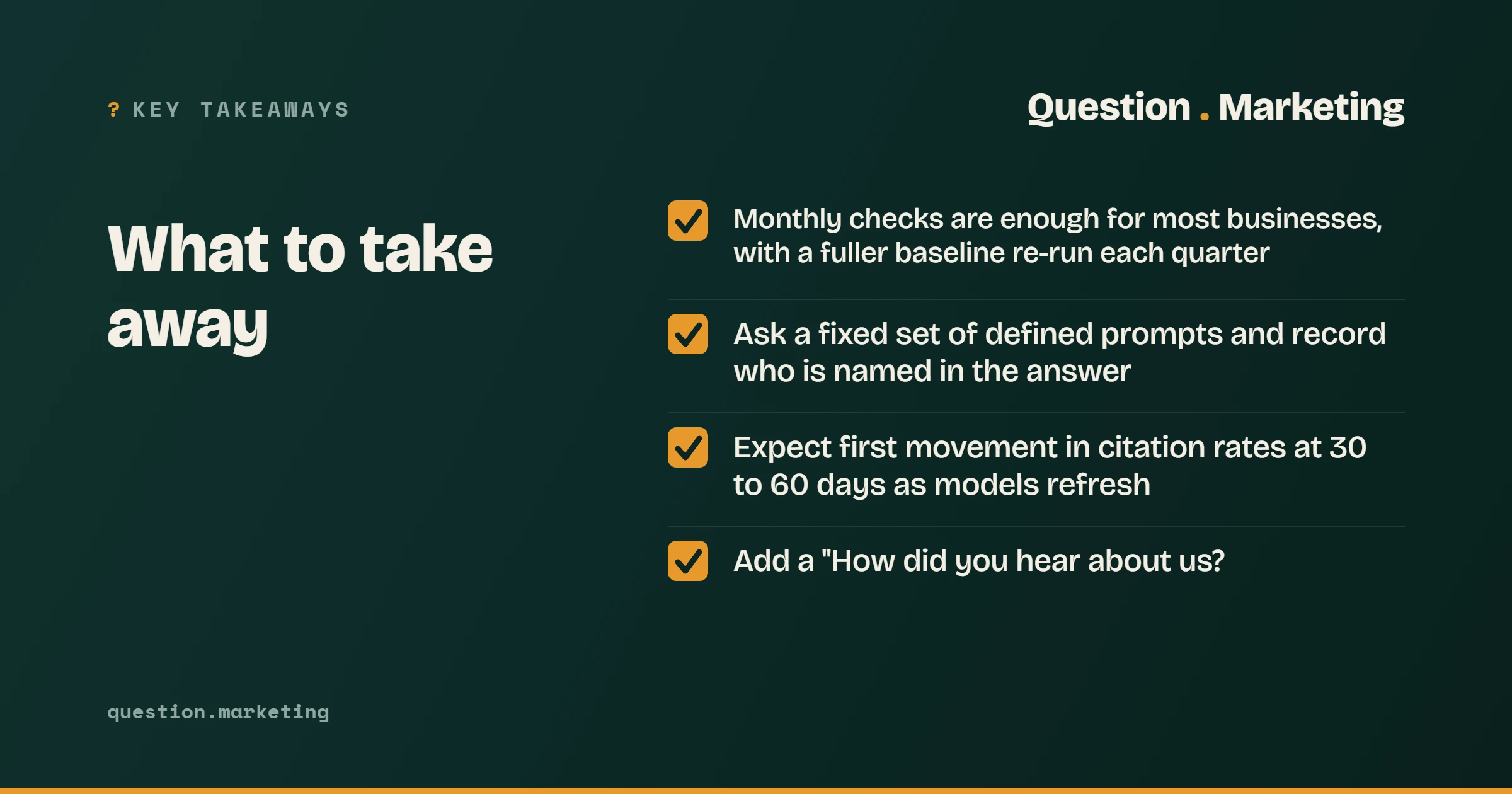
Monthly checks are enough for most businesses, with a fuller baseline re-run each quarter. We run the same discipline on ourselves: Question.Marketing's own tracker is a monthly own-name LLM visibility check across 22 defined prompts, with screenshot evidence and first-answer counts. A monthly cycle gives you a regular reading without turning your reporting into noise.
Why is checking weekly or daily a poor use of time?
Checking more often mostly captures random variation. A single check carries a margin of roughly ±9 to 13 points, which is why one screenshot proves nothing. If you ask the same question on Monday and Thursday and get different answers, you have not seen a trend, you have seen the spread that sits inside every single check.
Why is checking less often than monthly also a problem?
Checking less often makes it hard to link changes to the work you have done. When months pass between readings, several pieces of work and several model refreshes land in the same window, and you cannot tell which one moved the result. We see first movement in citation rates at 30 to 60 days as models refresh, so a monthly rhythm captures that early movement as it happens.
What a proper check looks like
How do I check whether ChatGPT recommends my business?
Ask a fixed set of defined prompts and record who is named in the answer. Every report should show the same defined prompts, every cycle, every engine, with screenshot evidence of where you appear and who appears instead. Start with the engines that matter most. Our own tracker prioritises ChatGPT, Google AI and Perplexity.
Why do I need the same prompts each time?
Changing the wording between checks makes the results incomparable. A fixed prompt set lets you compare this month with last month and see whether a gain is real. The same logic applies to how we sample: we use around 1,500 sampled answers per source per cycle across 30 prompts, with Wilson confidence intervals and a published margin of error of roughly ±1 to 2 points. Sampling at that scale narrows the margin from ±9 to 13 points on a single check to ±1 to 2 points.
What should I record at each check?
Record the figure, the period and the margin. Client baselines state all three. Share of voice, prompts won, and "cited as the source" are the measurement language. There is no "AI ranking position". There is being named, or not.
The quarterly baseline
What is a quarterly baseline re-run?
A quarterly baseline re-run is a fuller repeat of your original measurement, using the same defined prompts across all the engines you track. Monthly checks tell you whether you are drifting. The quarterly re-run tells you whether the work is paying off, because it gives you a larger sample to set against the figure, period and margin you started with.
How many prompts and engines should a baseline cover?
Coverage scales with the size of the business. On our Visibility level we track 30 to 40 prompts across ChatGPT, Google AI and Perplexity. At the Recommendation level that rises to 100 to 120 prompts, adding Gemini, Claude and Copilot. A single-site business does not need the larger set, and a multi-site business should not rely on the smaller one.
Reading the results
How long before my checks show a change?
Expect first movement in citation rates at 30 to 60 days as models refresh. Meaningful shortlist presence for a flagship service in your town typically arrives by month four to six. Monthly checks in the first two months will often look flat, and that is normal.
Does being absent from ChatGPT mean I am absent everywhere?
No. Local visibility varies sharply by platform. SOCi's 2026 study of 350,000+ locations found 1.2% of locations recommended by ChatGPT versus 35.9% appearing in Google's 3-pack. Check each engine separately and do not treat one answer as a verdict on all of them.
Could my site be invisible for a technical reason rather than a content one?
Yes, and it is the first check on any audit. Cloudflare's default settings block AI crawlers, and roughly 22% of web traffic sits behind Cloudflare. Content behind a default block is invisible to AI engines regardless of how well it is structured. If your checks show nothing at all, confirm crawler access before changing any content.
Beyond the mention count
How do I tell whether AI visibility is bringing in enquiries?
Add a "How did you hear about us?" field to your enquiry form and list the individual AI engines as options. A visibility check tells you whether you are named. Attribution tells you whether being named produces enquiries, and you need both to judge the work.
What is the practical routine?
Run your fixed prompt set once a month, record who is named and where, and compare against the previous month with the margin in mind. Re-run the full baseline each quarter and judge progress against that, not against any single screenshot. Review the attribution field alongside both.
If you want a baseline that states the figure, the period and the margin, our AI Visibility Audit is delivered in five working days and is yours to keep whether or not you hire us.
For the bigger picture, read what answer engine optimisation is.