How-to guide
What are the core parts of an AEO strategy?
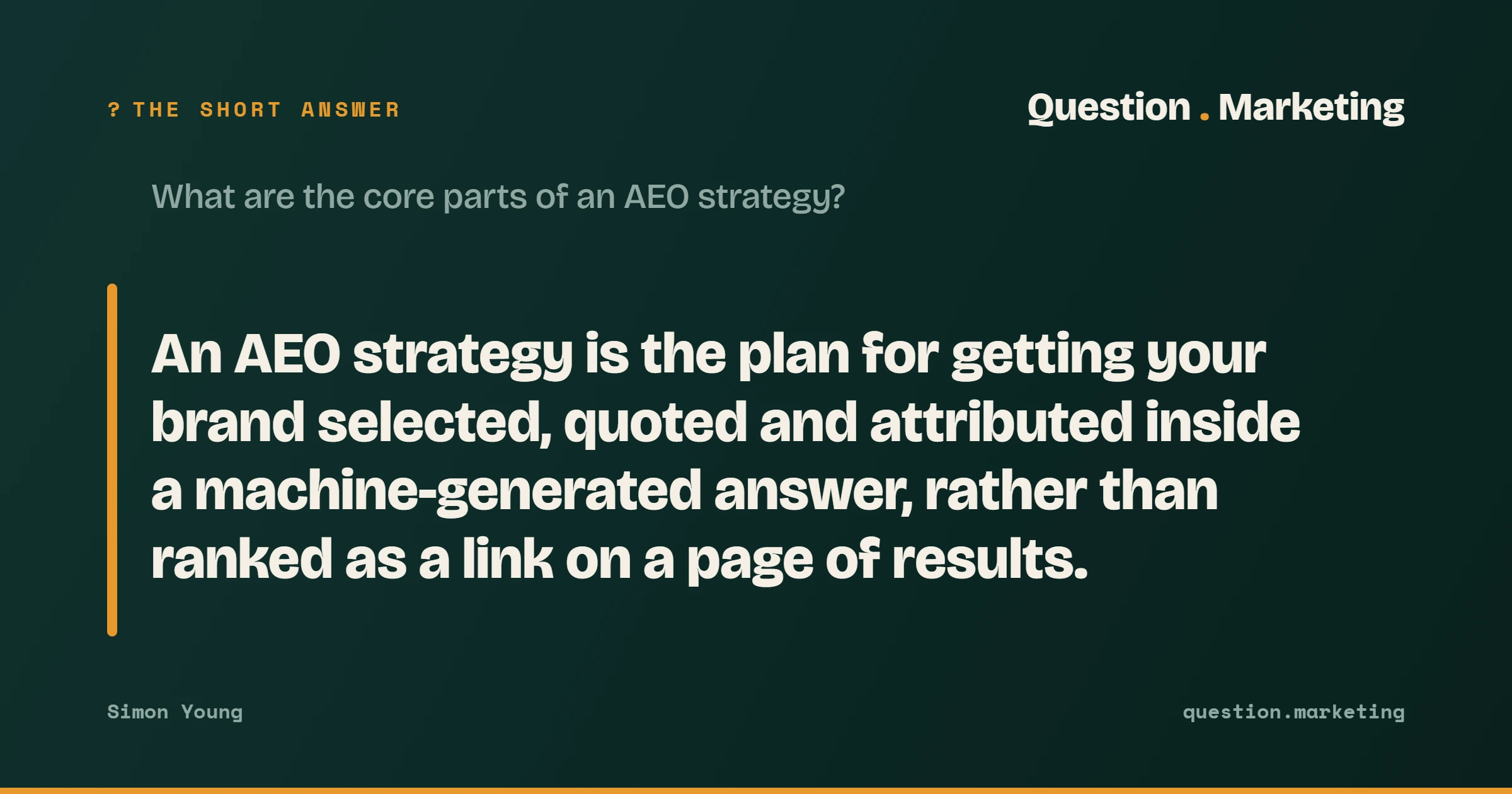
An AEO strategy is the plan for getting your brand selected, quoted and attributed inside a machine-generated answer, rather than ranked as a link on a page of results. This guide walks you through the five parts a working strategy covers, in the order we would tackle them, so you can build your own plan and know what to measure along the way.
The reason this matters is the click. Around six in ten searches now end without anyone visiting a website, and when a Google AI Overview appears, click-through on the top result falls by somewhere between a third and two thirds depending on query type. AI referral traffic is still around 1% of total web traffic, so "we'll pick up our AI traffic instead" is not a plan. The plan is to be inside the answer.
Prerequisites
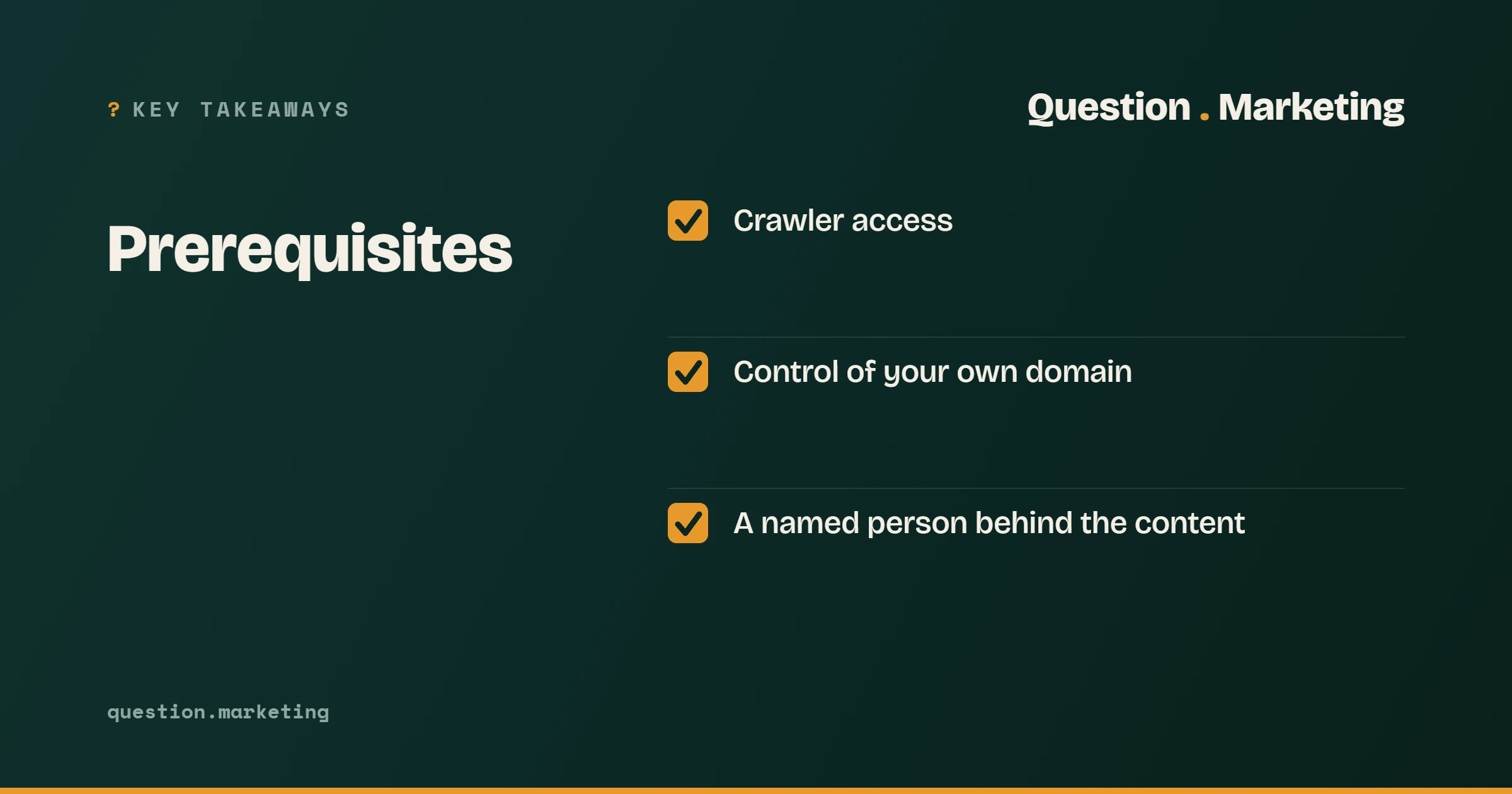
Before you start, get these three things in place:
- Crawler access. Many websites sit behind Cloudflare, and by default AI crawlers do not access content behind it. Set Cloudflare to allow AI crawlers, otherwise you will never get listed.
- Control of your own domain. Video and audio are invisible to models unless the text lives on a domain you control, so you need a place to publish full transcripts and answer pages.
- A named person behind the content. Models cite people as readily as brands, so decide now who the named experts are.
Step 1: Baseline how AI engines describe you today
Start by finding out where you stand. Ask ChatGPT, Gemini and Perplexity the questions your buyers actually ask, and record what each one says about you, who it names instead, and what it gets wrong. State which platforms you tested. A result on one engine tells you nothing certain about the others.
Build a defined set of prompts and keep it fixed, so you can compare like with like later. A robust tracking set spans several prompt categories, for example claim, entity, shortlist, education and clinical prompts, with screenshot evidence and first-answer counts for each. The engines to prioritise first are ChatGPT, Google AI and Perplexity. a. Write your prompt set, covering the question types above. b. Run it across each engine and capture screenshots. c. Count how often you are named in the first answer. d. Date the result. This is cycle zero, and every later cycle is judged against it.
This baseline is the number everything else is measured from, so do not skip it.
Step 2: Make your entity information clear and consistent
With a baseline in hand, fix the facts about who you are. Name, address, registration details, people and claims must say the same thing everywhere a model can read them: your site, regulators, directories, review platforms, professional bodies and Companies House. Contradictions are the single most common reason a model stays vague about a provider.
Work through a short audit: a. List every place your business details appear. b. Check each one for mismatches in name, address, people and claims. c. Correct the outliers so every source agrees. d. Attach named people to your content rather than anonymous bylines. In regulated sectors the named human carries most of the trust.
Schema and embedded metadata support indexing, but they are secondary to text-based companion pages on domains you control. Treat schema as ongoing maintenance, not a one-off setup.
Step 3: Build answer-shaped content that matches real questions
Models retrieve and cite content that is structured as self-contained, answer-first passages with complete standalone opening sentences. Build your content to that pattern: a. Write H2 headings as the question the reader actually typed. b. Put a complete standalone sentence under every heading, one that could be lifted out and quoted on its own. c. Publish full transcripts of any video or audio on your owned domain. d. Add original, proprietary knowledge. The Princeton GEO paper found information gain drives citation, though the C-SEO Bench corrective shows the effect is smaller and more variable than that paper suggested.
Publishing original, proprietary knowledge earns AI citations. AI-generated derivative content does not. Using AI to help structure your material is fine, but you have to give the knowledge base something that makes a difference.
Step 4: Earn third-party corroboration
Your own site is only one voice. Brand mentions across the web matter more than backlinks: an Ahrefs study of 75,000 brands found a 0.664 correlation for branded mentions versus 0.218 for backlinks. That makes dissemination of your content, through PR and publishing, and third-party citation of it, a core part of the strategy rather than an optional extra.
Your priorities here: a. Identify the sites, publications and directories AI engines already draw on in your sector. b. Get your named experts and your original knowledge mentioned there. c. Keep every mention consistent with the entity facts from Step 2.
Be wary of any supplier who says third-party authority does not matter. Usually that is because they cannot deliver it.
Step 5: Measure repeatedly and show movement
AEO is not a one-time project. Re-run the same prompt set from Step 1 on a regular cycle, on the same engines, and compare against the baseline. Track how often you are named, how you are described, and which competitors appear beside you.
You can also watch traffic signals. Tools such as Semrush, Ahrefs and Google Search Console give some visibility into sessions from AI, though this measurement is still in its infancy. Because rankings can hold while sessions collapse, visibility inside the answer is the number to watch, not rank reports alone.
Tips & Best Practices
- Build a 30 to 90 day plan. Use the baseline for the first stretch, entity fixes and answer pages next, then third-party work and a second measurement cycle.
- Treat the funnel as a question bank. People now research inside answer engines and arrive more qualified, which is why a connected set of answers that moves people down a funnel matters.
- Be wary of shortcuts. Some black hat techniques are creeping into the space. Original, trusted content is the durable route.
- Vet any supplier. Ask whether they can explain the difference between AEO and GEO, and whether they can show screenshot evidence of multi-LLM citation tracking against a defined prompt set.
Troubleshooting
- Not appearing at all? Check that AI crawlers are allowed through Cloudflare first.
- Models describe you vaguely or inconsistently? Return to Step 2 and look for contradictions across your listings and profiles.
- Content published but not cited? Check that each section opens with a standalone, quotable answer under a question-shaped heading.
Summary
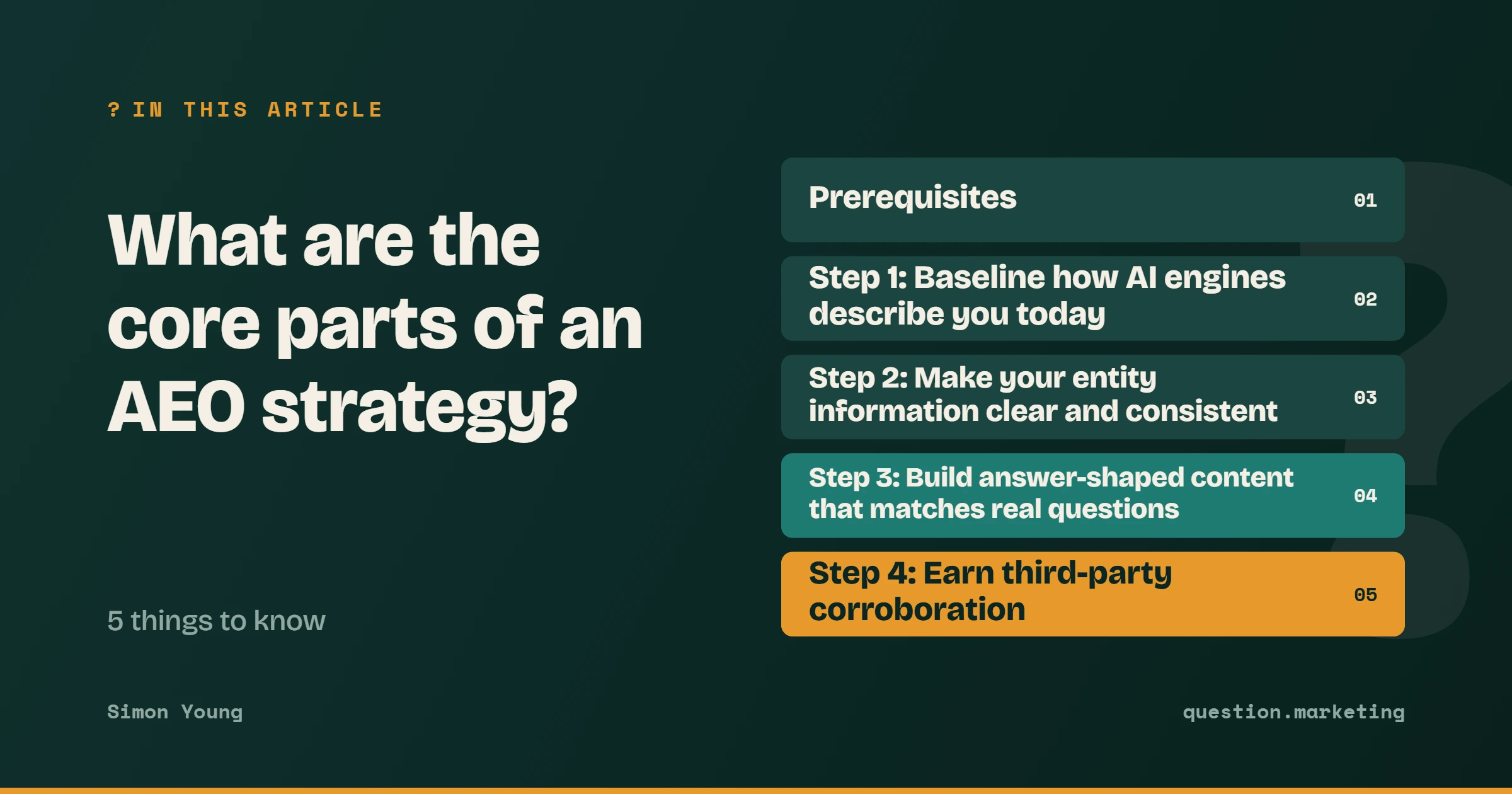
A working AEO strategy has five parts: a baseline of how AI engines describe you today, clear and consistent entity information, answer-shaped content that matches real questions, third-party corroboration, and repeat measurement to show movement. AEO is where the questions and answers live, and GEO is the work that gets you into that space. Start with the baseline this week, because without cycle zero you cannot prove that anything else worked.
For the bigger picture, read what answer engine optimisation is.