How-to guide
How do I get my business into an AI model's training data?
You cannot submit your business to an AI model's training data. There is no form, no portal and no paid route in. The practical route is to be described the same way, everywhere a model can read about you, on sources that are widely crawled and trusted. This guide walks through how we approach that work, and where training data stops mattering and live retrieval takes over.
Understand how AI engines actually find brands
Training data is only one of the ways an answer engine learns about you. Roughly two-thirds of the time, content is not retrieved from what a model already knows. ChatGPT queries trigger a web search in a share of cases, and the rest is answered from other data sources. So the job has two parts: be present in the sources models learn from, and be easy to retrieve when they search live.
Each engine also leans on different sources. ChatGPT works mainly with Wikipedia, LinkedIn and brand-owned content that is structured properly, while Google leans on YouTube and existing SEO. That difference is why one strategy built on a single platform is fragile. Reddit is the clearest example: in September 2025, ChatGPT's Reddit citation share dropped from roughly 60% to 10% within weeks.
Prerequisites
Before you start, gather these:
- Your exact legal name, trading name, address, registration details and the names of your key people.
- A single, agreed description of what you do and who you do it for.
- Access to your website, your LinkedIn page and any directory or review profiles you already hold.
Step 1: Check that AI crawlers can reach your site
Start with a binary check. Cloudflare's default settings block AI crawlers. The default block has been active since July 2025, and defaults were tightened on 15 September 2026. Roughly 22% of web traffic sits behind Cloudflare.
Content behind a default WAF block is invisible to AI engines regardless of how well it is structured. Confirm whether your site sits behind Cloudflare or a similar firewall, and check what it allows through. Fix this before anything else, because every later step depends on it.
Step 2: Make your own site the clearest source about you
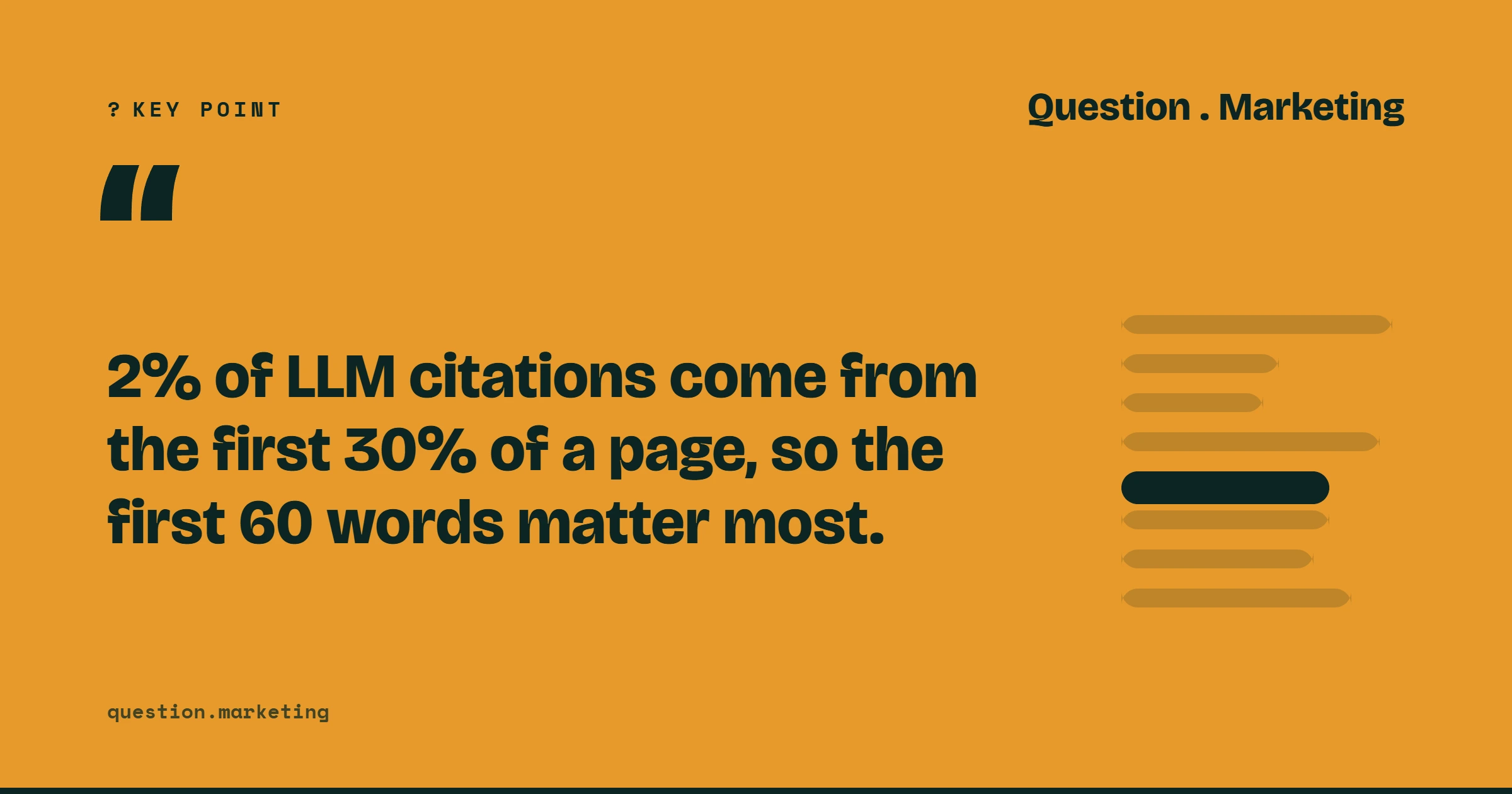
Your own domain is the one source you fully control, so make it unambiguous. a. Put the answer first. Models cite content that is structured as self-contained, answer-first passages, with a complete standalone sentence under every heading that could be lifted out and quoted on its own. b. Write question-shaped H2 headings. Use the question your reader actually typed. c. Place the important content near the top. 44.2% of LLM citations come from the first 30% of a page, so the first 60 words matter most. Treat your H1 as the question and publish the answer directly beneath it. d. Publish transcripts of video and audio on a domain you own. Video and audio are invisible to models unless the text lives on a domain you control. LinkedIn and YouTube strip embedded MP4 metadata on upload, so the caption file, the video title field and a transcript page on your own site are the real levers for discoverability. e. Name real people. Models cite people as readily as brands, and in regulated sectors the named human carries most of the trust.
Step 3: Make every description of you say the same thing
Entity consistency is the heart of this work. Your name, address, registration details, people and claims must say the same thing everywhere a model can read them: your site, regulators, directories, review platforms, professional bodies and Companies House. Contradictions are the single most common reason a model stays vague about a provider.
A model that finds conflicting versions of you will not guess which is right. It looks for the version that appears most often. Audit each profile against your agreed description and correct the outliers.
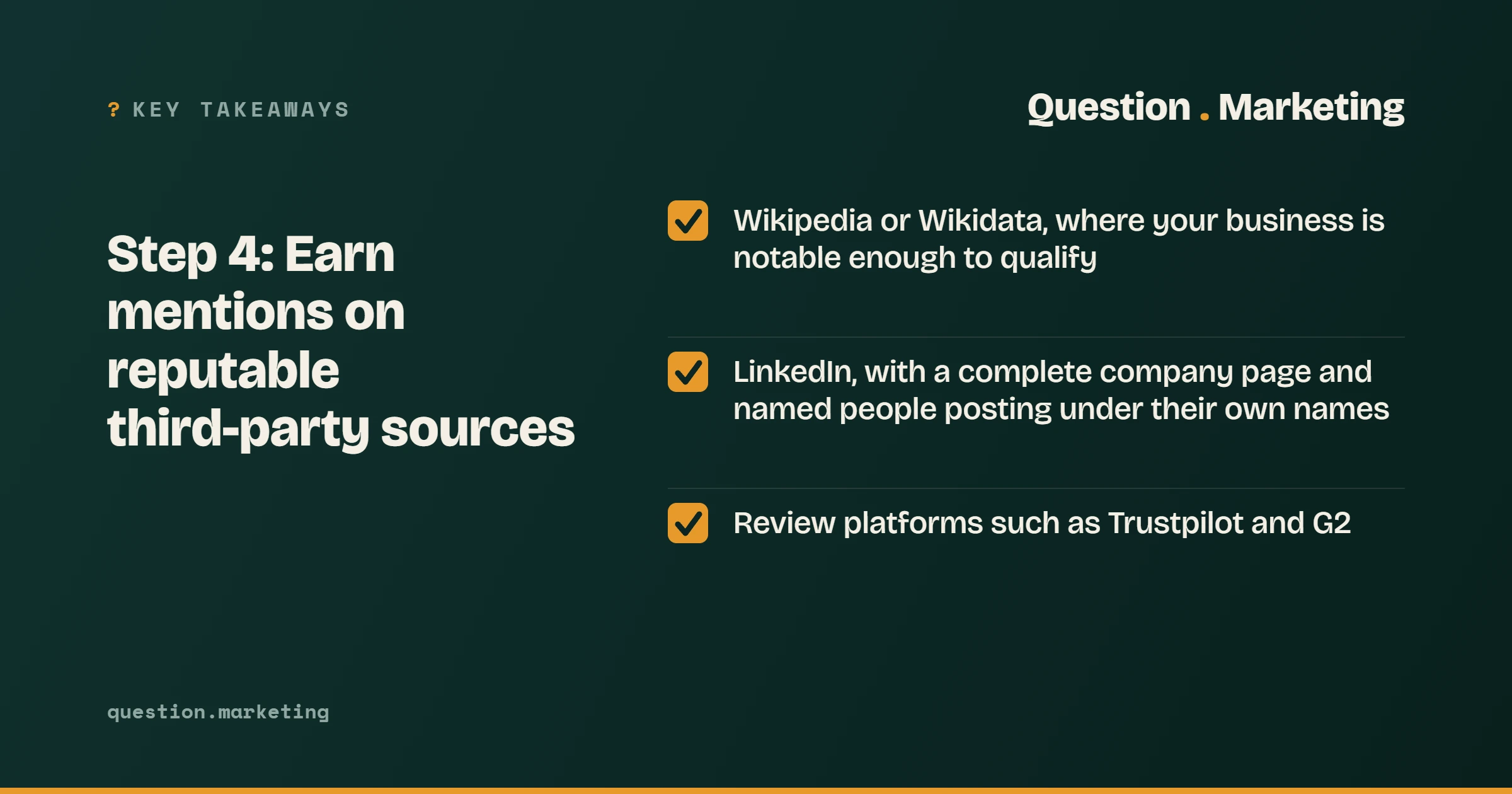
Step 4: Earn mentions on reputable third-party sources
Brand mentions across the web matter more than backlinks. Ahrefs, studying 75,000 brands, found a 0.664 correlation for branded mentions versus 0.218 for backlinks.
Work through the sources models are known to draw on:
- Wikipedia or Wikidata, where your business is notable enough to qualify. ChatGPT works mainly with Wikipedia among other sources.
- LinkedIn, with a complete company page and named people posting under their own names.
- Review platforms such as Trustpilot and G2. When a model finds your content, it wants to check its validity, and review sites are part of that check.
- Industry directories, press and professional bodies, which corroborate the facts on your own site.
Third-party corroboration also helps with a core problem. Where many sources give different answers to the same question, there is no single source of truth, and to be ranked in the answer engines you need to become that single source.
Step 5: Publish original knowledge that only you have
AI engines want what is inside your head. Digitise your knowledge, build a knowledge base, and publish it in your own voice.
Original, proprietary knowledge earns AI citations. AI-generated derivative content does not. The Princeton GEO paper found information gain drives citation, but the C-SEO Bench results show the effect is smaller and more variable than the original paper suggested, so treat it as a lever and not a guarantee. Many AI engines are also working to filter out AI-generated content, because that content is scraped from other AI sources. Content with unique statistics and a distinct perspective reaches further.
Step 6: Measure whether it is working
Measure with a fixed method, because a single check proves nothing. A single check carries ±9 to 13 points of noise. Our own approach uses around 1,500 sampled answers per source per cycle, 30 prompts and Wilson confidence intervals, with a published margin of error of roughly ±1 to 2 points.
Use the same defined prompts every cycle, across every engine, and keep screenshot evidence of where you appear and who appears instead. To tie visibility to enquiries, add a "How did you hear about us?" field that lists the individual AI engines. State every baseline with its figure, period and margin.
Tips and best practices
- Spread your presence across several platforms. A strategy built on one platform can disappear in weeks, as the Reddit shift showed.
- Treat the citation as the end of the process, not the start. Seer Interactive's testing of 362,388 responses found models recommend before they cite: "the citation is the bibliography, not the brainstorm".
- Skip llms.txt as a priority. A 2026 synthesis by Cyrus Shepard scores it 2.0 out of 10: "It doesn't hurt. It isn't a service".
- Do not use black hat tactics such as spinning articles or farming content across hundreds of sites. AI engines are moving to clean up the web, and they want unique new knowledge instead.
- Do not expect guarantees. Citation behaviour varies by platform and changes quickly.
Troubleshooting
- A model describes you vaguely. Look for contradictions in your name, address, people or claims across sources, and align them.
- Your content is never cited. Check the firewall first, then move the answer into the top third of the page.
- Your videos are not surfacing. Publish the transcript on your own domain as well as the platform.
Summary
You cannot place your business in training data directly, so build the evidence models learn from and retrieve. Remove crawler blocks, make your own site answer-first, keep every description of your business consistent, earn mentions on reputable third-party sources, and publish knowledge that only you hold. Then measure with a fixed method so you can see where you are named and where you are not.
For the bigger picture, read what answer engine optimisation is.