Insight
How important are third-party mentions for AI recommendations?
AI engines prefer answers they can corroborate. A business described only on its own website is a weaker candidate than one that other sources mention too, and that gap shapes who gets named when someone asks ChatGPT, Gemini or Perplexity for a recommendation. Third-party mentions tell the model that other people agree with how you describe yourself.
We run this discipline on ourselves and on client work, so what follows is how corroboration works in practice, what the evidence says about its weight, and what you can do about it.
Third-party mentions carry more weight than backlinks
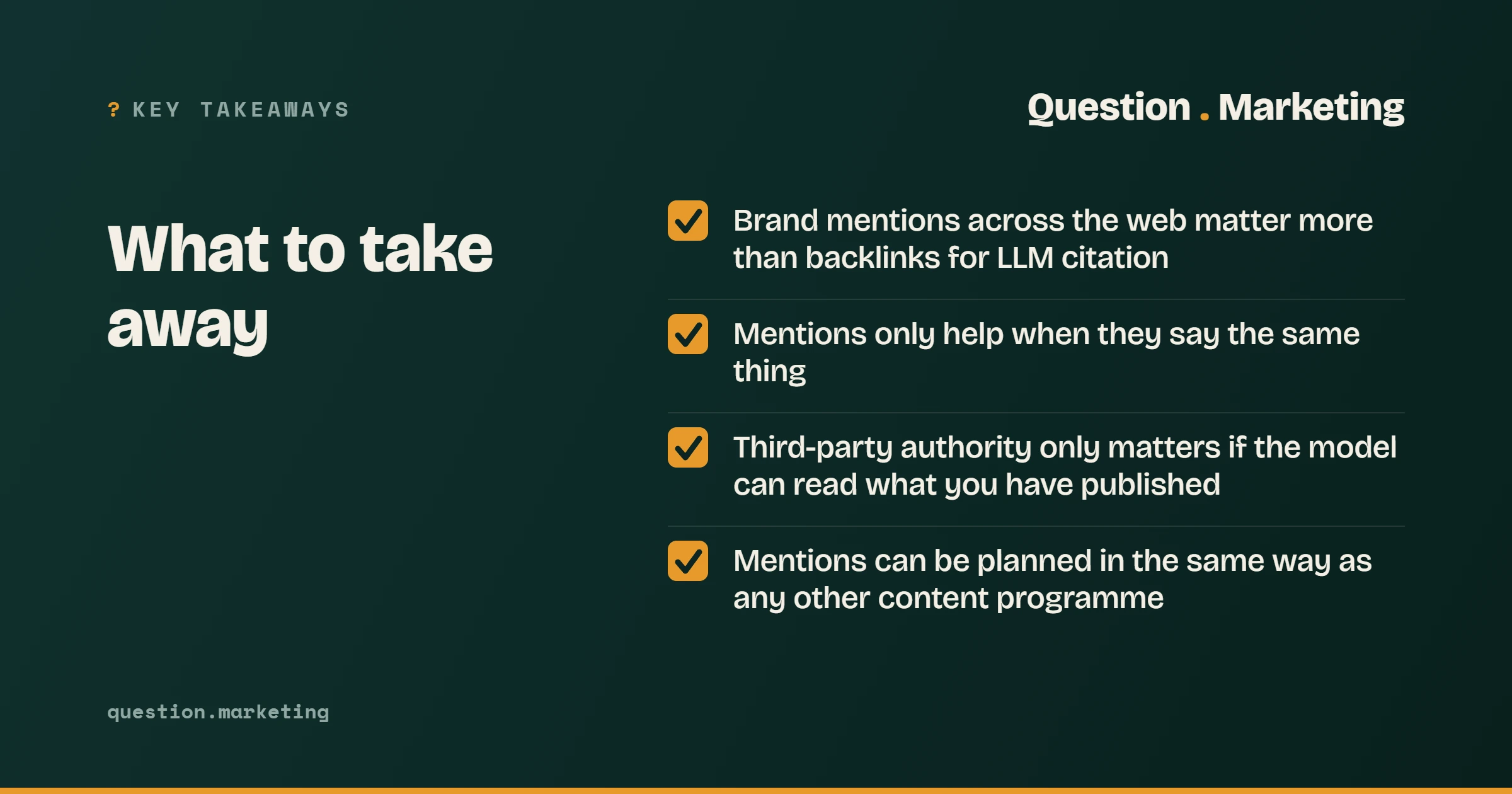
Brand mentions across the web matter more than backlinks for LLM citation. Ahrefs analysed 75,000 brands and found a 0.664 correlation for branded mentions versus 0.218 for backlinks. A correlation is not proof of cause, but the size of the gap is hard to ignore if your current strategy leans on link building.
The practical reading is that a model forming an opinion about your business looks for the same claims repeated in places you do not control. A link tells a crawler that one page points at another. A mention tells the model that a person or publication talked about you in their own words.
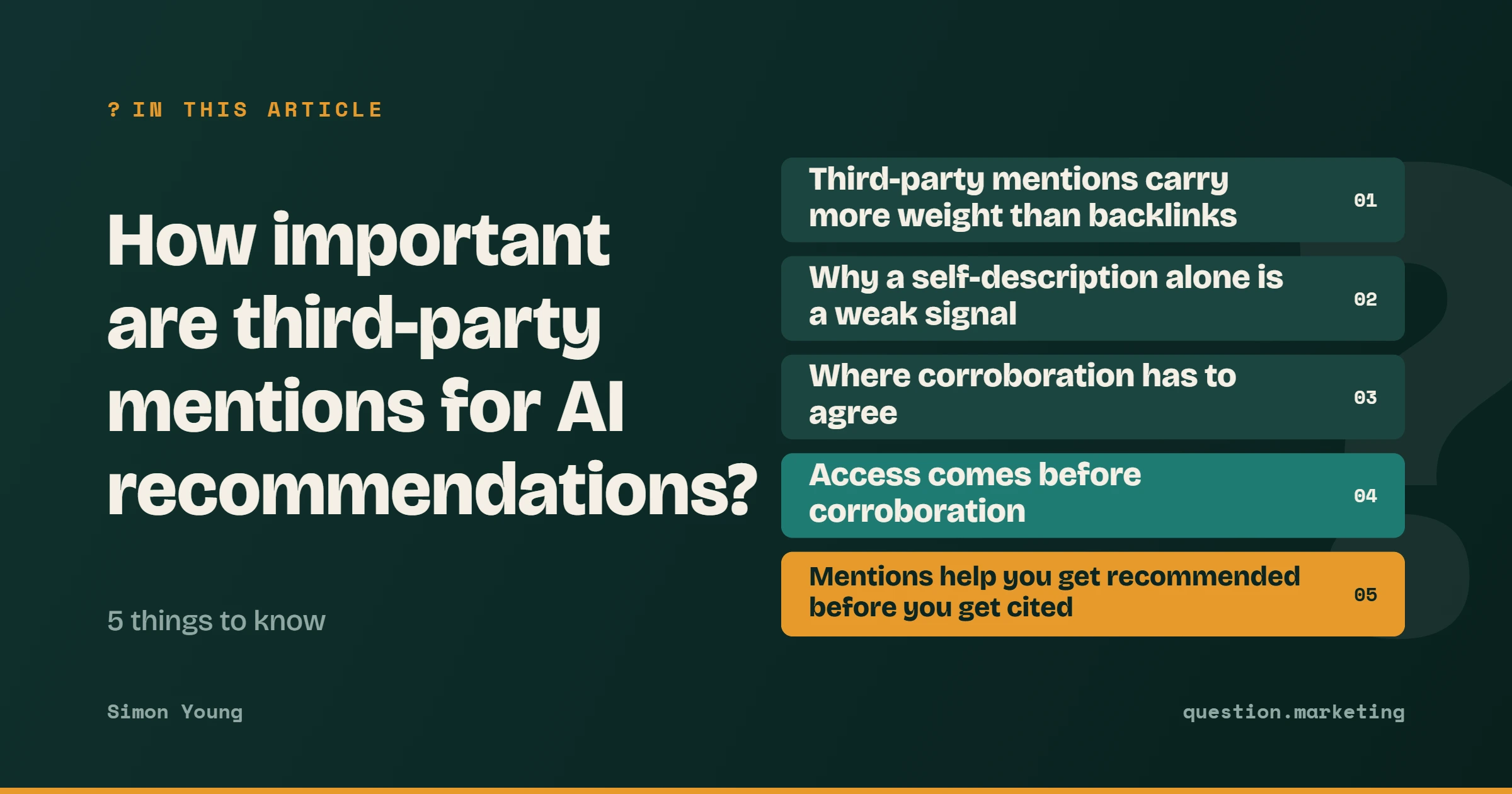
Why a self-description alone is a weak signal
Anything you publish on your own domain is, from the model's point of view, a claim made by an interested party. The trust layer of answer engines is built on a question: can this content be trusted and cited? That trust is measured partly by whether you appear on other sites, and by whether people who receive the answer treat it as true and interact with it.
A business with a strong site and no outside footprint gives the model one voice to check against nothing. A business that appears in industry lists, local press, partner sites and forums gives it several voices that agree. When the model has to choose a name to put in an answer, the corroborated candidate is the safer pick.
Where corroboration has to agree
Mentions only help when they say the same thing. Name, address, registration details, people and claims must match everywhere a model can read them: your site, regulators, directories, review platforms, professional bodies and Companies House. Contradictions are the single most common reason a model stays vague about a provider.
That makes entity consistency the first job before any outreach. If your trading name differs between your website and a directory listing, or a partner site describes you with an outdated service line, new mentions will compound the confusion instead of resolving it.
Named people strengthen the signal
Models cite people as readily as brands, and in regulated sectors the named human carries most of the trust. A mention that names a real adviser, clinician or founder alongside the business gives the model a second entity to verify, which is why anonymous bylines are a poor investment.
Access comes before corroboration
Third-party authority only matters if the model can read what you have published. Cloudflare's default settings block AI crawlers, the default block has been active since July 2025, and defaults were tightened on 15 September 2026. Roughly 22% of web traffic sits behind Cloudflare, and content behind a WAF default-block is invisible to AI engines regardless of how well it is structured.
We treat this as the first binary check on any audit. Verify your own scope before repeating those figures, then confirm that the crawlers can reach your pages.
Mentions help you get recommended before you get cited
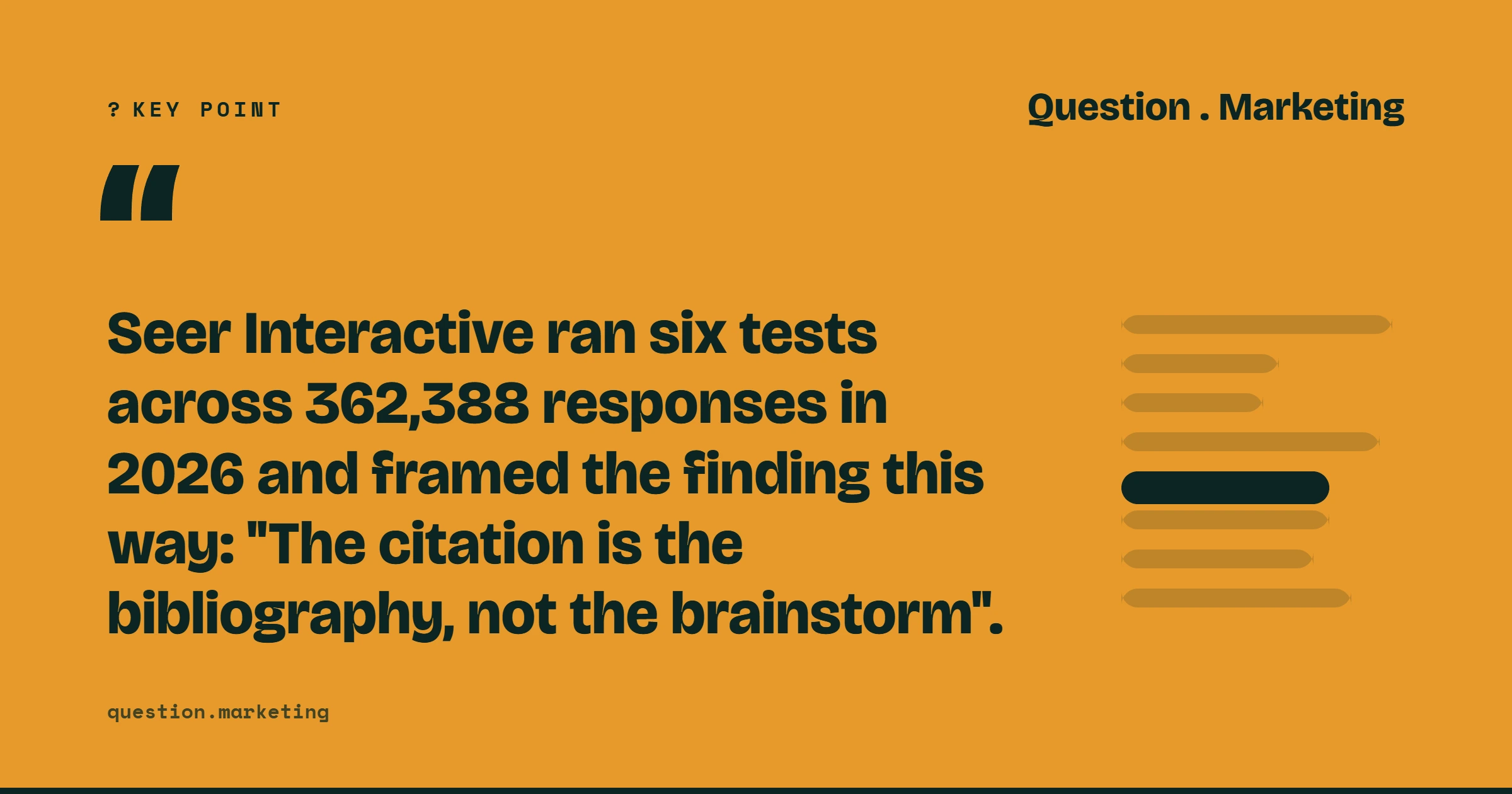
Seer Interactive ran six tests across 362,388 responses in 2026 and framed the finding this way: "The citation is the bibliography, not the brainstorm". The recommendation forms first, and the citation follows. That is where third-party mentions earn their place, because the model's sense of who belongs in a category is shaped by the wider web before it ever lists a source link.
Local search shows how steep the filter is. SOCi's 2026 study of more than 350,000 locations found 1.2% recommended by ChatGPT versus 35.9% appearing in Google's 3-pack. Appearing in the traditional results does not carry over automatically, so you have to earn a place in the model's view of your category.
Putting corroboration to work
Mentions can be planned in the same way as any other content programme. We are running one on ourselves, and the live September 2026 campaign shows the shape of it.
Pick routes that others can verify
Our agreed priority routes are a mention on a relevant partner domain, podcast guesting, a no-ask courtesy message to Jason Barnard, who is credited on our receipts page as the coiner of AEO, and regional press. Each route puts our claims in someone else's words on someone else's domain.
Work from a tiered target list
We hold a 20-show tiered podcast target list, and the first batch of eight personalised pitches is drafted. Tiering keeps effort proportionate and keeps each pitch specific to the show.
Give outsiders something worth citing
We wrote a source article, "Who was talking about answer engines before ChatGPT?", for Jason Barnard and for GEOforge, and it is awaiting publication on their site. A dated record of this kind needs third-party mentions to carry weight with the machines. Original, proprietary knowledge is what other people want to reference, and it earns citations where AI-generated derivative content does not.
Measuring whether mentions are working
One screenshot proves nothing. A single check carries a margin of roughly ±9 to 13 points, which is why we sample around 1,500 answers per source per cycle across 30 prompts, use Wilson confidence intervals and publish a margin of error of roughly ±1 to 2 points. The measurement language is share of voice, prompts won and "cited as the source". There is no AI ranking position, only being named or not.
We apply the same method to our own name, with a monthly tracker of 22 defined prompts across claim, entity, shortlist, education and clinical categories, screenshot evidence and first-answer counts. Baseline cycle 0 ran on 7 September 2026, and our priority engines are ChatGPT, Google AI and Perplexity. Every report uses the same prompts each cycle, so any movement after a new mention lands can be read against a stable baseline.
Add a "How did you hear about us?" field to your enquiry form, with the individual AI engines listed, so referrals from answers can be traced to the people who asked.
Testing a supplier's view on third-party authority
When you assess an AEO supplier, ask whether they say third-party authority does not matter. That answer usually comes from a supplier who cannot do the work. The same list asks them to explain the difference between AEO and GEO and to produce screenshot evidence of multi-LLM citation tracking against a defined prompt set.
What to do next
Start with consistency, then access, then outreach. Align your name, registration details and claims across every directory and profile, confirm that AI crawlers can reach your content, and build a short list of outside sites and shows where your expertise belongs. If you want a baseline of where you are named today and who appears instead, we run that measurement with screenshot evidence, and we can show you the figure, the period and the margin before any work begins.
For the bigger picture, read what answer engine optimisation is.