FAQ
Is AEO only relevant to big brands?
Answer engine optimisation (AEO) is not reserved for big brands. AEO means getting your knowledge selected, quoted and attributed inside a machine-generated answer rather than getting a link ranked on a page of links. This FAQ covers what that means for a smaller or specialist business, and what actually decides who gets named.
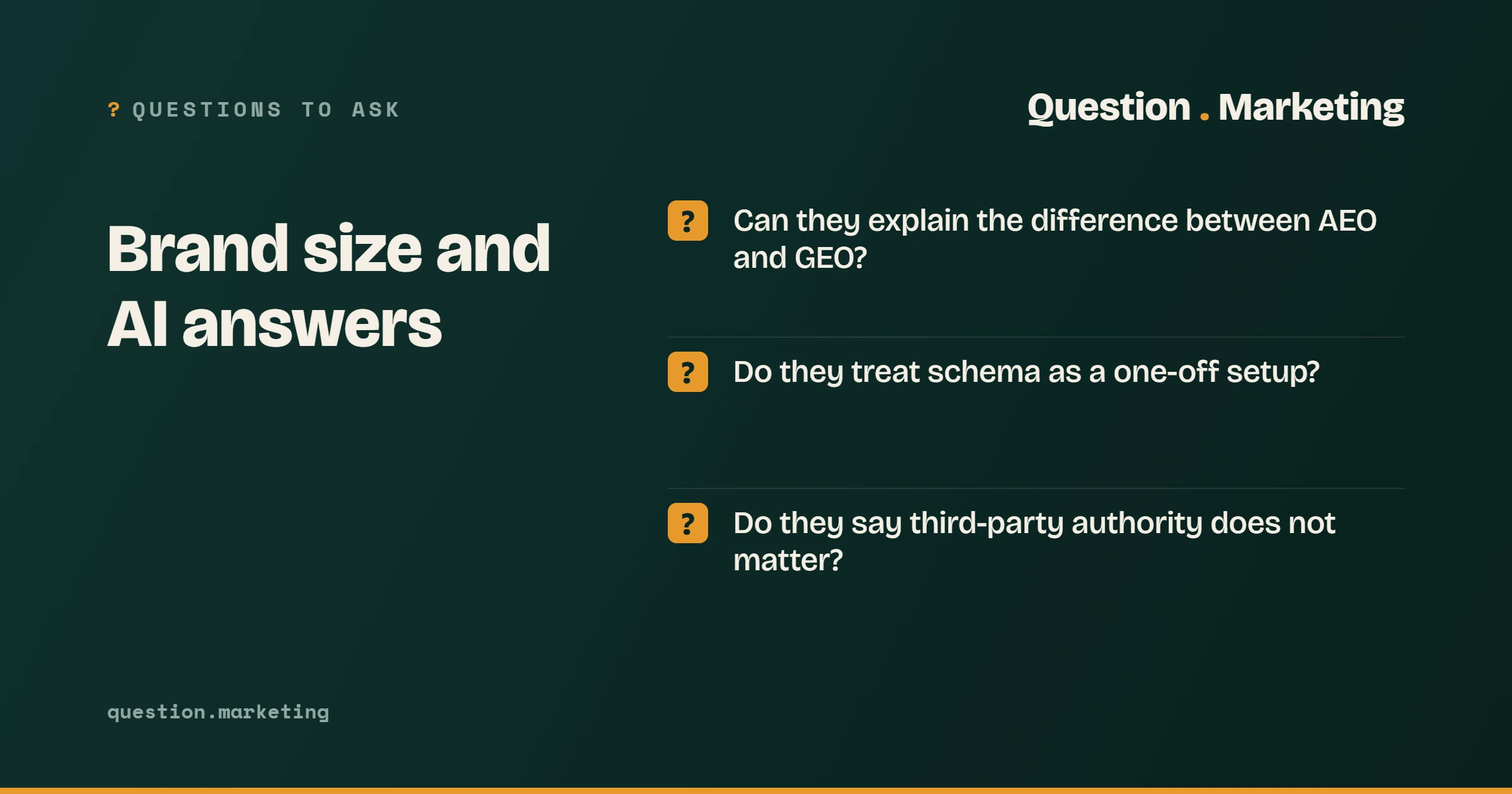
Brand size and AI answers
Brand size is a much weaker factor in answer engines than it was in traditional search, because the answer engine is matching a specific question to a specific answer. These questions cover where smaller firms stand.
Is AEO only relevant to big brands?
No. AEO is relevant to any business that can give a specific, well-structured answer to the questions its buyers ask. An exact answer will outrank a general answer. A niche specialist with a clearly defined service can therefore be named ahead of a larger generalist whose content stays broad.
Why can a small specialist beat a larger competitor in AI answers?
A small specialist can win because the competition happens at the level of the answer, not the page or the company. An answer engine can only answer from what it has, so it needs an exact answer to the exact prompt. A national brand with a general page on a topic loses to a specialist who has answered the precise question. We have also seen sites that are 10 to 15 years deep in SEO dominate niches while new competitors spring up with answers to questions nobody had built content for yet.
Do smaller firms with a defined service and location see results faster?
Smaller firms with a defined service and location are well placed to move quickly, because they can target very specific prompts. Take a specialist software recruiter in Manchester. A search for a very specific job title in Manchester is the kind of query where new content can fill a gap. This works like the long-tail keyword approach of the past: build content specifically for the question. We would not promise a timescale or an outcome, because citation behaviour varies by platform and over time.
What do I need to decide before I start?
You need to decide what you want to be found for, and it has to be specific. General queries such as "recruiter" or "recruitment agency" are too broad. Instead, decide on the exact prompts people type into AI tools when they are looking for you. Write those prompts down first, because every later content decision follows from them.
How should I structure content so a small site can compete?
Build a hub-and-spoke structure around one clear authority topic. The main question an AI user asks moves into sub-questions, and those sub-questions run separately below the authority question. In the recruitment example, a hub page on specialist software recruitment in Manchester sits at the centre. Around it sit 50 job-title pages, all linked back to the hub. Structuring that content properly matters, and many traditional SEO providers do not know how to do it.
Does it matter that the content is unique?
Yes, uniqueness matters more than volume. We argue that publishing original, proprietary knowledge earns AI citations, while AI-generated derivative content does not. You have to give something to the knowledge base that makes a difference. A small firm usually holds exactly this kind of knowledge: real case experience, local detail and specialist know-how that a large generalist does not publish.
Is there a technical barrier that applies to every brand, whatever its size?
Yes, your content has to be accessible to AI crawlers. Many websites use Cloudflare, and by default the AI crawlers do not access content behind it. You need to set it to allow AI crawlers onto your site, otherwise you will never get listed. This check costs a small business nothing and removes the most basic barrier.
Why does being named in an AI answer matter commercially?
People who arrive after being named in an AI answer are better qualified. They have often asked two or three questions and been pre-qualified before they reach you. We are finding that these visitors convert four or five times more efficiently than people who reach a website through traditional search. That is a pattern we observe in our own work rather than a guarantee for your business.
Is AEO just SEO under a new name?
No. AEO is a distinct discipline, and SEO comes as a consequence of doing the work properly. The traditional SEO playbook of keyword density, backlink churn and monthly rank reports is what is finishing, not rankings themselves. AEO and GEO produce rankings as a by-product. Within that, AEO is the primary term: building the marketing for the LLM and AI-search world and being the trusted answer inside the chat window. GEO is the mechanics that got you into that space.
What should I ask before hiring anyone to do AEO for me?
Ask five questions of any AEO supplier:
- Can they explain the difference between AEO and GEO?
- Can they produce screenshot evidence of multi-LLM citation tracking against a defined prompt set?
- Do they treat schema as a one-off setup? That answer is wrong.
- Do they say third-party authority does not matter? Usually that is because they cannot do it.
- In regulated sectors, will they publish claims with no named clinician or adviser, no review date and no regard for the regulator's advertising rules?
A small business has the most to lose from a supplier who cannot answer these, because there is less budget to waste.
What is the first practical step for a smaller firm?
Pick one service in one location and write down the exact questions your buyers ask. Check that AI crawlers can reach your site. Then answer each question with specific, original content, structured around a single hub page. Measure progress against a defined set of prompts across the engines you care about, such as ChatGPT, Google AI and Perplexity.
For the bigger picture, read what answer engine optimisation is.