FAQ
Does author expertise affect whether AI engines cite content?
Author expertise affects AI citation, but it works as one trust signal among several, not as a switch. This FAQ covers what the evidence in our work supports about named people, entity consistency, and the trust layer that decides whether an answer engine cites you or stays vague about you.
Authorship and citation
Does author expertise affect whether AI engines cite content?
Yes, named expertise is one of the levers that earns citations. Models cite people as readily as they cite brands, and in regulated sectors the named human carries most of the trust. We treat an expert byline as part of a wider trust package rather than a standalone fix, because trust is measured by whether your answer is also found on other sites and whether people interact with it and ask follow-up questions on the same subject.
Why do named authors beat anonymous bylines?
Named authors beat anonymous bylines because an answer engine can attribute a claim to a person it can recognise. We advise against anonymous or "admin" bylines for this reason. A named person gives the model something concrete to connect to a topic, which an anonymous byline does not.
Does authorship matter more in regulated sectors?
It matters most where the cost of a wrong answer is highest. In regulated sectors the named human carries most of the trust. When we assess an AEO supplier, one of the five questions we ask is whether they will publish claims with no named clinician or adviser, no review date and no regard for the regulator's advertising rules.
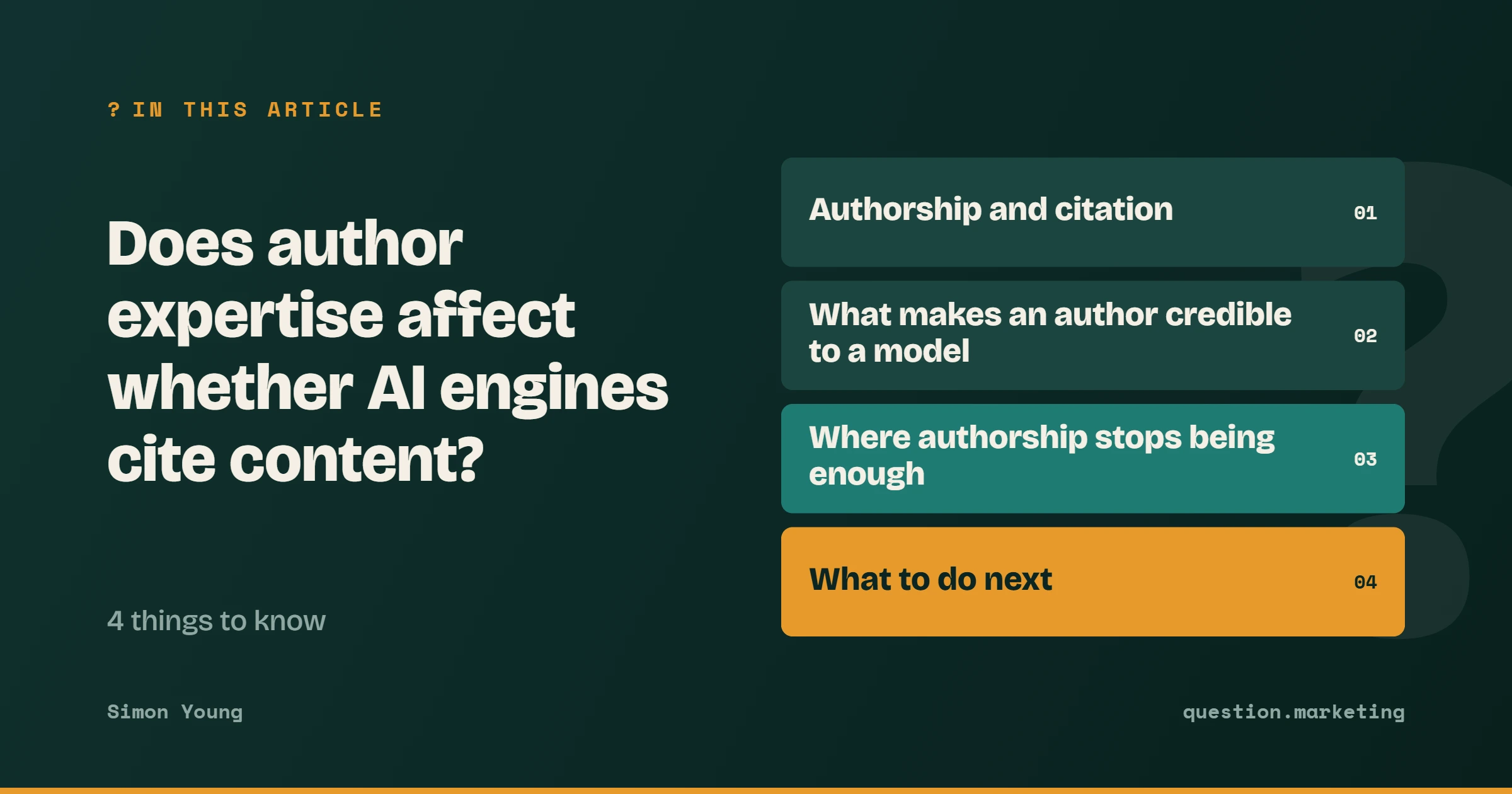
What makes an author credible to a model
What should an author profile contain?
Cover the fields a model can cross-check: name, role, registration details and the claims you make about them. Entity consistency means name, address, registration details, people and claims must say the same thing everywhere a model can read them. That includes your site, regulators, directories, review platforms, professional bodies and Companies House.
Why does consistency across sources matter so much?
Contradictions are the single most common reason a model stays vague about a provider. If your author's job title differs between your website and a professional directory, the model has conflicting evidence and hedges. Audit every place the author appears and make each entry match.
Do mentions on other websites help an author's credibility?
Yes. Brand mentions across the web matter more than backlinks, and Ahrefs data across 75,000 brands found a 0.664 correlation for branded mentions versus 0.218 for backlinks. Treat that as evidence that third-party corroboration of who you are carries weight. In practice, get your named experts mentioned and described consistently on sites you do not control.
Where authorship stops being enough
Can a strong author make up for weak content?
No. Original, proprietary knowledge earns AI citations, and AI-generated derivative content does not. The engines want unique and new knowledge, and they are moving to clean up AI-generated content because it is scraped from other AI sources. An expert name on a thin page is still a thin page. Put what is in the expert's head on paper, then publish it in their own voice.
Does authorship help if AI crawlers cannot reach the page?
It does not. Cloudflare's default settings block AI crawlers, and content behind a default WAF block is invisible to AI engines regardless of how well it is structured. Roughly 22% of web traffic sits behind Cloudflare. Checking crawler access is the first binary test in any audit, so run it before you invest in author profiles.
Where should the expert's answer appear on the page?
Put it at the top. Zyppy's 2025 analysis found that 44.2% of LLM citations come from the first 30% of a page. Lead each section with a complete standalone sentence that could be lifted out and quoted on its own. Your author's best claim belongs in that opening position.
Is the author's content cited, or just used for background?
Citation and recommendation are different events. Seer Interactive's six tests, covering 362,388 responses in 2026, support the line "the citation is the bibliography, not the brainstorm". A model may form its recommendation from many inputs and then cite a smaller set. Build the expert's presence across several sources, not just one page.
What to do next
How do I put this into practice?
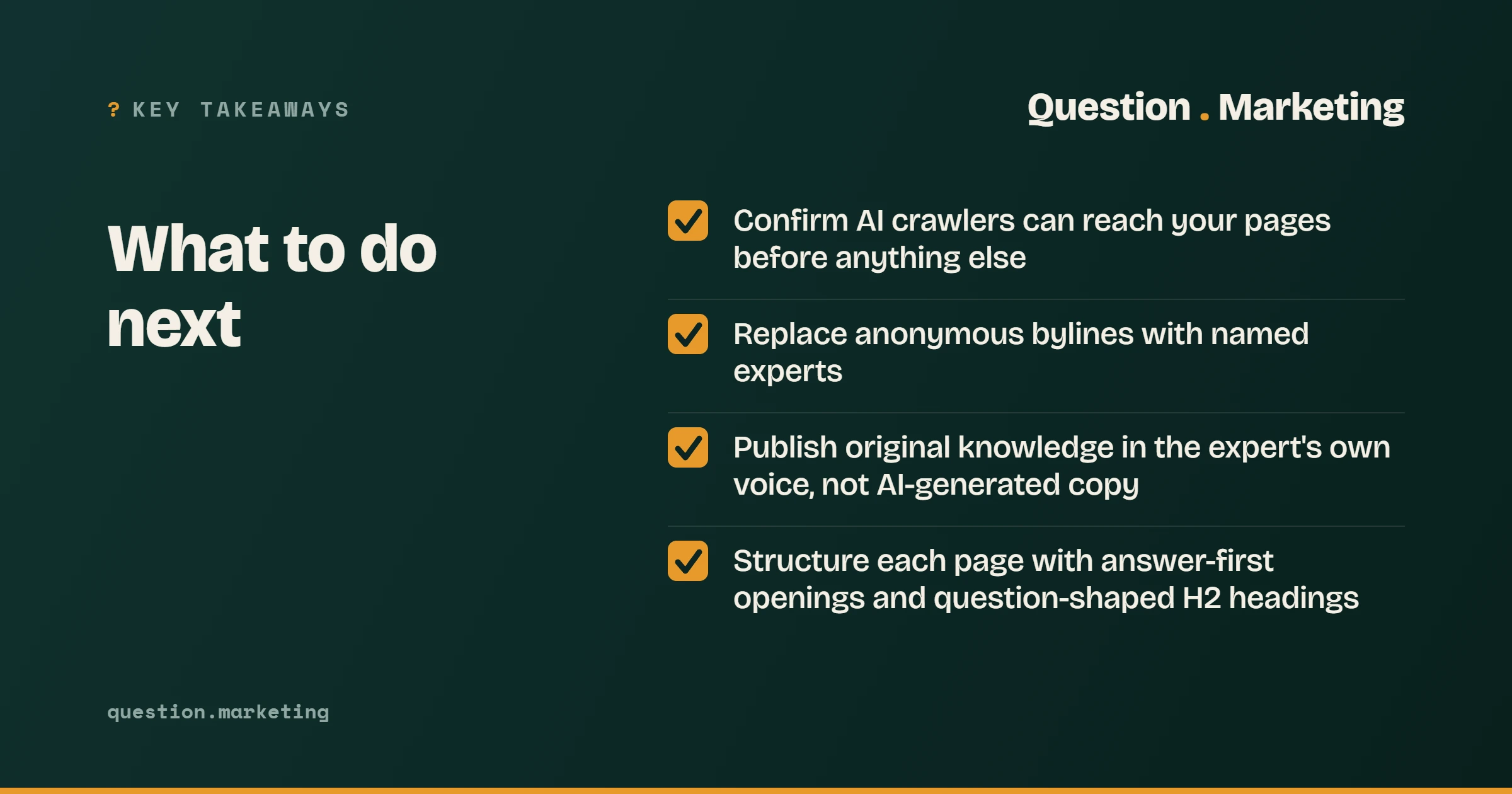
Work through these steps in order:
- Confirm AI crawlers can reach your pages before anything else.
- Replace anonymous bylines with named experts.
- Make each expert's name, role, registration details and claims identical across your site, regulators, directories, review platforms and professional bodies.
- Publish original knowledge in the expert's own voice, not AI-generated copy.
- Structure each page with answer-first openings and question-shaped H2 headings.
- Earn corroborating mentions of your named experts on third-party sites.
Can I guarantee AI engines will cite my experts?
No. Citation behaviour differs across engines and changes quickly. Until about a week before that recording, Reddit content was being cited quickly, and then several engines took less from it. We describe method and track record, not promised outcomes. Track results across a defined prompt set and the engines you care about, such as ChatGPT, Google AI and Perplexity.
For the full method, read how to get cited by AI answer engines.