How-to guide
How to find out which sources AI engines cite for your competitors
Finding out which sources AI engines cite for your competitors is a repeatable audit, not a guess. You run the prompts your buyers actually type, record every named brand and every cited link, then group those links by type. The groups show you where competitors earn their place in the answer and where you have no presence at all.
This guide walks through the full process. It assumes you want a defensible read of the evidence, not a screenshot you got lucky with.
Prerequisites
Before you start, have these ready:
- A list of 20 to 30 buyer prompts covering the questions prospects ask before they shortlist a supplier.
- Access to ChatGPT, Perplexity and Google AI Overviews. These are the priority engines we track.
- A spreadsheet with one row per prompt per engine, and columns for brands named, cited links and source type.
- A place to store screenshots, because every finding needs evidence of where a brand appeared and who appeared instead.
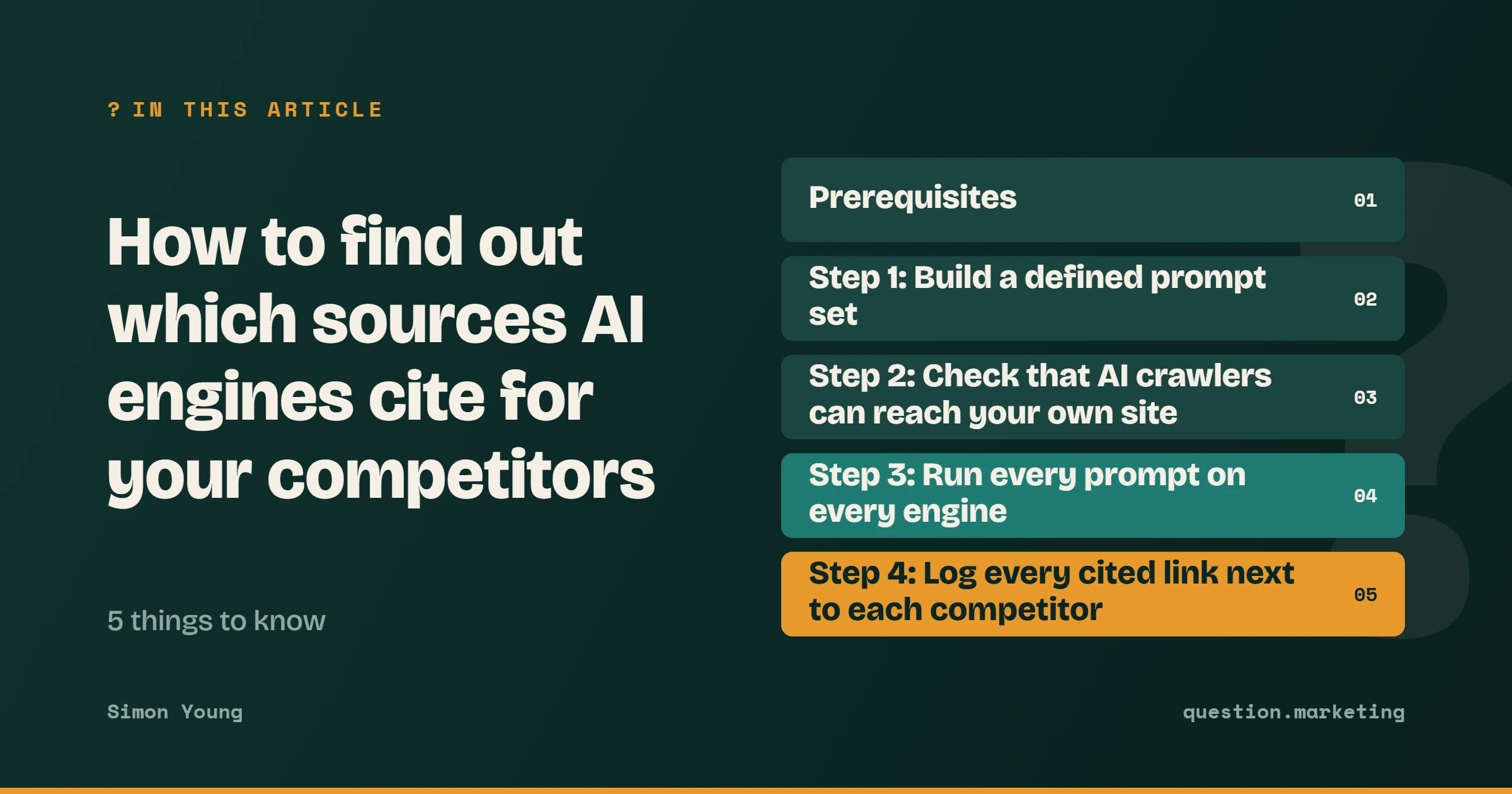
Step 1: Build a defined prompt set
Start by writing down the prompts you will test, then do not change them. A defined prompt set means every cycle asks the same questions, so results are comparable over time.
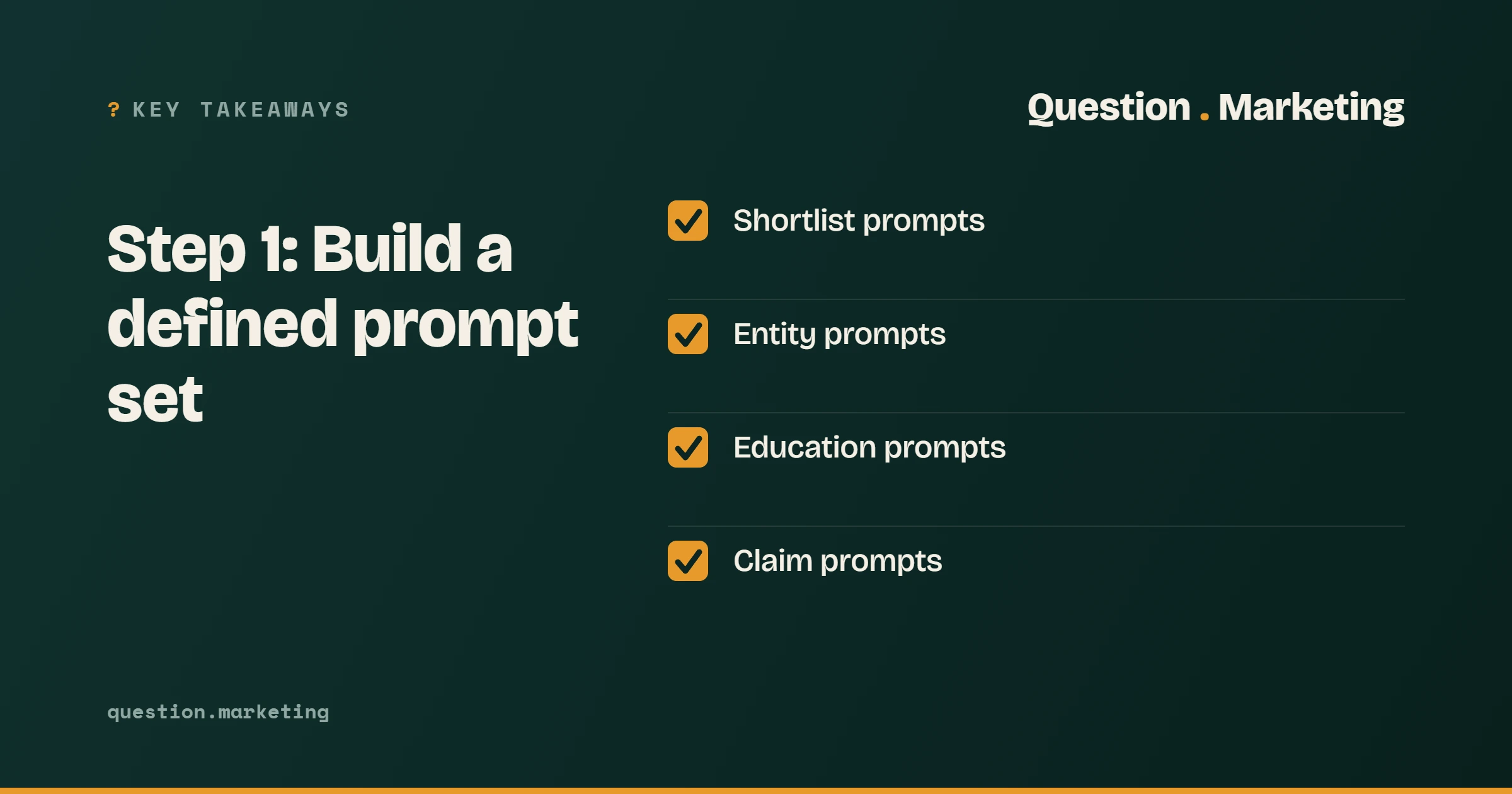
Cover different intents so you see different citation behaviour. Our own tracker uses 22 defined prompts across claim, entity, shortlist, education and clinical categories. You can borrow that structure for your sector:
- Shortlist prompts: "best [your service] for [your buyer type]"
- Entity prompts: "what is [your competitor] and what do they do"
- Education prompts: "how do I choose a [your category] supplier"
- Claim prompts: the specific claims buyers want verified, such as results, accreditation or pricing
The prompt that started this investigation, "Why does ChatGPT recommend my competitors but not my business?", belongs in the set too. It tells you how the engine frames the gap in its own words.
Step 2: Check that AI crawlers can reach your own site
Before you study competitors, confirm the problem is not on your side. Cloudflare's default settings block AI crawlers, and content behind a default block is invisible to AI engines regardless of how well it is structured. Roughly 22% of web traffic sits behind Cloudflare.
This is the first binary check on any audit. If your site blocks AI crawlers, no amount of competitor analysis will fix your absence from the answers.
Step 3: Run every prompt on every engine
Now run the full prompt set on ChatGPT, Perplexity and Google AI Overviews. For each answer, record:
- Which brands are named, and in what order
- Whether your business appears at all
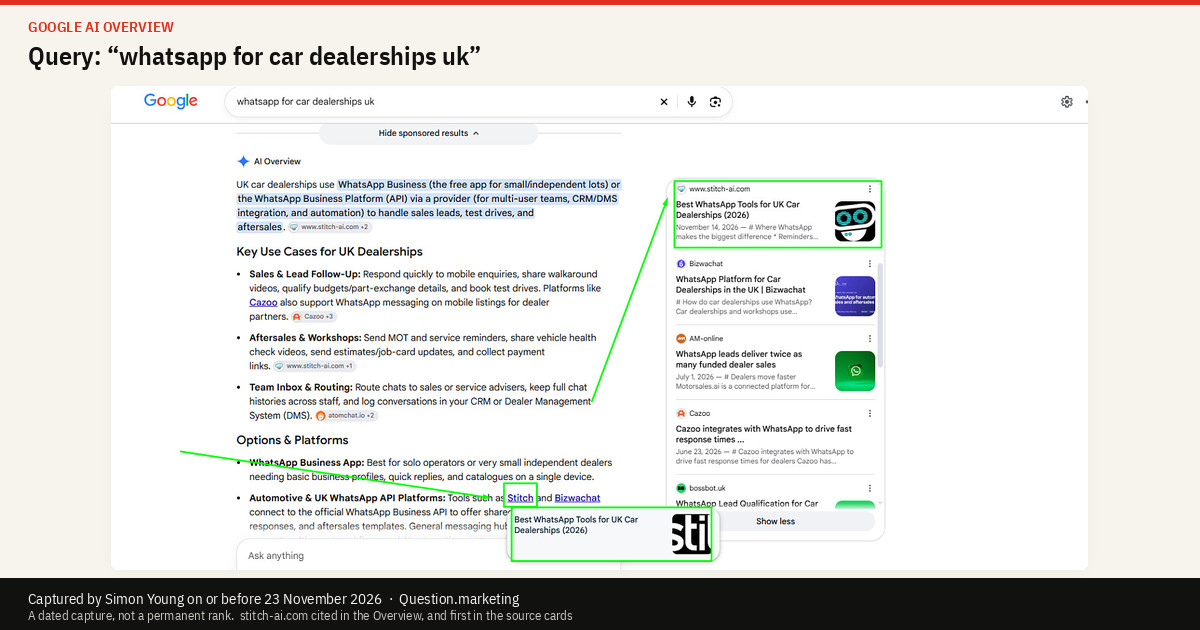
- Every cited link or source the engine shows
- A screenshot of the full answer
A single check proves nothing. One run carries a margin of roughly ±9 to 13 points, which is why one screenshot can never settle the question. Repeat each prompt several times and log every run. For a rigorous baseline, our own method samples around 1,500 answers per source per cycle across 30 prompts, with Wilson confidence intervals and a published margin of error of roughly ±1 to 2 points. You will not match that volume by hand, so state your sample size and treat small differences as noise.
Note the engines differ from each other. What gets cited varies across them, and the behaviour shifts quickly. Reddit-heavy tactics that produced fast citations a few weeks before our recording became far less reliable as some engines reduced how much they draw from it. Log the date of every run so you know which results are current.
Step 4: Log every cited link next to each competitor
Create a second sheet where each row is one cited link. Record:
- The competitor it supported
- The prompt and engine that produced it
- The full URL and domain
- The page title or a short description
Capture links whether or not they point to the competitor's own site. Many of the most useful findings are third-party pages that mention the competitor, because those show where you need to earn coverage. Mentions of a brand across the web matter more than backlinks: in an Ahrefs study of 75,000 brands, branded mentions correlated at 0.664 with AI visibility against 0.218 for backlinks.
Step 5: Group the sources by type
Sort every logged link into a small number of categories. These four cover most of what you will see:
- Reviews: review platforms and comparison sites
- Directories: professional bodies, regulator registers, listings and industry directories
- Articles: editorial coverage, industry publications and expert write-ups
- Forums: community threads and discussion sites
Add an "own site" category for competitor-owned pages, and an "other" category for anything that does not fit.
Then count. For each competitor, work out what share of their citations falls into each type. The pattern is the finding. If a competitor's citations cluster in directories and professional bodies, the engines are reading entity information from those registers. If they cluster in articles, the competitor has earned third-party editorial corroboration. Those source types show you exactly where you need to earn coverage.
Step 6: Compare against your own presence
Take each source type and check whether you appear in it. For every high-frequency source a competitor has, ask three questions:
- Are we listed or mentioned there at all?
- Does the listing carry the same name, address, registration details, people and claims as our own site?
- Is the information current?
Entity consistency across sources is a major factor here. Your name, registration details, people and claims must say the same thing everywhere a model can read them, including your site, regulators, directories, review platforms, professional bodies and Companies House. Contradictions are the single most common reason a model stays vague about a provider.
Step 7: Check what your competitors' cited pages do well
Open the pages that earn citations and study their structure. LLMs retrieve and cite content structured as self-contained, answer-first passages with complete standalone opening sentences. Look for:
- Question-shaped headings that match what the reader typed
- A complete, quotable sentence directly under each heading
- Named people rather than anonymous bylines
- Full transcripts of video or audio on a domain the brand controls
Position on the page matters too. A Zyppy 2025 study found 44.2% of LLM citations come from the first 30% of a page. Note where on the page the cited passage sits.
Step 8: Turn the findings into a coverage plan
List the source types where competitors appear and you do not, ranked by how often they were cited. That ranked list is your plan. For each gap, decide the action:
- Reviews and directories: claim, complete and correct your listings so they match your site exactly
- Articles: publish original, proprietary knowledge that other sites have reason to reference
- Forums: take part where real buyers ask the questions, with named, useful answers
Original knowledge earns citations. AI-generated derivative content does not. The engines want unique information drawn from what is in your head, digitised and structured so they can read it.
Tips and best practices
- Repeat the audit on a schedule. Run the same prompts every cycle, on every engine, so changes are visible. Our own tracker runs monthly, with its baseline cycle on 7 September 2026.
- State the figure, the period and the margin. A baseline without all three is not a baseline.
- Use the right measurement language. There is no "AI ranking position". The measures are share of voice, prompts won and being cited as the source. You are named, or you are not.
- Add attribution tracking. Put a "How did you hear about us?" field on enquiry forms and list the individual AI engines as options.
- Treat tools as support, not proof. Plenty of monitoring tools exist and the category is young. Semrush, Ahrefs and Google Search Console give some indication of AI sessions, but measurement is still in its infancy.
Troubleshooting
Your answers differ every time you run a prompt. This is expected. One check carries ±9 to 13 points of noise, so rely on repeated runs and a stated margin, not any single result.
No competitor links appear in the answer. Some answers name brands without showing links. Log the brand mentions anyway, then run follow-up prompts that ask where the information comes from.
A competitor is named but you cannot find why. Check the entity layer first. Inconsistent details across your own listings are a common cause of a model staying vague about a provider.
Your pages are well structured but never cited. Return to Step 2. A crawler block makes even well-structured content invisible.
Summary
To find which sources AI engines cite for your competitors, run a fixed prompt set across ChatGPT, Perplexity and Google AI Overviews, log every named brand and cited link with screenshot evidence, and group the links into reviews, directories, articles and forums. The groups show where competitors earn their place in the answer and where you need to build coverage. Repeat the audit every cycle with the same prompts, state your sample size and margin, and let the pattern in the sources direct your work.
For the bigger picture, read what answer engine optimisation is.