How-to guide
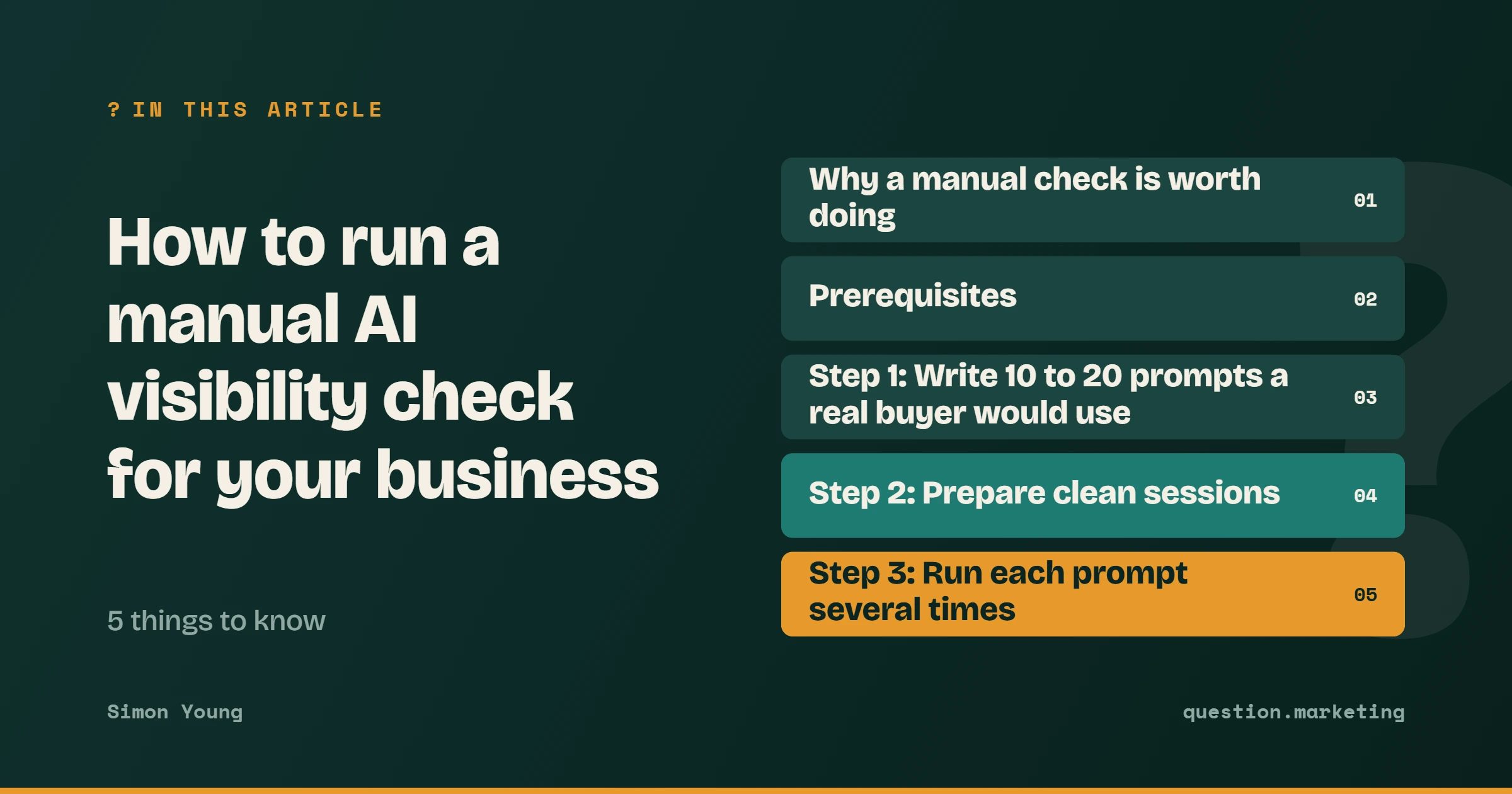
How to run a manual AI visibility check for your business

A manual AI visibility check is a repeatable test in which you ask answer engines the questions your buyers ask, record what comes back, and compare the results month to month. It tells you whether ChatGPT, Perplexity and Google AI name your business, how they describe you and who they name instead. This guide walks through the process we use, scaled down so one person can run it with a spreadsheet and a few hours.
Why a manual check is worth doing
Search did not die, but the click did. Google's AI Overviews now appear on roughly half of all queries, and around six in ten searches end without anyone visiting a website. Rankings can hold steady while sessions collapse, so a rank report no longer tells you whether prospects are seeing your name.
There is also no AI ranking position to check. There is being named, or not. A manual check measures exactly that.
Prerequisites
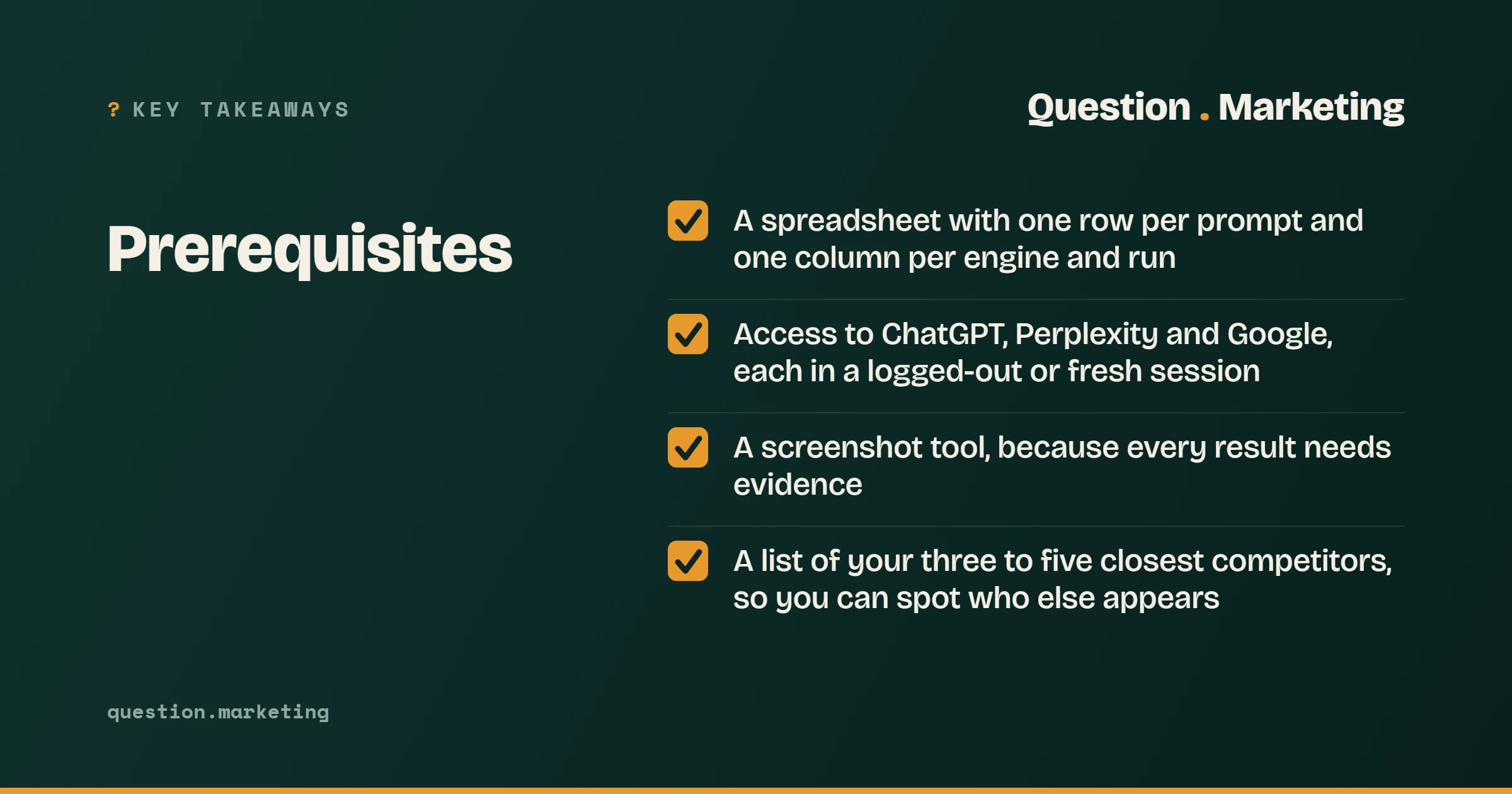
- A spreadsheet with one row per prompt and one column per engine and run.
- Access to ChatGPT, Perplexity and Google, each in a logged-out or fresh session.
- A screenshot tool, because every result needs evidence.
- A list of your three to five closest competitors, so you can spot who else appears.
- Two to three hours for the first cycle.
Step 1: Write 10 to 20 prompts a real buyer would use

Write the prompts the way a buyer types them, not the way your marketing team describes the service. Cover several categories rather than ten variations of one question. Our own tracker uses 22 defined prompts across claim, entity, shortlist, education and clinical categories. You can borrow that structure:
- Shortlist prompts: "Who are the best [service] providers in [location]?"
- Entity prompts: "What is [your business name] and what do they do?"
- Education prompts: the questions buyers ask before they know who to hire.
- Claim prompts: questions that test a specific claim you make about your business.
Lock the wording once you have written it. The same defined prompts must be used every cycle, otherwise you cannot compare one month with the next.
Step 2: Prepare clean sessions
Use a logged-out or fresh session for each engine so that your account history does not shape the answer. Open a new conversation for each prompt. Run the check in the same way each month, with the same browser setup and, where relevant, the same location.
Cover ChatGPT, Perplexity and Google AI first. These are the priority engines we track for our own business.
Step 3: Run each prompt several times
One run proves nothing. A single check carries a margin of roughly ±9 to 13 points, which is why one screenshot is not evidence. Answers vary from run to run, so run each prompt at least three to five times per engine and record every result.
Our formal reporting samples around 1,500 answers per source per cycle across 30 prompts, with Wilson confidence intervals and a published margin of error of roughly ±1 to 2 points. A manual check will not reach that precision. Treat your results as a directional read, and state that limitation whenever you share the numbers.
Step 4: Record what each answer says
For every run, log the same fields:
- Mentioned: is your business named in the answer text?
- Cited: is your website or another page about you listed as a source?
- Description: how does the engine describe you? Copy the wording exactly.
- Position: are you named first, or later in a list?
- Who else appears: which competitors, directories or publications are named instead of you?
Take a screenshot of every result. Every report we produce shows the same defined prompts, every cycle, every engine, with screenshot evidence of where the client appears and who appears instead. If you cannot show that, you are describing visibility, not measuring it.
Step 5: Turn the log into three numbers
Keep the scoring simple:
- Prompts won: the number of prompts where you were named in the answer.
- Share of voice: how often you were named, out of all the runs you logged.
- Cited as the source: how often your own pages were listed as a source.
Share of voice, prompts won and "cited as the source" are the measurement language of this discipline. Record each figure with the period it covers and the margin of error, because a baseline without those is not a baseline.
Step 6: Repeat monthly with the same prompts
Schedule the check for the same point each month. Our own tracker runs monthly, and its baseline cycle 0 ran on 7 September 2026. Your first cycle is your baseline. Every later cycle is compared against it.
Only change the prompt set when you have a clear reason, and note the change in the log so the comparison stays honest.
Tips and best practices
- Check the technical gate first. Roughly 22% of web traffic sits behind Cloudflare, and content behind a WAF default-block is invisible to AI engines however well it is structured. This is the first binary check on any audit.
- Read the descriptions as closely as the mentions. Contradictions across your site, directories and regulators are the most common reason a model stays vague about a provider.
- Do not set expectations from referral traffic. AI referral traffic is still around 1% of total web traffic, growing roughly a point a month. Visibility inside the answer is the goal, not a traffic spike.
- Add an attribution question to your enquiry form. A "How did you hear about us?" field that lists individual AI engines is what lets you connect visibility to enquiries.
Troubleshooting
Your results change every time you run them. That is expected. It is the reason for repeated runs and for reporting a range rather than a single answer.
You never appear for shortlist prompts. Note which competitors, directories and publications are named instead. Brand mentions across the web carry more weight than backlinks, with Ahrefs finding a 0.664 correlation for branded mentions against 0.218 for backlinks across 75,000 brands. Those named third parties show you where corroboration is missing.
Local prompts return almost nothing. This is common. SOCi's 2026 study of more than 350,000 locations found 1.2% recommended by ChatGPT, against 35.9% appearing in Google's 3-pack.
Summary
Write 10 to 20 buyer prompts, run each several times in ChatGPT, Perplexity and Google AI using fresh sessions, and record whether you were mentioned, cited, how you were described and who else appeared. Score the log as prompts won, share of voice and cited-as-source, then repeat monthly with the same prompts. A manual check shows you where you stand. If it shows you are absent, the next job is changing the content and structure that earn a citation, and that is the work we do.
For the bigger picture, read what answer engine optimisation is.