FAQ
What signals does ChatGPT use when it recommends a company?
ChatGPT does not publish a ranked list of signals for recommending a company, so no single factor decides the outcome. What we can describe is what the research and our own audits show about which content gets retrieved, cited and named. The questions below cover those signals in the order they usually matter.
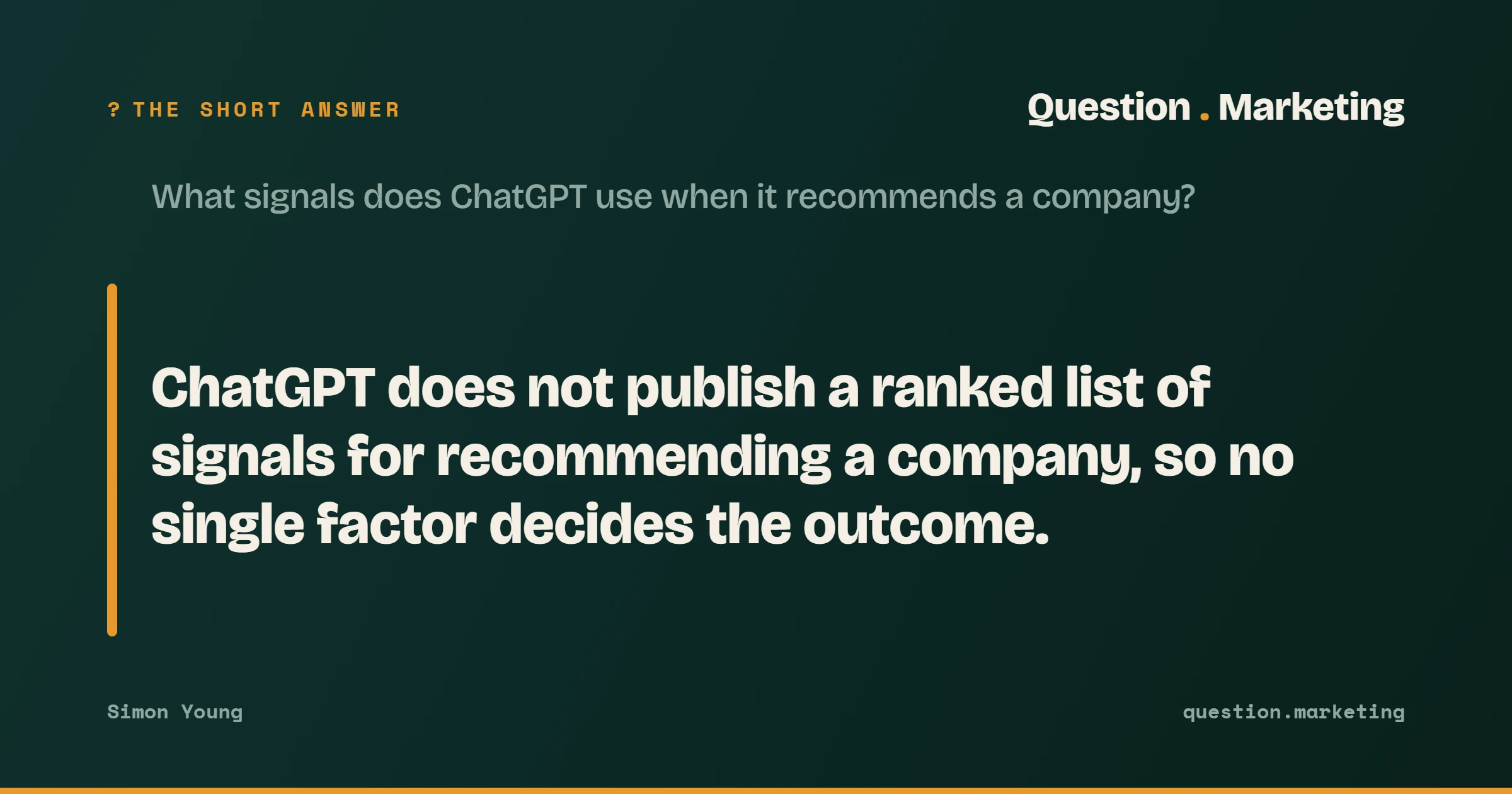
Can ChatGPT see your site at all?
Content that sits behind a default web application firewall block is invisible to AI engines, however well it is written. Cloudflare's default settings block AI crawlers, and roughly 22% of web traffic sits behind Cloudflare. Checking crawler access is the first binary test in any audit we run.
Which content gets retrieved and cited?
LLMs retrieve and cite content structured as self-contained, answer-first passages with complete, standalone opening sentences. The practical levers are a quotable sentence under every heading, question-shaped H2 headings, and full transcripts for video and audio on a domain you control.
Text is what models read, so a transcript page on your own domain does more for discoverability than metadata embedded in a video file.
Does it matter where the answer sits on the page?
Position on the page matters a great deal. Zyppy's 2025 research found that 44.2% of LLM citations come from the first 30% of a page. In practice, the first 60 words carry the weight. State the question as the heading and put the direct answer immediately beneath it.
Why does consistent information across sources matter?
Models stay vague about a provider when the sources contradict each other. Your name, address, registration details, people and claims need to say the same thing everywhere a model can read them: your site, regulators, directories, review platforms, professional bodies and Companies House. We find contradictions are the single most common reason a model hedges about a provider.
Do mentions on other sites count more than backlinks?
Brand mentions across the web matter more than backlinks. Ahrefs analysed 75,000 brands and found a 0.664 correlation for branded mentions against 0.218 for backlinks. Trust is also measured by whether a company appears on other sites and whether people interact with the answer and ask follow-up questions about it. Reviews, directories, comparison articles and press coverage all serve as this kind of third-party corroboration.
How specific does your content need to be?
An exact answer outranks a general one. "Recruitment agency" is too broad a target. The prompts worth winning are specific ones, such as software recruitment in Manchester for a particular job title. A main question then splits into sub-questions, so a hub page supported by detailed pages for each sub-topic builds the depth a model draws on.
Does it matter who wrote the content?
Models cite named people as readily as they cite brands. In regulated sectors the named human carries most of the trust, so anonymous bylines waste an opportunity.
Does original information help?
The Princeton GEO paper found that information gain, meaning knowledge the model cannot find elsewhere, drives citation. The C-SEO Bench results show the effect is smaller and more variable than the original paper suggested, so we always cite the two together. Our central argument is that publishing original, proprietary knowledge earns AI citations, while AI-generated derivative content does not.
Is ChatGPT's recommendation the same as its citation?
The two are separate steps. Seer Interactive ran six tests across 362,388 responses in 2026 and found that recommendations are formed before citations appear. In Seer's words, "the citation is the bibliography, not the brainstorm." Being cited is therefore evidence that you were already considered, which is why corroboration across the web matters before anyone clicks a link.
Does local presence guarantee a recommendation?
A strong local presence does not carry over automatically. SOCi's 2026 study of more than 350,000 locations found that ChatGPT recommended 1.2% of them, compared with 35.9% that appeared in Google's 3-pack. A local pack ranking is no proof that a model will name you.
Do schema or llms.txt files help?
Schema and embedded metadata support indexing, but they rank below text-based companion pages on domains you control. Cyrus Shepard's 2026 synthesis scores llms.txt at 2.0 out of 10: "It doesn't hurt. It isn't a service."
How do you find out whether ChatGPT recommends you?
A single check tells you almost nothing. One check carries a margin of ±9 to 13 points, which is why one screenshot proves nothing. Our method samples around 1,500 answers per source per cycle across 30 defined prompts, with Wilson confidence intervals and a published margin of error of roughly ±1 to 2 points. The useful measures are share of voice, prompts won, and being cited as the source. There is no AI ranking position, only being named or not.
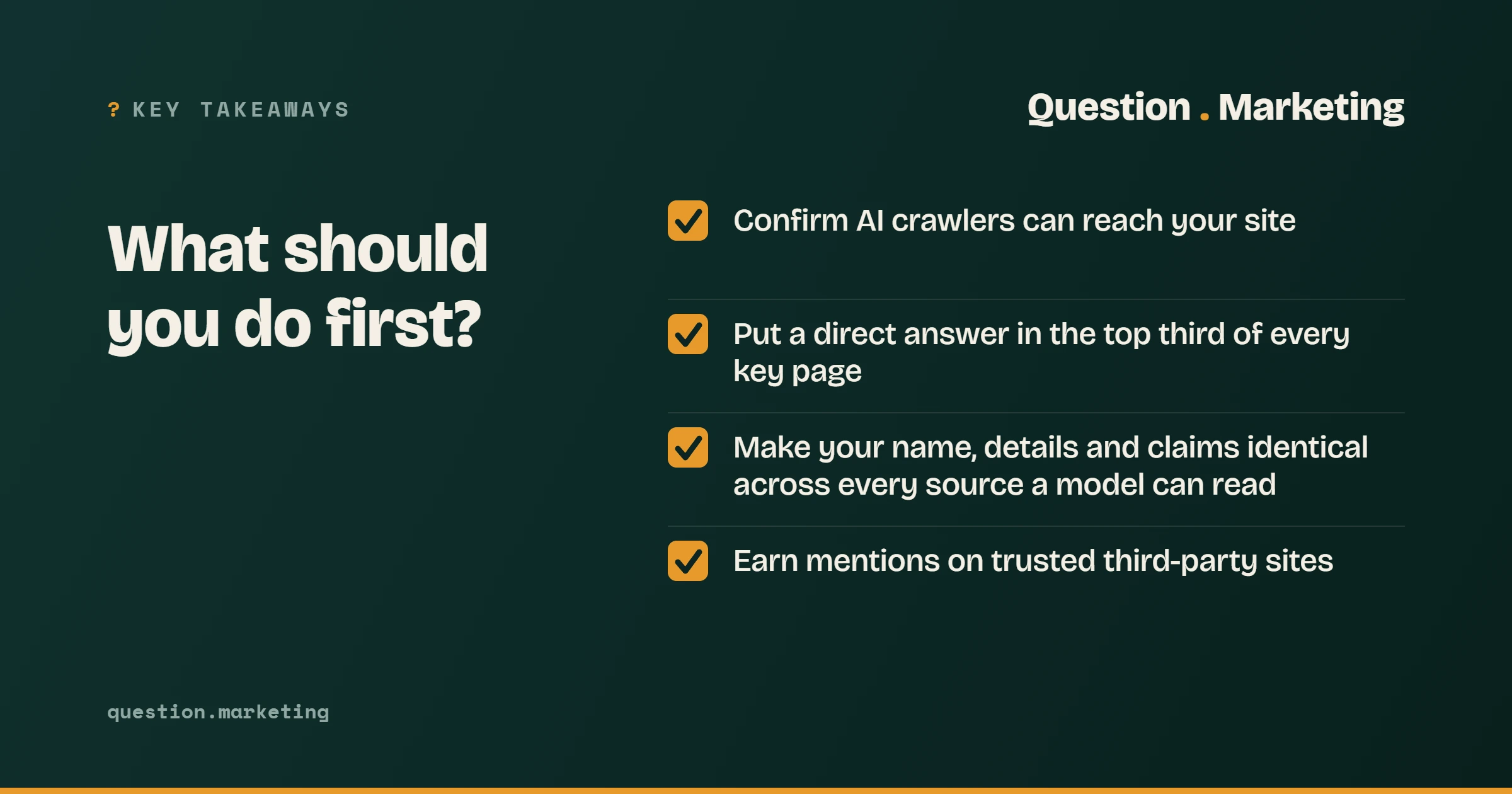
What should you do first?
Work through the signals in order:
- Confirm AI crawlers can reach your site.
- Put a direct answer in the top third of every key page.
- Make your name, details and claims identical across every source a model can read.
- Earn mentions on trusted third-party sites.
- Add a "How did you hear about us?" field that lists individual AI engines, so you can attribute enquiries.
- Measure the same defined prompts every cycle, with the figure, the period and the margin stated.
For the bigger picture, read what answer engine optimisation is.