FAQ
Which prompts should I test to see if AI recommends my business?
Testing whether AI recommends your business means running a fixed set of prompts that mirror how your buyers actually ask questions, then repeating that set on a schedule across several engines. Below we cover which prompt types to run, how to mix broad and specific wording, and how to read the results without fooling yourself with a single lucky or unlucky answer.
What to test
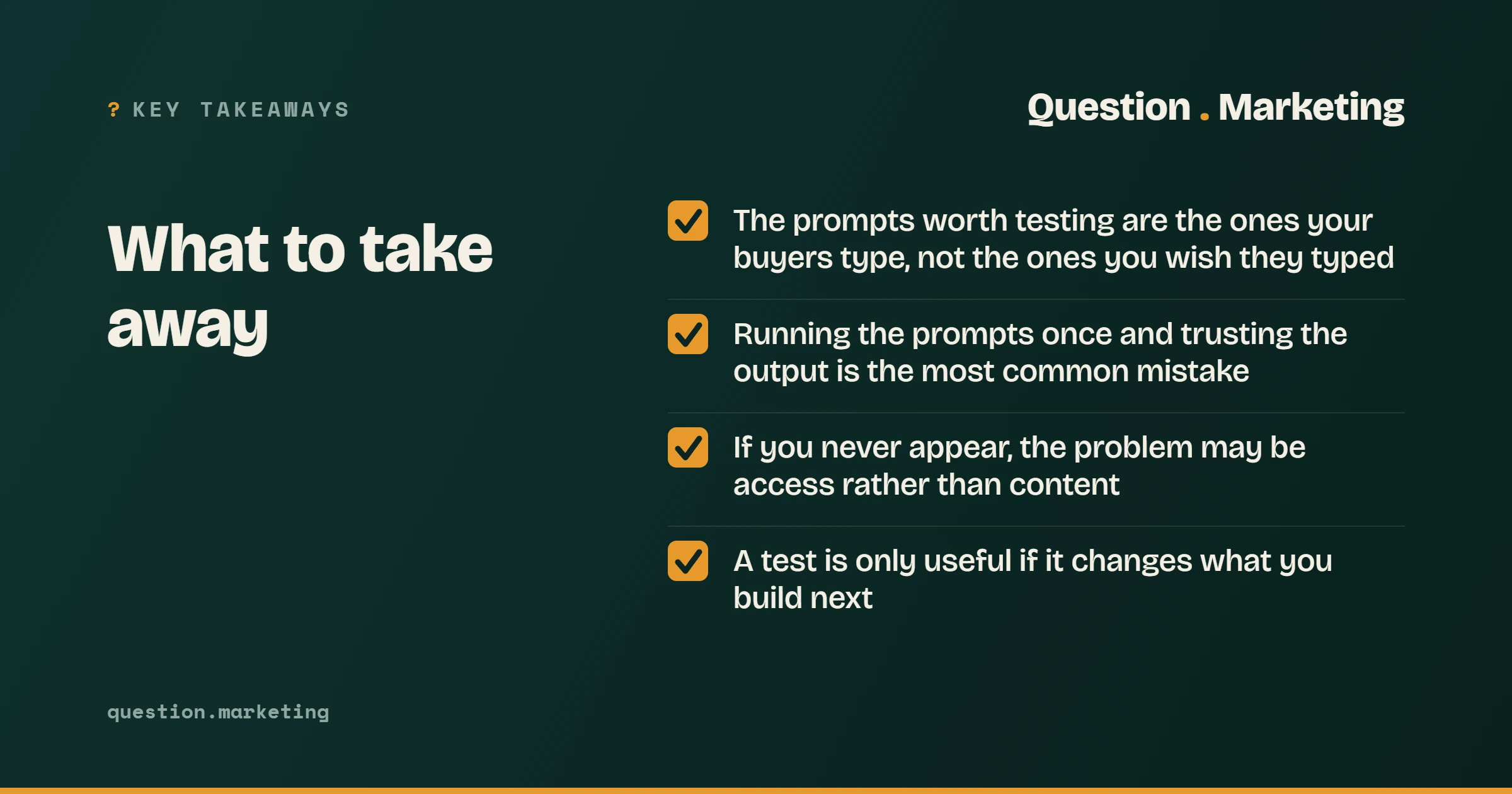
The prompts worth testing are the ones your buyers type, not the ones you wish they typed. Each category below shows a different kind of visibility.
Which prompt types should I test first?
Start with five types: "best [service] in [town]", "who can help with [problem]", comparisons with named competitors, price questions and "is [your brand] any good". Together they cover category visibility (do you appear when no brand is named?) and brand visibility (what does the engine say when your name is the subject?).
The same logic runs through the tracked prompt sets we build for clients, which span claim, entity, shortlist and education categories. Your own set can be smaller, but it should still cover those same angles.
Once you have the five types, the next question is how specific each prompt should be.
Should I use broad prompts or specific ones?
Use both, because they measure different things. A broad prompt such as "recruitment agency in Manchester" tells you whether you appear in the category at all. A specific prompt such as "specialist software recruitment agency in Manchester for Azure engineers" tells you whether you win the exact answer.
The specific end matters more than most businesses expect. An exact answer outranks a general one, and a main question then fans out into sub-questions that run separately beneath it. If you only test the broad prompt, you miss the questions where you can realistically be named.
With the prompt mix set, you also need to know what counts as a win.
What am I actually looking for in the answer?
You are looking for whether you are named, not where you rank. There is no "AI ranking position". There is being named, or not. For each prompt, record whether your business appears, whether you are cited as the source, and who appears instead.
The competitor column is as useful as your own. Every report we produce shows where the client appears and who appears instead, with screenshot evidence. Knowing which competitors are named in your place tells you where the gap is.
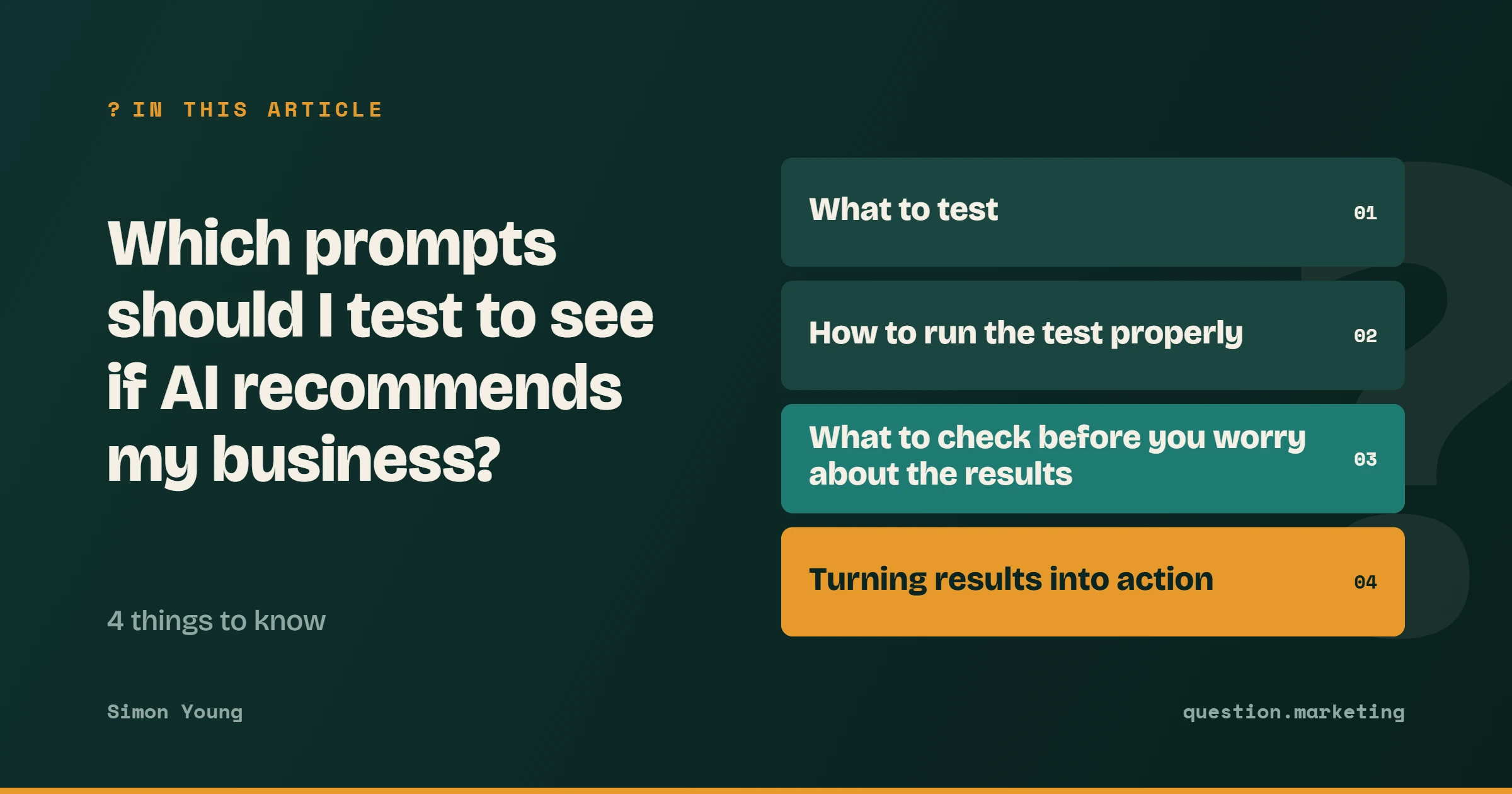
How to run the test properly
Running the prompts once and trusting the output is the most common mistake. The method matters as much as the wording.
Why is one check not enough?
A single check carries a margin of error of roughly ±9 to 13 points, which is why one screenshot proves nothing. Answers vary between runs, so a one-off result can flatter or punish you by chance.
Our own methodology samples around 1,500 answers per source per cycle across 30 prompts, with Wilson confidence intervals and a published margin of error of roughly ±1 to 2 points. You do not need that scale to learn something useful, but you do need repetition. Run each prompt several times and treat the pattern as the finding.
Which AI engines should I test on?
Test ChatGPT, Google AI and Perplexity first. Those are the priority engines for our own visibility tracker and for the entry-level scope of our Visibility package, which covers the same three. Add Gemini, Claude and Copilot once the first three are mapped.
Name the engines in anything you report. A result from ChatGPT says nothing reliable about Perplexity, so keep the platforms separate in your notes.
How often should I repeat the prompts?
Repeat the same defined prompts every cycle, on every engine, with screenshot evidence. We run our own tracker monthly, using 22 defined prompts, and the baseline cycle ran on 7 September 2026. A fixed set run on a fixed schedule is what turns a collection of screenshots into a trend you can compare.
What to check before you worry about the results
If you never appear, the problem may be access rather than content. Rule that out first.
Why might my business be invisible even with good content?
Your site may be blocking AI crawlers. Roughly 22% of web traffic sits behind Cloudflare, and content behind a WAF default-block is invisible to AI engines regardless of how well it is structured. This is the first binary check on any audit. If you use Cloudflare, confirm it is set to allow AI crawlers before you judge any prompt result.
What if the AI describes my business inconsistently?
Check that your name, address, registration details, people and claims say the same thing everywhere a model can read them: your site, directories, review platforms and Companies House. Contradictions are the single most common reason a model stays vague about a provider. A vague or mixed answer to "is [your brand] any good" often points here.
Turning results into action
A test is only useful if it changes what you build next.
What should I do with the gaps I find?
Build content that matches the exact question. If a specific prompt returns competitors and not you, write a self-contained, answer-first page for that question. Lead each section with a complete standalone sentence that could be lifted out and quoted on its own, and use question-shaped headings that match what the reader typed. Placement matters too: 44.2% of LLM citations come from the first 30% of a page, so the first 60 words carry the most weight.
For a topic with many variations, build a hub. A specialist software recruitment page in Manchester, for example, could be surrounded by 50 pages on individual job titles, all linked back to the main page.
How do I know whether AI visibility is bringing enquiries?
Add a "How did you hear about us?" field to your enquiry form and list the individual AI engines as options. Prompt tests tell you whether you are named. Attribution tells you whether being named produces leads. You need both to judge whether the work is paying off.
Can I get this done for me?
Yes. Our AI Visibility Audit is £495, delivered in five working days, and you keep it whether or not you hire us. It is credited in full against the first month if you start within 30 days. It gives you the baseline prompt results, with screenshot evidence, that this FAQ describes how to start yourself.
For the bigger picture, read what answer engine optimisation is.