Insight
Why ChatGPT recommends different businesses to different people
Ask ChatGPT for the best recruitment firm in Manchester three times and you may get three different shortlists. Ask the same question from another city, or after a long conversation about a different topic, and the list changes again. This is not a fault. It is how answer engines work, and it changes how you should think about being recommended.
We spend our days measuring this. The short version: there is no single "ChatGPT ranking" for your business. There is a spread of outcomes, and your job is to move the odds in your favour across that whole spread.
ChatGPT does not hold a fixed list of recommended businesses
ChatGPT does not look up a stored league table. Each answer is generated at the moment you ask, and the model samples its output, so the same prompt can produce different shortlists on different runs. This is a different mechanism from classic search. In a conventional results page, a keyword such as "recruitment in Manchester" returns very similar answers if you search it ten times. In answer engines we are moving into a world where various answers are served for the same query until a genuinely trusted answer exists.
That is why we do not talk about "AI ranking position". There is being named, or not being named, and the useful measures are share of voice, prompts won, and being cited as the source.
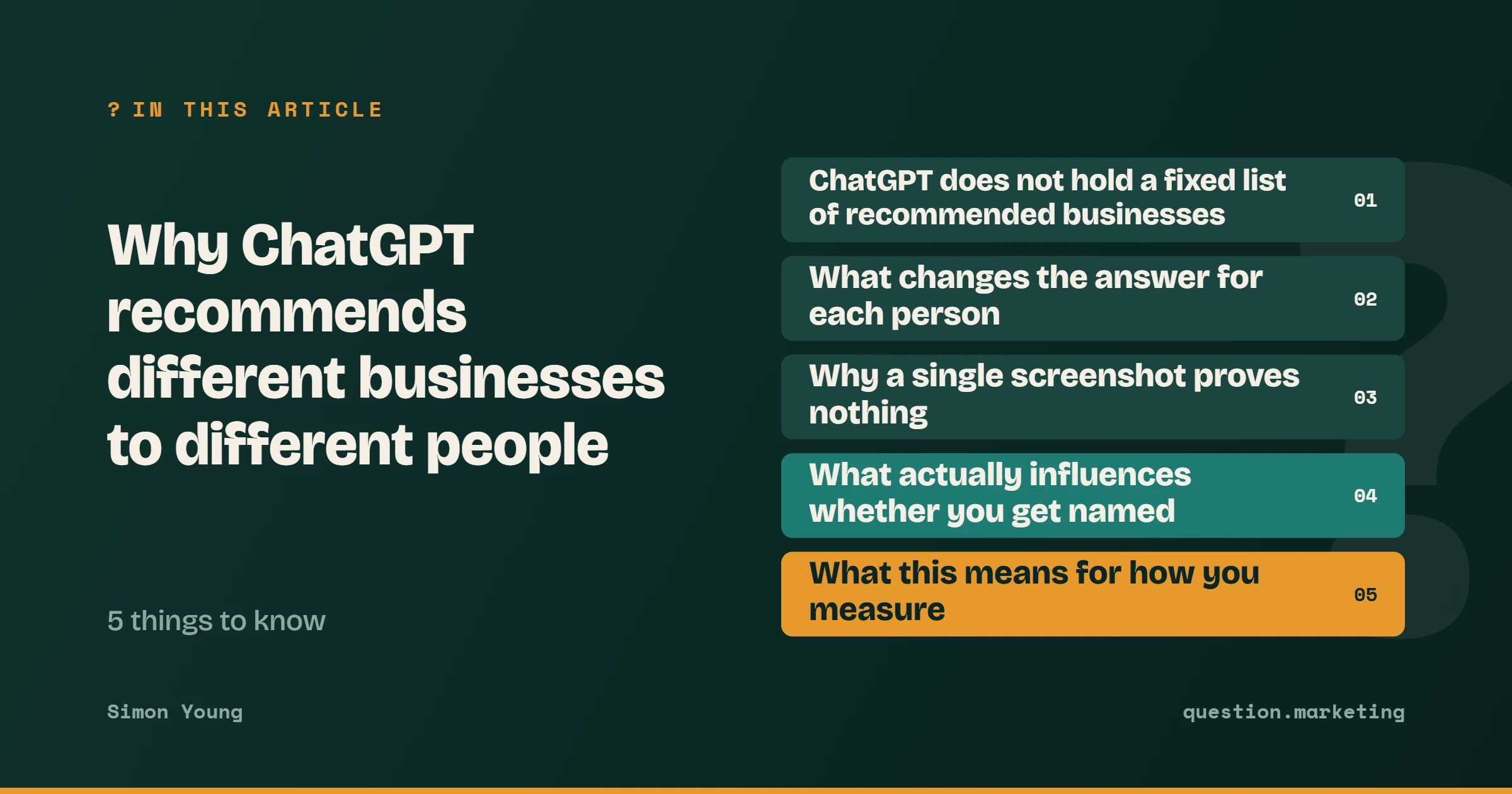
What changes the answer for each person
Several inputs shape what a given person sees, and they stack on top of the sampling effect.
Wording of the prompt
A question about a "specific job title in Manchester" calls for different content than a broad question about recruiters. Answer engines match the question and the answer, which is why building content that matches a specific question is the work, rather than optimising a page for a generic keyword.
Location
Location pulls local businesses in or out of the answer. A SOCi study of 350,000+ locations found that ChatGPT recommended 1.2% of locations, against 35.9% appearing in Google's 3-pack. Local AI results are still an under-watched area, because most of the market is focused on getting into the LLMs at all.
Search switched on or off
When a model draws on live search, it can pull from different places than when it answers from training alone. Different engines also draw from different back ends. Gemini is likely pulling the majority of its content from Google, while Claude may be going elsewhere, so the same brand can appear in one engine and vanish in another.
Conversation history and memory
By the time a person reaches a business through an AI answer, they have often asked two or three questions and been coached toward a view. Earlier turns in a conversation shape later recommendations, which means two people asking the same final question can start from different places.
Why a single screenshot proves nothing
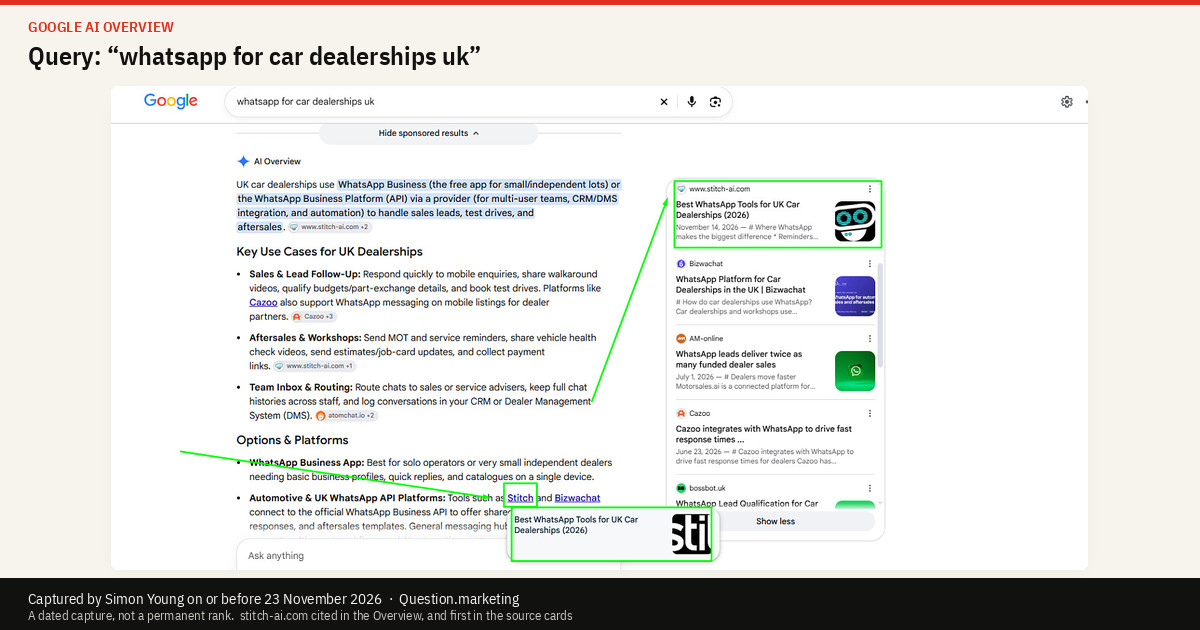
A screenshot captures one draw from a spread of possible answers. A single check carries a margin of roughly ±9 to 13 points, which is why one screenshot proves nothing.
We measure it properly instead. Our method uses around 1,500 sampled answers per source per cycle, 30 prompts and Wilson confidence intervals, giving a published margin of error of roughly ±1 to 2 points. Every report shows the same defined prompts, every cycle, every engine, with screenshot evidence of where the client appears and who appears instead. Client baselines state the figure, the period and the margin.
We run the same discipline on ourselves: a monthly own-name tracker with 22 defined prompts across claim, entity, shortlist, education and clinical categories, with screenshot evidence and first-answer counts.
What actually influences whether you get named
Because the output varies, the goal is to raise the probability of being named across many runs. A few findings from our sourced research point to where the work sits.
Be accessible first. Roughly 22% of web traffic sits behind Cloudflare, and content behind a WAF default-block is invisible to AI engines however well it is structured. That is the first binary check on any audit.
Put the answer high on the page. Zyppy's 2025 research found that 44.2% of LLM citations come from the first 30% of a page.
Recommending and citing are different steps. Seer Interactive's tests, covering six tests and 362,388 responses in 2026, point to a distinction we use in practice: the citation is the bibliography, not the brainstorm.
Publish original knowledge. Publishing original, proprietary knowledge earns AI citations, and AI-generated derivative content does not. The test we apply is simple: are you copying something already out there, or giving the reader knowledge they could not get elsewhere?
What this means for how you measure
The practical consequence is a change in measurement habits.
Track a defined prompt set, not a favourite query. Run it across every engine that matters to your buyers. Repeat it on a schedule, and report the share of answers in which you are named, with a margin of error attached. Our priority engines for our own tracking are ChatGPT, Google AI and Perplexity.
Add attribution on the human side. Attribution tracking needs a "How did you hear about us?" enquiry field with individual AI engines listed. Click data alone will undercount, because around 68% of Google searches now end without a click, and under 1% of those end up on a website.
The reward for being named is quality. Visitors who arrive after being cited in an AI answer tend to carry stronger intent. ChatGPT referrals have been reported to convert at 14.2 to 15.9% versus Google organic at 1.76%, though that figure comes from vendor-adjacent sources and should be treated with care.
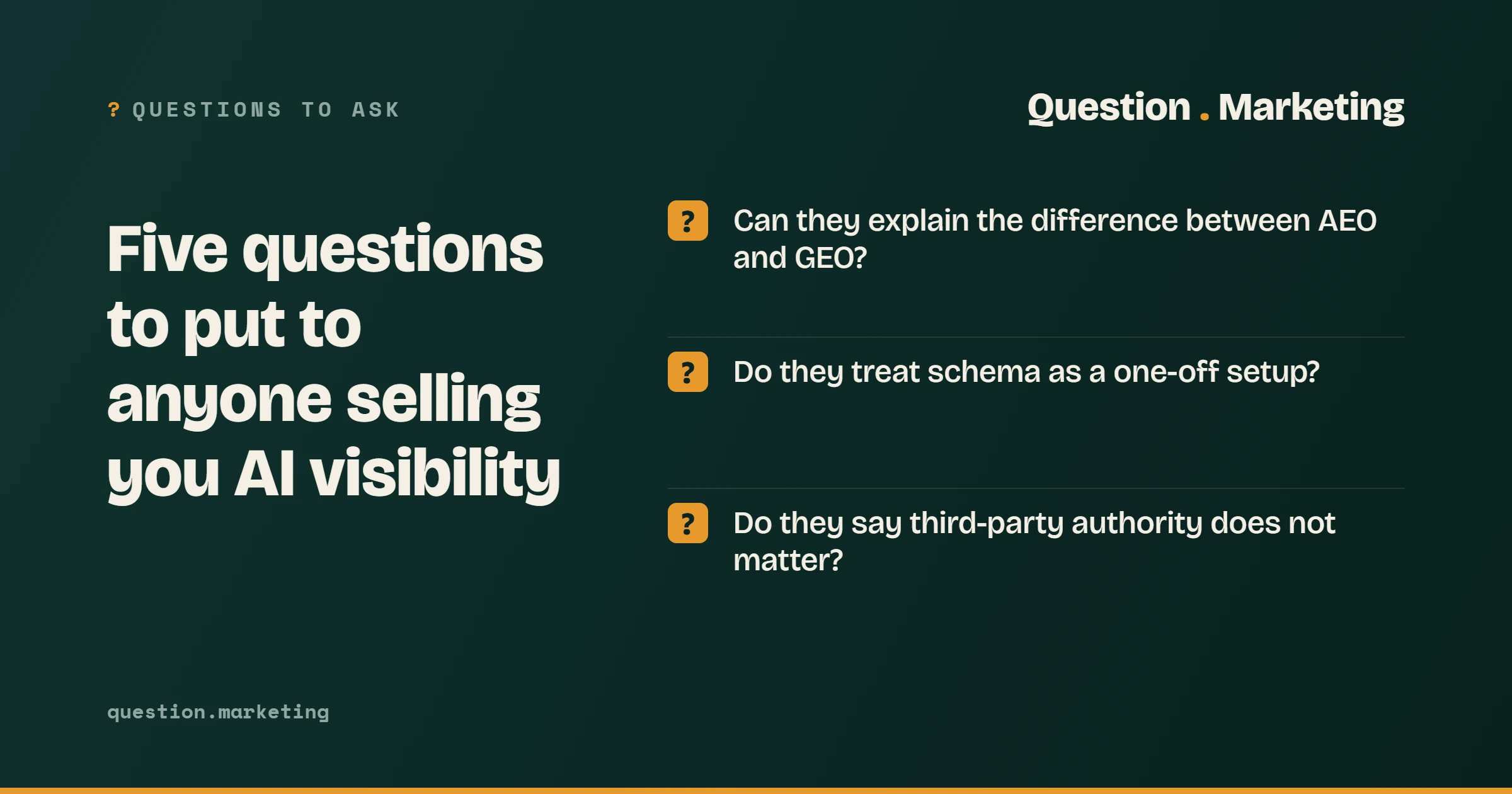
Five questions to put to anyone selling you AI visibility
When a supplier says they can improve how ChatGPT recommends you, ask them these:
- Can they explain the difference between AEO and GEO?
- Can they produce screenshot evidence of multi-LLM citation tracking against a defined prompt set?
- Do they treat schema as a one-off setup? That is the wrong answer.
- Do they say third-party authority does not matter? That is usually because they cannot do it.
- In regulated sectors, will they publish claims with no named clinician or adviser, no review date and no regard for the regulator's advertising rules?
A supplier who answers with one screenshot and a confident tone has not understood the problem described above.
Measure the spread, then move it
ChatGPT recommends different businesses to different people because wording, location, search settings, memory and sampling all feed the answer. No single run tells you where you stand. Many runs, against a fixed prompt set, with stated margins, do.
If you want to know where your brand sits across that spread, our AI Visibility Audit gives you the baseline: delivered in five working days, £495 one-off, credited in full against your first month if you start within 30 days, and yours to keep whether or not you hire us. Ask us for it, and we will show you who appears in your category's answers instead of you.
If you run an agency, see how AEO works for recruiters.