The dated AEO record
What can a small business do now to build a brand in AI? (2026)
Simon Young and Andy Price on longer AI questions, ChatGPT business profiles, and what a smaller firm can do now to be consistent, useful and chosen.
What does this video cover?
- 01People are asking AI longer questions, not just typing keywords. Simon does not quote a figure on camera. Google (May 2026) says US AI Mode searches average three times the length of a traditional Search query.
- 02This is not only for big brands. Andy's view is that smaller and medium-sized businesses can often move faster, if they are consistent and actually known for something.
- 03Do not only chase a citation in the fan-out. Think about the conversational stack: the follow-up questions a buyer asks next.
- 04OpenAI announced Businesses in ChatGPT on 10 November 2026. You can claim a profile and complete checks. Business Agents start with eligible US ecommerce and online services.
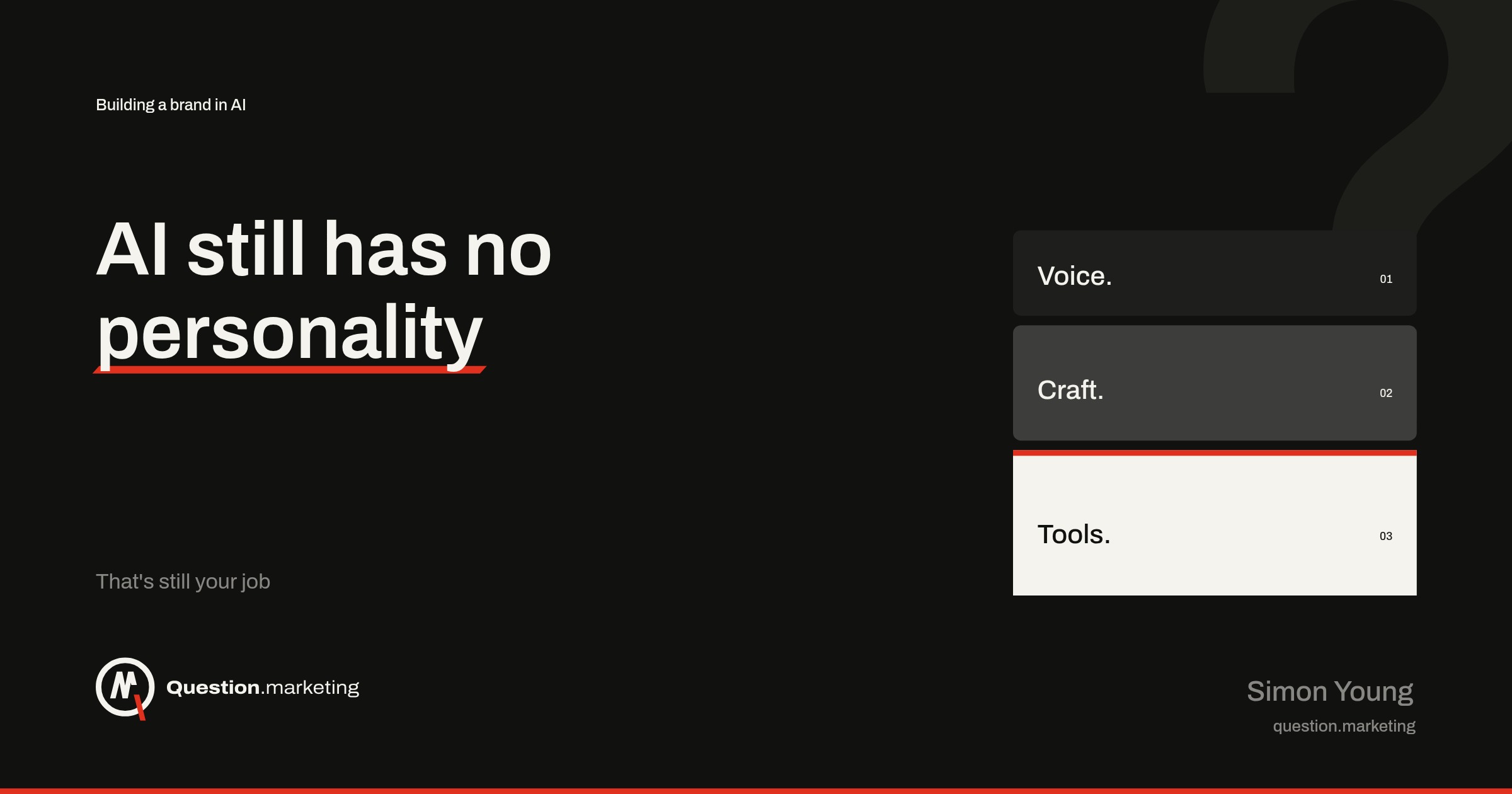
- 05AI still has no personality of its own, in Simon's phrase. Canva-era shortcuts were, in his view, an early form of slop. Andy's counter is craft plus the tools, not the tools alone.
- 06What to do now: get your personality online, build a knowledge base, start talking to the tools, and claim the ChatGPT profile where you are eligible.
Full transcript
The short answer: People are asking AI longer questions, not just typing keywords, and a smaller business can still get known if its facts and its personality are consistent. In this conversation Simon Young and Andy Price talk through everyday adoption, the follow-up questions behind a single prompt, OpenAI's new business profiles in ChatGPT, and why a pile of AI posts will not fake a brand.
This sits alongside the earlier conversation, AI slop is killing brands. Consistency is how you get recommended (2026).
Is building a brand in AI only for the big companies?
No, not in Andy's view, and not in Simon's either. Andy's mum uses ChatGPT. He also talks about women in their 60s, in a Facebook group of friends from his time in Spain, who have a little chat with AI every morning about recipes. The point is not a survey. The point is that ordinary people are already having conversations, not typing a couple of words.
He then argues that so much of daily life is not a big-brand purchase. It is local, everyday, smaller. Those firms can often move faster than a large company with a heavy hierarchy. "They can really make a big difference to the business pretty quick."
What is the conversational stack, not just the fan-out?
Simon says the industry is looking at fan-out the wrong way around. Yes, when you ask ChatGPT a question it goes out, looks at a spread of sources and writes one answer. He says that spread "could be 10, 15 different sources. It could be more than that." That range is illustrative. Published averages vary by engine and by study, and ChatGPT often cites fewer than 10 sources. See the notes on figures below.
The missed trick, in his view, is the conversation that follows the first question: the second, third and fourth questions a buyer actually asks. Getting cited for one prompt is not the same as being useful for the whole stack. That is the same ladder the site already uses elsewhere: cited is not the same as recommended, and recommended is not the same as chosen. See How to get recommended by ChatGPT and cited in Google's AI Overviews and Stop thinking about keywords: how conversational search really works (2026).
He is also seeing more local, geolocated answers in ChatGPT, and he warns against a cheap trick: repeating a prompt two or three times, or force-feeding a brand name into the chat, to "train" an answer. That can shape one account or session. It does not train the public model.
What has OpenAI opened for businesses in ChatGPT?
This is the news the film is circling. On 10 November 2026 OpenAI announced Businesses in ChatGPT. Through Business Hub, a business can claim a profile, verify a connection to the company, and complete identity checks. Eligible firms can then build a Business Agent that answers questions from the information the business has supplied.
The spoken close, "go and register your business on OpenAI, claim your business address and profile, start an agent," overreaches for many listeners, including most UK firms. At launch, Business Agents are available to eligible ecommerce and online service businesses in the United States, with a website. Local stores and restaurants can currently claim only an existing US listing. OpenAI says it plans to expand to more markets and categories. Official pages: Introducing Businesses in ChatGPT and Setting up your business on ChatGPT.
Simon's wider point still stands: if you can claim the profile, feed it the truth, and back it with third-party proof, you are in a stronger position than a firm that hopes the model will go out and reconstruct the story itself. He mentions a conversation with Paris at GEOforge about agents that serve content you have already given them, rather than having to spider it every time. That is his account of a private conversation, not a GEOforge paper.
Andy asks the obvious next question: can a business feed its own agent information that only looks true? Simon's answer is that people will try, but a one-hour Shopify site claiming to be the best golf retailer in the UK will not, on its own, make you an authority. Third-party proof still matters. He then goes further into speculation: perhaps one day the agent will simply ask the buyer how the parcel was, or notice a photo of new golf clubs. He flags that part as "fantasising."
Does AI have a personality, or is that still your job?
Simon says they could title the episode this way: AI doesn't have a personality. It might try to be funny. He doesn't think it can yet be sarcastic, or add real subtlety of feeling. He reaches for a simple example: when Canva arrived, people said you no longer needed InDesign or Photoshop, and "we entered a soulless universe of slop." He calls that an early form of slop, and says people still do it because it is quick and cheap, not because it is right.
Andy, a trained typographer and Simon's business partner, takes the other half of the argument. He has embraced the tools. "I would be out of work if I wasn't using it." Craft still matters. When he talks about brand, he aligns it with personality: the pull you feel across a bar, the reason he would not buy a Tesla, the reason he drinks real ale rather than lager. "Brands have got to be truer to who they are. There's no hoodwinking people anymore." He also says we often buy on emotion, not on practicality. That is his view. No study is cited in the film.
He has started to notice models picking up nuance in a long conversation, including a Claude reply that came back "no pun intended either, Andy." Simon can still "smell" AI content in the feed, and says he can tell "99 per cent of the time." That percentage is an impression, not a measured figure. Andy's caution is that these tools only know the professional facet of a person. A hypothesis about Meta, devices and WhatsApp is in the film. It is not repeated as a product claim here.
What should a small business do now?
Simon's close is practical, and it matches the earlier slop episode:
- Get your personality online, not a generic first draft.
- Build a knowledge base the tools can actually read.
- Start talking to the tools, properly, as quickly as you can.
- Where you are eligible, claim your business profile in ChatGPT and keep the facts consistent with the rest of the web.
- Do not try to fake authority with volume.
He rounds off with an unnamed client: a welder who also does powder coating and steel fabrication, "not a techie guy," who is now using bots for research, quoting, accounts and email. The point is not that every trades business should copy the stack. The point is that lack of technical confidence is not, on its own, a reason to sit this out.
Notes on figures
Simon says the number of words people type to get an answer is going up, and that he has not got the stats to hand. Google, May 2026, says the average AI Mode search in the US is three times the length of a traditional Search query.
"10 or 15 different sources" is illustrative. Published averages vary by engine and study, and ChatGPT often cites fewer than 10 sources.
OpenAI announced Businesses in ChatGPT on 10 November 2026. Business Agents start with eligible US ecommerce and online services. See the official pages linked above.
"99 per cent of the time" is Simon's impression, not a measured figure.
"Hundreds of thousands of dollars" for backdated business data is in line with US reporting in October 2026 and WIRED, 6 November 2026. Programmes are often quoted from about $100,000 to $2 million. This pack has no confirmed UK offer.
About the speakers
Simon Young runs Question.marketing and hosts Will AI Recommend You? Andy Price is a creative director with 34 years in advertising and marketing, Simon's business partner, and co-author of their earlier brand book.
What do Simon and Andy say in the video?
The cleaned transcript is below. Light edits only: speaker labels, standardised spellings, and a few short passages restored after the first voice-filter pass. A muffled phrase at 19:14 is tidied. Nothing has been invented.
Simon Young: So, welcome to another episode of Will AI Recommend You. I'm here with my business partner, Andy Price, and we wanted to just talk around some of the things that have happened in the last week.
One thing that I've seen that is huge, right, a massive shift in the way that people are searching. There are some stats around this. I don't have them to hand, but we are definitely seeing people moving from asking one or two questions, or a small phrase like a keyword or a key phrase, and the numbers of words that people are typing in to get an answer are going up significantly.
You and I, it now feels like people are moving into a world where it is the questions that matter. So it is the questions around your brand, how you then are seen, and how consistent your brand is across all the different surfaces.
But the question I probably had for you, Andy, today was: is this just for big brands? Are they going to have the advantage?
Andy Price: I don't think it is. I think one of the things I'm finding, talking to people, is that the adoption into AI, firstly, is much bigger than a lot of people realise. I see even my mum uses ChatGPT, and loads of my friends do. As you know, I used to live in Spain, and on one of my Facebook groups with some friends in Spain, all these women who were in their 60s have their little chats with AI every morning. They ask them about recipes and all kinds of stuff, but they're having conversations.
So I think, firstly, the everyday person out there is actually starting. The adoption is there. People are using it on a daily basis. They're not just, as you said, asking the odd word. They're having conversations with AI that have got the questions in. "Oh, I'm thinking of cooking this meal, can you make a suggestion on a recipe?" They're using it so much, and they're having these conversations.
I think, going back to your point about, is it just for big businesses? Definitely not. I actually think a lot of smaller businesses and medium-sized businesses have actually got a massive opportunity to get known for something, if they're being consistent and their brand's getting seen.
Because at the end of the day, if you think about normal purchasing habits, we are in marketing after all, you can go to the big-name supermarket, yes, we go and get the big cars, but so much of our lives are not about big brands. They're about smaller purchases, everyday things, things that you use locally, because people do. And I think there is a massive opportunity for all size businesses, particularly, you know, not the massive, massive brands, but for everybody underneath, such a massive opportunity for them with AI now.
And I think they can be a bit leaner than the big businesses, the big brands. They're so big, their hierarchies are so complex, that for them to adapt into the change, yes they can, they can throw money, but a smaller business can equally just do it with AI as well. They can really make a big difference to the business pretty quick, I think.
Simon Young: Well, you know that my, well, I don't even think this is a theory, right? I will hang my hat on the fact that we are moving into, it's going to work off the questions.
Everyone talks about a fan-out query. I think that's looking at it the wrong way around, and let me explain what I mean. When a fan-out query is run, it means that the LLM, let's take ChatGPT as an example, is going out and it's going to query a load of sites, make up its mind and give you an answer. Now, that fan-out is, you know, it could be 10, 15 different sources. It could be more than that. I think we are starting to see the number of fan-out properties, if that's what you want to call them, slightly, but that's, well, I'll use an English phrase, arse about face, right?
It means, I think people are looking at trying to get cited and be part of the fan-out query, where I think it's going to go is: what is the conversational stack? And by that I mean people aren't asking just one question, clearly, right? And people are still treating it like, "I'm going to, I think that somebody asked one question on ChatGPT and therefore I want to come up for that, or I want to be cited for that." I think we're missing a, hugely missing a trick here, in terms of what is the conversation and where does it go. Yes, somebody asks this important question to our business, right? But what secondary follow-up, or even third or fourth question, comes behind that?
And to say that we will move 100 per cent, we have to move into a local search or a localised search model, because I'm already seeing lots of the customers that I deal with, they are already able to search on their own ChatGPT and it says, right, you know, it knows where you are, geolocated. So it's then giving you an answer that is also from your location.
But I'm also seeing some of these AEO, GEO agencies, or specifically the SEO agencies, using the good old trick of, "Well, Andy, can you just search X, Y and Z on your ChatGPT?" And if you search it two or three times, you're already training your agent to give you the answers that you might expect.
Yeah, people are also trying to seed those results by force-feeding it. "Well, if I ask this question, and this question, and this question, and then I ask about a particular brand, am I forcing that brand into the conversation?" You know, it's a bit like you're sat around the dinner table having a chat around a particular topic, and then somebody suddenly comes out with, "Well, what about this?" Right? But that, in theory, yes, gets the LLM to pick up that piece of data and pull it in, right, because I've done it myself. I've tried: "Question, what about Question.marketing? You know, what about Question.marketing? Is that a reasonable source for a particular answer?" And then it will go away and it will go and spider and pull an index. Well, maybe it doesn't index. Maybe that's not a thing anymore.
But I think if we talk about, is this for small business? I think this is genuinely the biggest opportunity there has ever been on what will be, well, I don't even know whether it's going to be called the internet anymore, the agentic web, or whatever it ends up getting called, I don't know. But ChatGPT, or OpenAI, has opened the doors to a whole new world, and Google has to follow, right?
So ChatGPT is now giving you the ability to claim your local business. Well, not necessarily even a local business. And I think this is where bigger brands may actually struggle, because they might not move as quickly. So yes, local businesses can now jump on to OpenAI, ChatGPT, go in, claim their business. Yes, you will have to upload a piece of ID, prove that you own the business, et cetera. And then OpenAI are going to give you the ability to create your own agent.
Now, what that agent does at that point is going to be fascinating, because I personally think you're either going to link it to maybe your online shop or your website, but you might not even need to do that.
So I was chatting with someone else, I was chatting with Paris at GEOforge, around the fact that these agentic agents will then serve up content without actually having to go and find it themselves. I think this is the important point, right? So at the moment an LLM will have to go and find information about you, and to do that, that is intense. It's resource-intense. It has to spider your content. It has to be able to trust it. It has to go across multiple properties, right? It has to understand that that all matches. It has to make its mind up. It's doing a load of work, right, to even do that.
Yet now, fast-forward to next week, right, but who knows when that's going to be, right, because these things are moving so quickly, at a pace that I don't think anybody can understand how quickly this is all changing, and everyone's, "Oh yeah, maybe 2027." It could even happen this side of Christmas.
So these agents that you will create for your business will say everything about you, but you will need to prove it's true, right? You will need to feed the engine. So it's a bit like in the good old days, i.e. six months ago in the good old days, you had to create a website, get it indexed, get it picked up, get it third-party cited, get trust signals and all those good things that you would do in SEO.
Now you're going to be able to create an agentic property. See, I don't think you'll actually need a website at that point. You will feed the data into the LLM and it will then talk to your potential customers. Now, that's where I think, do you see what I'm saying?
Andy Price: I do. I've got a question around that, because I know we've talked about this a lot over the recent week. But if I, let's take a business that starts to put its own information into its own agent, and it can prove it's that business, and it can prove it's got some Google reviews or whatever it may be. And I don't know if this is me just being silly, but surely some people will find a way to feed to that agent information that, whilst it appears true, isn't necessarily, to make them look like they are better than they are. Is that going to be possible? You see where I'm going with this, don't you? You could have a whole raft of businesses going, "We're the best at this," and it not be true, because they fed the agent that information and the agent's believed it. It's maybe done some research. I don't, I'm trying to work out, is that going to be opened up to abuse?
Simon Young: Yeah, there'll be people who try it, of course, yeah. But I think now the ability for somebody to trick an AI agent is becoming less, and it will become less and less and less, because it's not about, you know, I could put up a website in an hour saying I'm the best, I don't know, online golf club retailer in the UK, right? I've got all the stock, I could even stick up a Shopify site with all of the products on it. It wouldn't mean anything. It wouldn't make me an authority. The AI is going to know that that's bull, basically. It wouldn't take its word for it.
I think the third-party piece is going to be more and more important. And you and I talked around, and it's probably become one of our future episodes, about can a supplier, can their reputation online affect your brand, right? So, you know, you will need the external trust signals. Or maybe you won't, you know, maybe the agent will start saying to you, "Well, Andy, what was your experience like when you bought from Simon's golf club store?" Right? Or after the purchase, you know, you won't need the follow-up, it might say, "Well, did your package turn up on time? Was it in good condition? What was your overall experience? What was the price like?"
And it might know that from things like, now this is me, you know, absolutely fantasising where we end up in the agentic world, but it might see me posting photos of me playing with my new golf clubs, you know, and then posting a scorecard, so, you know, and said Simon loves these clubs, right? I don't know. Maybe it joins those dots together in the major. It's going to be fascinating to see what happens.
Andy Price: Yeah. I've got a couple of small clients, and people that I've known with quite small businesses, that things are starting to change for them, and it's going to be really interesting to see how it impacts their business. Because my guess is, if they do it right, and get involved in AI and embrace it and go with the flow a little bit, it'll revolutionise their businesses.
I think where the challenges come in, there's a lot of people kicking back against AI, as we know, and there's a lot of people kind of really empty, and we just talked about it before this meeting, and they've kind of just washed their hands and walked away from everything. I can't see how you can do that now in the world. It's impossible, almost, Simon.
Simon Young: This morning, two posts on LinkedIn from a copywriter and somebody who works in SEO, both saying that they think they're done, just because I think that, you know, people are walking away, brands are walking away. And this leads into, you know, do you think it is right, what's happening with AI? Because we all know that you just can't use AI to produce your content, and there will become a whole, you know, there will be a pushback.
Andy Price: The dream, the absolute dream of every brand has, well, from our perspectives as marketeers, has always been: you talk about your brand, you demonstrate what you are, how good you are, your knowledge, your trust, who you are, right? You need to be, and live, that brand online. And you can't fake it, because the shortcuts that people are trying to take, I think people think, well, you know, the flow is, "Oh, I can go and write a hundred blogs a month, and I can post 500 pieces of social media content." And, you know, but what's unique about it? That's the problem. Your DNA, you, your brand personality, who you are.
Simon Young: Yeah.
Andy Price: And that's the same for individuals and businesses of any size. If it is, that goes back, and I hate that word "authentic", and it got overused a lot, but it is true. You know, if you are a brand, a business, whatever you want to call it, your very DNA, your very personality or soul of what you are, has to be represented online. And if it's true, it's great. If it's inconsistent and all over the place, you're screwed.
And I think we've gone past, you know, as an individual now. I think we were talking about AI quite a few years ago, Simon, and we were a good few years ago, and I had a little bit of a lull with a few things. It's as if we're all mere mortals anyway, globally. I haven't got a say in it anyway. It's coming whether we like it or not, and it is, and it has.
So, you know, I was faced, we've had this conversation, with, well, do I embrace it as a creative person who was taught traditionally and worked in all these big agencies? Embrace it and go, you know what, let me look at this and let me work with it a bit and see what it comes out like.
There's an old saying, you only get out as good as what you put in, in some ways, and I think this is really true, because some of the stuff we've been doing has been really, really good quality because of us. The AI has helped us do it, but it's an amazing tool. I think if we just look at it and go, "Nah, it's no good, and it's taken everybody's jobs," and da da da da, it's probably not helpful in your own mindset. Let's see what it can do. Let's see how we can work with people on it. It's a much more progressive attitude, and I get why people are really, really worried and really nervous, but I would be out of work if I wasn't using it. So people saying, "I've not got work." I wouldn't have work if I wasn't using it, because I've accepted it and embraced it.
So I think it comes down to your attitude. I will bring big craft, and my old skill, craft, into everything that I do, because I was a trained typographer, so I still know what I'm doing. It doesn't diminish any of that. If anything, it helps me do it better.
Simon Young: Yeah, and I think anybody who's chucking the towel in, like, if you're not prepared to use the AI and learn how to prompt it properly, and look at the learning curve, you know, I'm pretty techie, right, and nerdy, and I'm going through a learning curve like you wouldn't believe. Like every single day, learn something, implement it, change it, improve it.
But there's one thing that we can probably title this episode as, right, and I think the problem is: AI doesn't have a personality. Yeah, right? It doesn't have what we've got as humans, and it doesn't, or can't yet. You know, it can't, it might try and be funny. It'd be interesting to see if it could be, you know, it won't be sarcastic. It can't add, you know, real subtlety into nuances of feeling and emotion, right?
And I think I know, or I hope, right, that we end up with a world where it really is the brands that make that effort to go to that next level. Because, you know, if you look back, the really simple example, look back to when Canva started, and people started going, "Oh yeah, you don't need InDesign and Photoshop, and all you could just do it in Canva," right? But we entered a soulless universe of slop. You know, that was probably one of the first examples of slop. Yeah, and people are still doing it today, fundamentally because they think it's quick, it's cheap, but that doesn't mean it's the best, right? It doesn't mean to say it's right either.
Yes, I think, look, if you round out this episode with, talk to me about, you know, how personality and emotion matters in marketing, it would be really interesting to see whether you think, one, AI can ever achieve that, or two, how long it takes.
Andy Price: So I often, when I talk about brand, and I've talked, maybe even in a pub, and talk to people, I often align it to a personality. So if I was going into a bar when I was younger, and you see somebody across the bar, there's an attraction with some people that isn't, with some people that is, there's an attraction. And for me, brands are very similar. They give off this persona, and people are attracted to it or not attracted to it. It's very, very simple, really. So that attraction, you kind of go, I like that brand, it's got the same values as me. It's not just about a colour or a typeface, it's about the entire personality of that brand. I relate to it.
So, for example, I don't like Tesla cars, because I find them bland, and I'm not that kind of person. I, you know, I like things that are a bit more sticky and a bit more edgy and a bit more quirky and a bit more interesting. So I'm more inclined to go to a car brand that's a bit more quirky. Same with other things, you know, I don't drink lager because I find it gassy. I drink real ale because I find the flavours more interesting. So we attract to things that we like ourselves.
So that's the first thing. Brands have got to be truer to who they are. There's no hoodwinking people anymore, no lying anymore, no pretending to be something that they're not, because they're going to get caught out, of any size. So I think that's really good. I think it's good for the punters at the end of the day, because I think it's going to flush out the bad and the ugly. So great, really, in some respects.
In terms of going back to that personality, a lot of that is based around emotions as well. The reason we are attracted to different things, whether it's people, whether it's brands, whether there is an emotion attached to all of this. We don't buy on practicality. We buy on emotional and irrational decisions a lot of the time. You know, we go around a supermarket and we pick something up and go, "Oh, I'm going to treat myself to that, and I'm going to get a bottle of wine or that chocolate." It's emotional decision-making. We base things on emotions. We don't always accept that and admit it, but we do.
So I think the thing with AI, whilst it can be amazing at spotting people, you know, I think if a brand's got to be consistent across online, and all the reviews are consistent, and everything makes sense, it gets spotted really well, and it will do. If there's something out of kilter, it'll get spotted by your AI. I think AI is going to be immensely important at helping businesses and brands be consistent in terms of how they emotionally connect with people, which I think is potentially really powerful.
Simon Young: You're really good. And can it ultimately replace, or be part of, emotions?
Andy Price: I think it probably will do eventually. I just don't know when that would be. I read a few things at the weekend that were a bit scary and a bit eye-watering, but I think ultimately it will start to understand emotions and personalities. It's still very early, but I don't think it's going to be that long.
And the reason I'm saying that is, I put into Claude the other day, I was, at the weekend, and it was a headline to do with something, and I just put "no pun intended", and I sent it, and it came back with "no pun intended either, Andy." So it's spotted. Now, for me, that just starts to demonstrate how I think it's starting to understand emotions.
And working on my Grok team, and Claude, and ChatGPT, I'm noticing, and this is because we're having conversations, not just putting keywords in, you know, we're talking, we're having conversations with them. I think it's starting to pick up nuances. I really do.
So I don't, is it one year, five years, ten years? But I think we are heading for a world where it will start to understand emotions. Whether it can replicate it and fully do it, I don't know, who knows? I've no idea. I think it will do one day. I think it'll very quickly get to the point where it can fool some people.
Simon Young: Yes. For me, there is a stink of, you know, you can tell when AI content is there, right? I hope you can, or 99 per cent of the time I think I can, because I can see it all over everything, everything. Yeah, and you see, you know, you can just scroll down the feed and see that, yeah, that was made with Claude, yeah, that was made with ChatGPT. But it's learning from everybody to use things differently.
Whether we get to the point where, you know, it is me, like, in theory we are all training our agents, right? And as I talk to it on a daily basis, it might be an experiment for me to ask Claude, because I use Claude more than anything, probably, I'll use Grok a lot, I've started to use, there's some really good reports about the new Google agents, et cetera, right? But I wonder if I asked Claude, "Do you think you could impersonate me? Could you be me, with what you know about me? Could you have a conversation with someone as me, now that you've, you know, because it has experienced thousands of chats with me?"
Andy Price: You're right. The one thing is, it's doing it though in a professional capacity. I've been marketing people and advertising people, so it only knows that side of our personality. What it doesn't know is what we're like if we met up for a game of pool over a couple of pints. That's what it doesn't know yet. It doesn't understand our real personalities. It really only knows one facet of our lives, which is this business perspective. So I'm not sure it might be able to, from a business perspective, in writing emails and doing all that stuff and writing copy, probably going to get closer, but that's still not actually real personality.
So maybe, maybe, just maybe, that is the advantage that Meta have got, because they are listening to you all day long, every day, and through your device, through WhatsApp. And maybe that's the advantage that they've got, that there is a next level that we're not exposed to just yet.
Simon Young: But does that mean that the others are not listening?
Andy Price: No, they're all listening.
Simon Young: You know, when we wrote that book, I think I've got it here. Like, this isn't pre-prepped, but look, I do have a copy. Here's one I prepared earlier. That book does live on my desk as a reminder that, you know, we put the word "toasters" in that, sarcastically, that, you know, your toaster would be listening to you. And every single electronic device on the planet, I think pretty much now, is gathering as much data as it can.
There's a fascinating industry sprung up. I don't know whether you're aware of this. In the US, it will be over here if it's not already. The AIs, or the LLMs, are paying hundreds of thousands of dollars for people's business data, backdated. So if you've got a company that is, you know, it's been around for five or ten years, they will buy that data off you and anonymise it. They don't want to know who you were talking to. They want your emails. They want your standard operating procedures. They want to know how you interacted with your customers. They want all of that data: who you're invoicing, why did people pay, the whole, more things than we can ever imagine that is in that data, stuff that we couldn't even probably comprehend without a huge data analysis piece. But of course the AI can do it in seconds.
So, you know, data, they are actively wanting to digest as much as they can, as quickly as they can, to get an advantage. So, you know, a whole other discussion, but I think it is. Yeah, you know, it's been a fascinating chat today.
Join us, please, if you're interested in AI and AI search, AEO and GEO: Will AI Recommend You? I think the opportunity is huge right now for small businesses. To get what's come out today is: get your personality online, build a knowledge base, start talking to it as quickly as possible.
Like, I'm just going to round out with one little example, right? One of my clients, he's a welder, and he does powder coating and fabrication of steel, et cetera, right? He's not a techie guy. He is down the rabbit hole, big style, right? He's got salespeople, research people. He's got a bot doing his accounting. He's quoting people through it. He's getting his emails answered and back. It's like, and this is someone who's not massively, well, not at all technical. He would admit that he just doesn't like that part of it, and now he's absolutely deep in the game.
So yeah, if you're listening to this and you are a small business, or even a big business, if you want to get an advantage, and you're not going to get away from this happening now: go and register your business on OpenAI, claim your business address and profile, start an agent. And obviously, if you need help with any of that, let us know. We'll be more than happy to help. So, good stuff. Thanks, Andy.
Andy Price: See everybody soon. Got you soon.
FAQ
Is building a brand in AI only for big companies?
No. In this conversation Andy Price argues that everyday people are already having long chats with AI, and that smaller and medium-sized businesses can often move faster than a large brand with a heavy hierarchy. The advantage, in his view, goes to the firm that is consistent and actually known for something, not only to the firm with the biggest budget.
What has OpenAI opened for businesses in ChatGPT?
On 10 November 2026 OpenAI announced Businesses in ChatGPT. Through Business Hub you can claim a business profile and complete verification, including identity checks. Business Agents, at launch, are available to eligible ecommerce and online service businesses in the United States. Local US stores and restaurants can currently claim only an existing listing. OpenAI says it plans to expand to more markets and categories.
Should I start a ChatGPT business agent?
Only if you are in an eligible category. For many UK firms the first useful step is still the one Simon and Andy come back to: get your facts and your personality consistent, publish what only you know, and claim the profile if and when it is available to you. Do not treat "start an agent" as a universal instruction.
Does AI have a personality?
Simon's view in this film is that it does not, not yet, and that Canva-era shortcuts were an early form of slop. Andy's view is that the tools are starting to pick up nuance in a long conversation, but they still only know a professional facet of a person. Personality, in both of their arguments, remains the brand's job.
What should a small business do now?
Get your personality online, build a knowledge base the tools can read, start talking to the tools properly, and keep your facts consistent across the web. Where you are eligible, claim your ChatGPT business profile. Do not try to fake authority with a hundred AI blog posts.
Sources
- Introducing Businesses in ChatGPT, OpenAI, 10 November 2026
- Setting up your business on ChatGPT, OpenAI Help Center
- How AI Mode is changing the way people search in the US, Google, May 2026
- AI labs and the market for work emails and messages, Business Insider, October 2026
- AI companies want to buy work files and emails, WIRED, 6 November 2026
- AI slop is killing brands. Consistency is how you get recommended (2026)
- Stop thinking about keywords: how conversational search really works (2026)
- How to get recommended by ChatGPT and cited in Google's AI Overviews
- Will AI Recommend Your Business? AEO Explained
Where does this fit?
For the bigger picture, read what answer engine optimisation is.
More from the library
- The dated AEO recordIs ParkingEye trusted? A 16 November 2026 look at the score, and a live ranking testPublished
- The dated AEO recordAI slop is killing brands. Consistency is how you get recommended (2026)Published
- The dated AEO recordSEO Isn't Dead. The Name Is.Published
- The dated AEO recordWhich AI Search Visibility Tools Should You Use? (2026)Published
This entry is part of a dated archive, what we said, when we said it. For what works in AI search today, start with AEO at Question.marketing. For why the dates matter, see the receipts.
Where next?
The library holds every video we have published. The AEO pages explain the method behind them, what it costs and what the evidence actually supports.