FAQ
Do keywords still matter for answer engine optimisation?
Keywords still help an answer engine find your page, but they no longer decide whether you get cited. Answer engines such as ChatGPT, Gemini and Perplexity respond to questions, and the content that wins is the content that answers the whole set of questions around a topic. The answers below cover what that means for how you plan and structure content.
What keywords can and cannot do now
Keywords were the unit of planning in the old SEO playbook, and the questions below test how much of that playbook survives.
Do keywords still matter for answer engine optimisation?
Keywords matter much less than questions. The traditional SEO playbook of keyword density, backlink churn and monthly rank reports is finished, even though rankings themselves are not. Answer engines respond to specific prompts people type, so the job is to decide which exact prompts you want to be found for and answer them precisely.
Why does a broad keyword like "recruitment agency" fail in AI answers?
A broad term is too general to be the thing an answer engine retrieves. Ranking for "recruiter" or "recruitment agency" was the gold standard in SEO, but you now have to decide what you want to be found for, and it will not be the general queries. An exact answer will outrank a general answer.
What should I plan content around instead?
Plan around the specific prompts people type into AI tools. Decide those first, then build content that answers each one exactly. A target such as "specialist software recruitment agency in Manchester" gives an answer engine something concrete to match, where a bare category keyword does not.
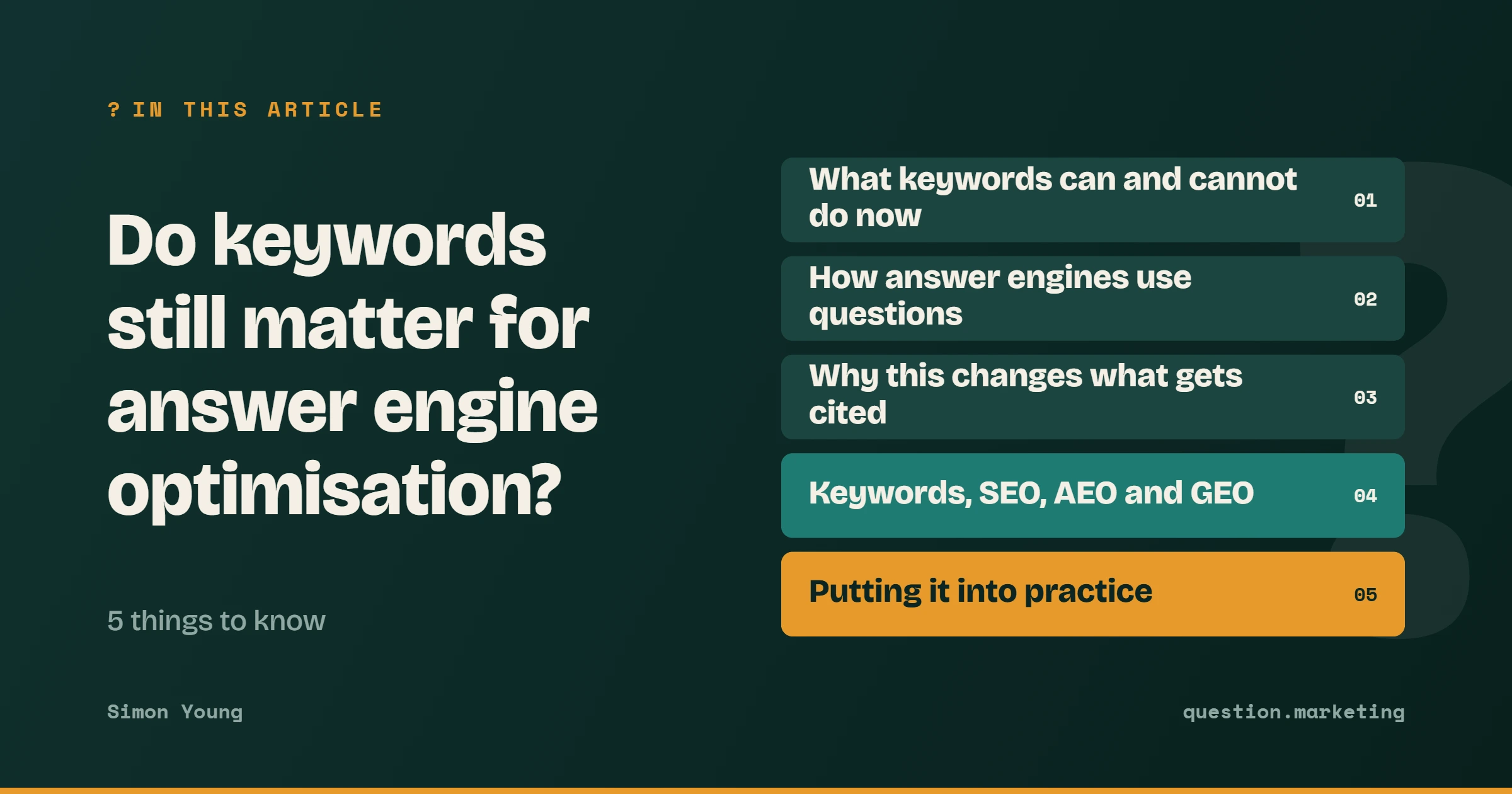
How answer engines use questions
The shift from keywords to questions follows from how an answer engine handles a single prompt.
How does an answer engine handle one user prompt?
The main question someone asks moves into sub-questions, and those sub-questions run separately below the authority question. That is why one keyword is a thin foundation. The engine is working through a family of related questions, and your page is competing on each of them.
What is a question bank and why does it matter?
A question bank is the full set of questions and answers you publish around a topic. As you build out the question bank and knowledge bank, moving people down the funnel becomes more important. Answer engine optimisation is, at its core, creating questions and the answers that go with them so you become listed and cited within large language models such as Gemini, Claude, ChatGPT, Perplexity and Copilot.
What does covering the full question set look like in practice?
Build a hub with detailed pages circling it. Take specialist software recruitment in Manchester: you would write content for 50 different job titles across the disciplines, link all of it back to one main hub page, and so build a large bank of knowledge around the topic. Structuring that content properly is hugely important, and many SEO practitioners do not know how to do it.
Why this changes what gets cited
Answer engines reward completeness and specificity, and they work from quality of answer rather than keyword match.
Why do complete answers get cited more than single-keyword pages?
Many websites were simply too thin, with too little detail to solve the whole of a problem, so people had to scour multiple sites for the answer. AI now does that scouring for the user. If you are the authority and you are cited, you win, and publishing complete information faster than anyone else matters.
What does a gap in the knowledge base mean for me?
A gap is an opportunity. If an answer engine has no answer to a specific question, a piece of content that covers it can be pulled the next time someone asks. Specific, answer-shaped pages fill gaps that a general keyword page never will.
Does a citation matter if clicks are falling?
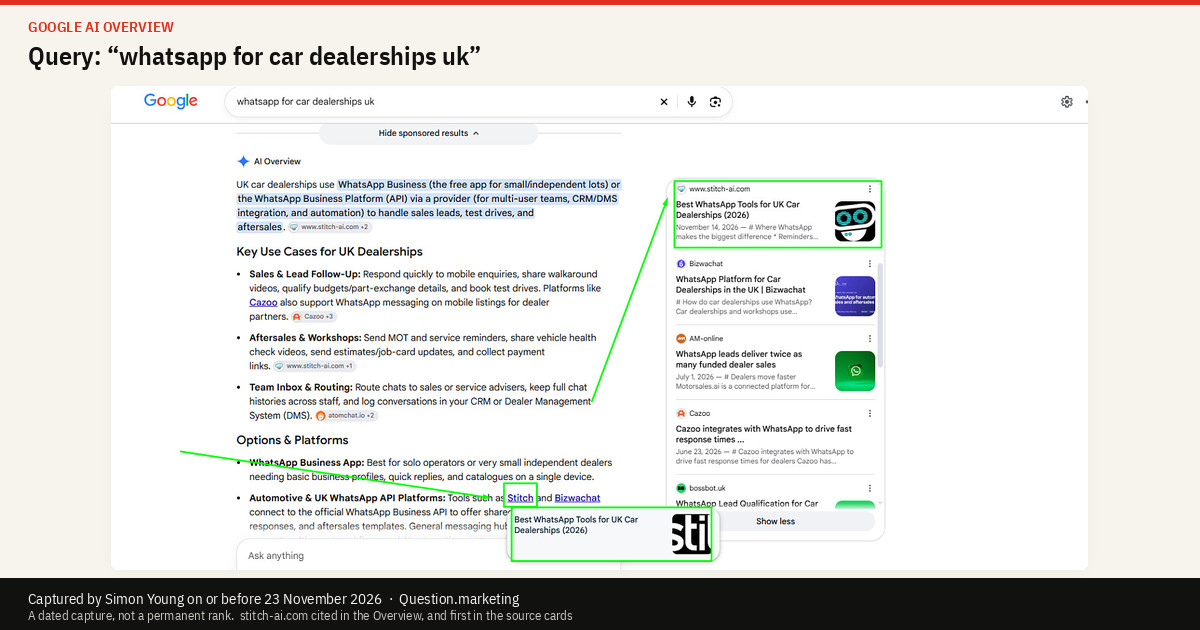
A citation matters more because clicks are falling. Around six in ten searches now end without anyone visiting a website, and when an AI Overview appears, click-through on the top result falls by somewhere between a third and two thirds depending on query type. Rankings hold while sessions collapse, so the plan is to be inside the answer.
Keywords, SEO, AEO and GEO
Keywords sit inside a wider question about how the disciplines relate, which is what the original prompt asked.
What is the difference between AEO, GEO and SEO?
AEO (Answer Engine Optimisation) is the primary term and means building the marketing for the LLM and AI-search world, being the trusted answer inside the chat window. GEO (Generative Engine Optimisation) is the mechanics, the plumbing that replaced SEO's plumbing. We use "AEO and GEO" as a pair when both are meant, and we do not treat one as a synonym for the other.
Where does SEO fit now?
SEO comes as a consequence of doing the AEO and GEO work properly. Publishing original, proprietary knowledge earns AI citations, and the ranking gains that follow are a by-product rather than the goal. Our position is that the traditional SEO business model is finishing, while rankings themselves are not dead.
Should I stop doing keyword research?
Keep it as one input and stop treating it as the strategy. Use it to learn the language your audience uses, then convert that language into the specific questions they ask and answer each one in full. That is the same shift from broad terms to exact prompts described above.
Putting it into practice
The remaining questions cover access, measurement and what to do first.
What has to happen before an answer engine can cite me?
Your content has to be accessible, retrievable and found when the question is asked. Many websites use Cloudflare, and by default AI crawlers do not access content behind it, so you need to set it to allow AI crawlers or you will never be listed.
How do I measure whether this is working?
Track citations across several LLMs against a defined set of prompts, with screenshot evidence. One way to organise this is a prompt set spanning claim, entity, shortlist, education and clinical categories, with first-answer counts, run across engines such as ChatGPT, Google AI and Perplexity. We use the same test when vetting an AEO supplier: ask whether they can show screenshot evidence of multi-LLM citation tracking against a defined prompt set.
What should I do first?
Do these three things in order:
- List the specific prompts your buyers type into AI tools, rather than the broad keywords you tracked before.
- Build a hub page with detailed supporting pages that answer each sub-question.
- Check that AI crawlers can reach your site, then track citations across the main engines.
For the full method, read how to get cited by AI answer engines.