FAQ
How long should content be to get cited by ChatGPT?
ChatGPT does not publish a word count that earns a citation, and nothing in our sources points to a magic length. What our sources do show is where citations come from on the page, how passages are structured, and what the surrounding page needs to do. This FAQ covers those points so you can decide how long each piece should be.
Length and structure
Is there an ideal word count for getting cited by ChatGPT?
No ideal word count exists, and the sources we work from point to structure and position as the levers instead. The research we rely on found that 44.2% of LLM citations come from the first 30% of a page. We summarise it as "the first 60 words are the whole game". A 600-word page and a 3,000-word page can both be cited if the answer sits near the top.
How long should the passage that gets cited be?
The cited passage should be a self-contained answer that opens with a complete standalone sentence. LLMs retrieve and cite content structured as self-contained, answer-first passages. The test is simple: could the sentence under your heading be lifted out and quoted on its own? If it could, it is the right length. Write that sentence first, then use the sentences after it to support it.
Where on the page should the answer go?
Put the answer directly under the question and keep it in the top third of the page. The models do not search through everything on a page, and they prefer content in the top third. Treat your main heading as the question and publish the answer immediately below it. Anything buried at the bottom of a long page is competing against the 44.2% statistic.
Do longer pages get cited more often?
Our sources do not support a claim that longer pages get cited more often. They support a claim about structure: standalone answers placed high on the page, under headings that match real questions. A longer page earns its length by covering the topic and its follow-up questions in separate, answer-first sections. It does not earn citations by length alone.
Building a page that gets cited
What makes a heading citation-friendly?
A citation-friendly heading is the question the reader actually typed. Question-shaped H2 headings are one of the primary levers for earning a citation, alongside a complete standalone sentence beneath each one. Google has built up a web of real questions over years through its "People also ask" section. Use that as a guide to the phrasing people use.
How should I structure each section?
Structure each section as a question heading, a direct answer, then supporting detail. The answer-first sentence has to stand alone, and the supporting sentences add evidence or context. Content also needs to be formatted so an engine can pull the answer out. Schema and markup tell the engine which text is the question and which is the answer, and without that formatting you have little chance of being featured.
Should I fill a page with short answers only?
No, because a page of short answers misses the part of the job that builds trust. Build content that matches the question and answer, in the way we used to build very long-tail keyword content. Cover the topic and its related questions on the same page. Unique content is what the engines want most: new knowledge from inside your head, written in your own voice.
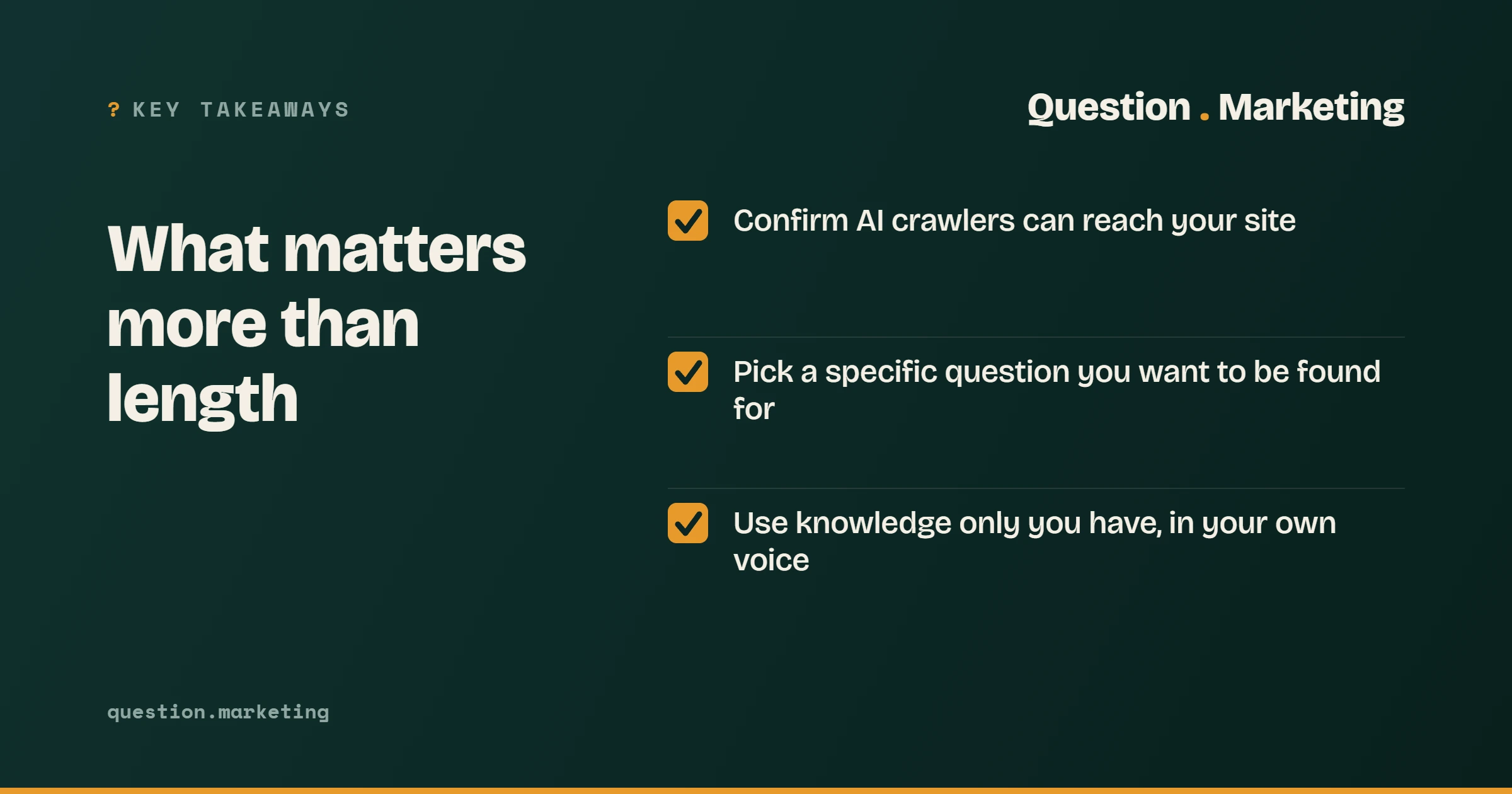
What matters more than length
Can the content be written entirely by AI?
You should not publish content generated entirely by AI. The engines are trying to clean up the web, and AI-generated content is fundamentally scraped from other AI sources. Original, proprietary knowledge earns citations, while AI-generated derivative content does not. The slower route of unique content in your own brand voice is the one that wins.
Can ChatGPT see my content at all?
Not if your site blocks AI crawlers, and this is the first check on any audit. Roughly 22% of web traffic sits behind Cloudflare, and Cloudflare's default settings block AI crawlers. Content behind a default block is invisible to AI engines regardless of how well it is structured or how long it is. Check this before you rewrite anything.
What else affects whether I get cited?
Entity consistency, third-party corroboration and named authors all affect citation. Your name, address, registration details, people and claims should say the same thing everywhere a model can read them. Contradictions are the most common reason a model stays vague about a provider. Brand mentions across the web also matter more than backlinks, with a correlation of 0.664 for branded mentions versus 0.218 for backlinks across 75,000 brands. Models cite named people as readily as brands.
Does being cited actually help me?
Being cited improves the quality of the clicks you get. People who reach your content after finding you in an AI answer have usually asked two or three questions already, so they arrive with stronger intent and are more likely to convert. ChatGPT referrals have been reported to convert at 14.2 to 15.9% versus 1.76% for Google organic, but those figures come from vendor-adjacent sources, so treat them with care. AI referrals are still around 1% of traffic, so this is a fast-growing, small channel.
What should I do first?
Start with this checklist:
- Confirm AI crawlers can reach your site.
- Pick a specific question you want to be found for.
- Write that question as a heading and put a standalone answer directly beneath it, in the top third of the page.
- Add the supporting detail and related questions below, with schema marking up the question and answer.
- Use knowledge only you have, in your own voice.
We do not promise a citation from any of this. The engines are non-deterministic, and we describe method rather than outcome.
For the full method, read how to get cited by AI answer engines.