FAQ
Is GEO the same thing as AEO?
Short answer: no, GEO and AEO are not the same thing, even though they are often used as if they were. Many people use the two terms interchangeably, and the overlap is real, but we treat them as two parts of one discipline. This FAQ sets out where each term came from, how we use them, and how both relate to SEO.
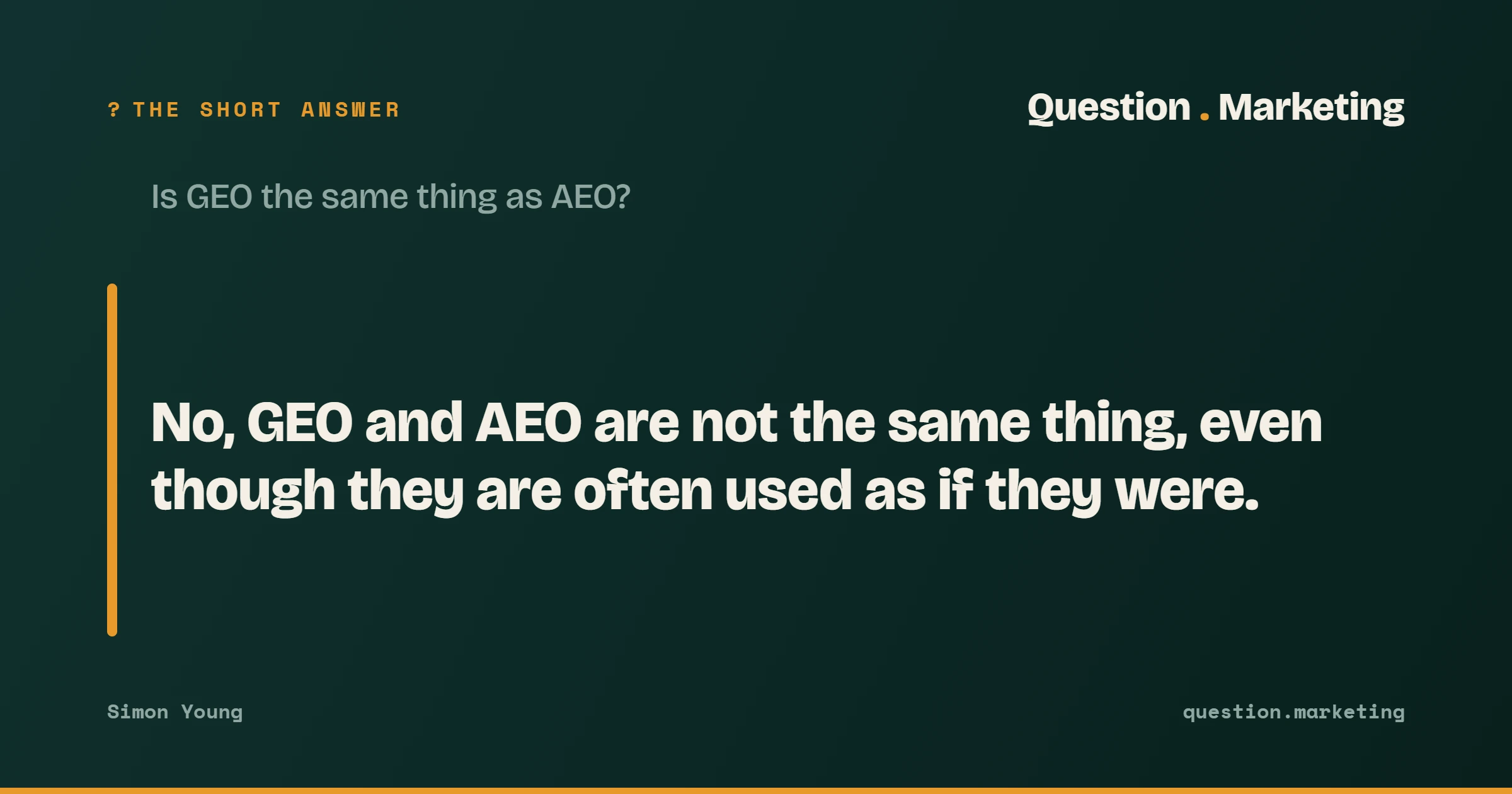
Definitions and origins
AEO and GEO describe closely related work, so the clearest way to separate them is to look at what each one covers and where each term originated.
Is GEO the same thing as AEO?
GEO and AEO are not synonyms, and we do not use one as a stand-in for the other. AEO (Answer Engine Optimisation) is the primary term. It means building the marketing for the LLM and AI-search world, so that you become the trusted answer inside the chat window. GEO (Generative Engine Optimisation) is the mechanics: the plumbing that replaced SEO's plumbing. When we mean both, we write "AEO and GEO" or "AEO/GEO".
Where did the term AEO come from?
AEO was coined by Jason Barnard of Kalicube in January 2018. Simon Young adopted the term and began building for it with clients in 2019, before the market did. The term gained exposure at Brighton SEO in 2018, when the conversation centred on voice assistants such as Alexa that gave users one answer to a question.
Where did the term GEO come from?
GEO comes from an academic paper published in November 2023, more than four years after Simon was already using AEO with clients. The Princeton work behind it was an experiment on AI citation: how to be listed, what content can be listed, and the fundamentals behind that.
Why do people treat the two terms as the same thing?
Both disciplines aim at the same outcome: getting your knowledge selected, quoted and attributed inside a machine-generated answer, rather than getting a link ranked on a page of links. That shared goal makes the labels blur in conversation. Our view is that AEO is where the answers and questions will live, and that GEO is the work that gets you into that space.
How AEO and GEO relate to SEO
Once the two terms are clear, the next question is how they sit alongside SEO. We answer it directly, because a lot of confusion starts here.
What is the difference between AEO, GEO and SEO?
AEO is the marketing for the AI-answer world, GEO is the mechanics that get you into it, and SEO comes secondary to both. We think AEO/GEO is what proper SEO should have been all along, and that rankings now arrive as a consequence of doing the work properly. Many SEO practitioners disagree and argue that AEO and GEO are a subset of SEO. We expect time to settle that debate.
Is SEO dead?
The SEO playbook is finished, but rankings are not. We mean keyword density, backlink churn and monthly rank reports when we say the playbook is dead. AEO/GEO work produces traditional search rankings as a by-product, and we celebrate ranking wins for our clients. The accurate framing is that the traditional SEO business model is finishing.
Should I use other labels such as "AI SEO", "LLMO" or "AIO"?
No. We avoid "AI SEO", "LLMO" and "AIO". There are many acronyms in circulation. A single term for the discipline (AEO) and a single term for its mechanics (GEO) keeps the vocabulary clear.
What the work involves
Knowing the vocabulary is only useful if it points to something you can act on, so here is what the discipline requires in practice.
What does AEO/GEO work involve in practice?
It goes well beyond on-site tweaks and blogging. We build schema and structured content, trusted content, dissemination of that content through public relations or publishing, and third-party citation of all of it. You also need something unique to add to the knowledge base, because publishing original, proprietary knowledge earns AI citations, while AI-generated derivative content does not.
Is there a technical prerequisite for being cited?
Yes: AI crawlers must be able to reach your content. Many websites use Cloudflare, and by default AI crawlers do not access the content behind it, so you need to set it to allow them. If crawlers are blocked, you will not get listed.
Which platforms does this apply to?
The answer engines include ChatGPT, Gemini, Claude, Perplexity and Copilot. When we track visibility, our priority engines are ChatGPT, Google AI and Perplexity.
Choosing and judging an AEO/GEO supplier
If you are hiring for this work, the definitions above double as a quick test of whether a supplier understands the field.
How can I tell whether a supplier really understands AEO and GEO?
Ask five questions:
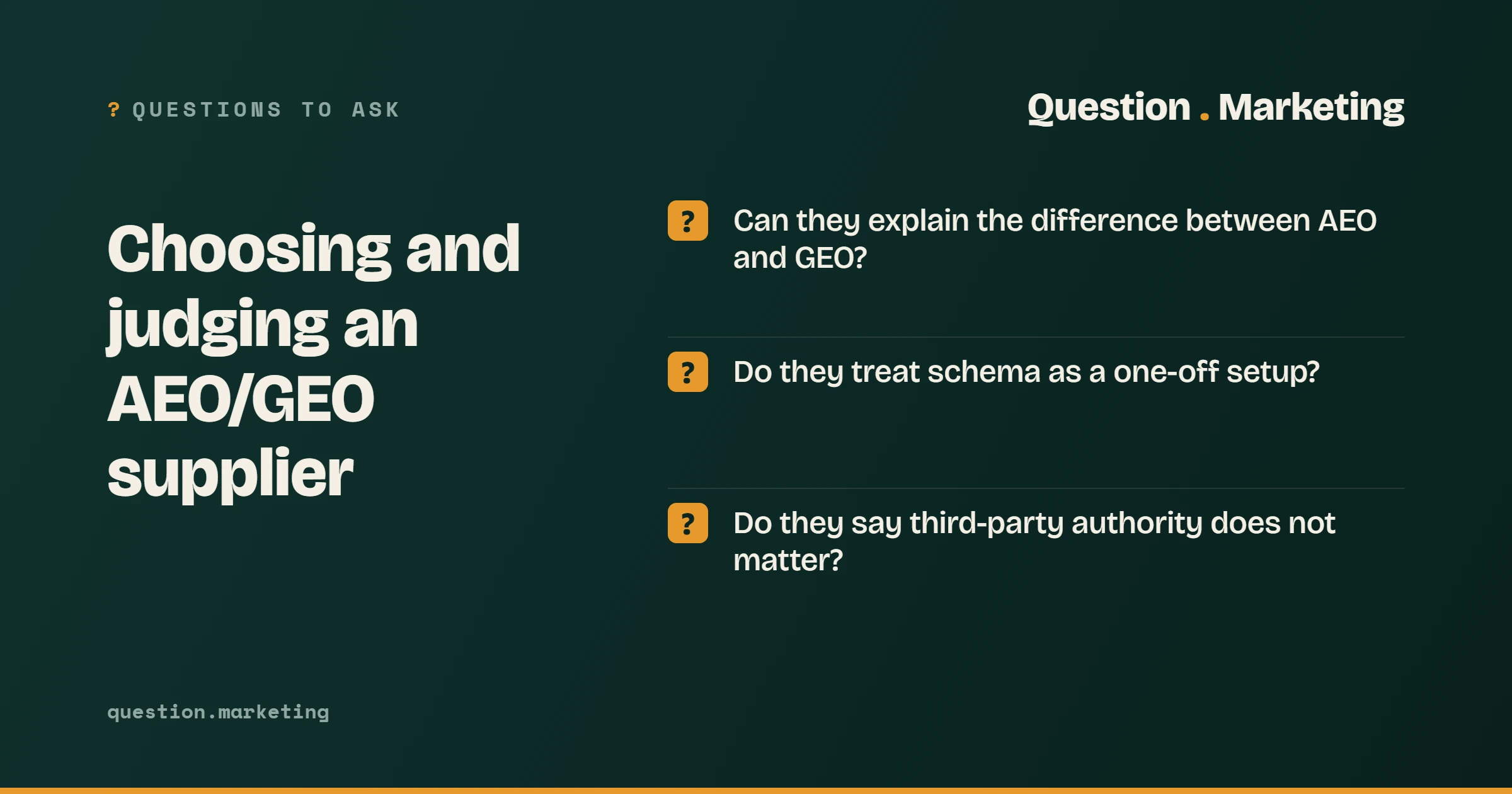
- Can they explain the difference between AEO and GEO?
- Can they produce screenshot evidence of multi-LLM citation tracking against a defined prompt set?
- Do they treat schema as a one-off setup? That answer is wrong.
- Do they say third-party authority does not matter? Usually that means they cannot do it.
- In regulated sectors, will they publish claims with no named clinician or adviser, no review date and no regard for the regulator's advertising rules?
A supplier who treats AEO and GEO as the same word with no further explanation has probably not done the work. Our recommendation is to start with the definition question, because the answer shows quickly whether they have.
For where search fits now, read how AEO differs from SEO and GEO.