FAQ
Should I split my budget between SEO and AEO?
Most businesses should treat AEO as an extension of search, not a replacement for it. The questions below cover how we split a budget, what each line should buy, and what to avoid when a supplier pitches you a new retainer.
Where the budget question starts
Budget decisions get easier once you know what changed and what did not.
What actually changed in search that affects my budget?
The click changed, not the search. Google's AI Overviews now appear on roughly half of all queries, and when one appears, click-through on the top result falls by somewhere between a third and two thirds depending on query type. Around six in ten searches now end without anyone visiting a website, so rankings and impressions can hold while sessions collapse. That is the reason a pure SEO budget no longer covers the whole job.
Can AI referral traffic replace the clicks I am losing?
No. AI referral traffic is still around 1% of total web traffic, growing roughly a point a month, according to two sources using different methods. In sector after sector the clicks stopped rather than moved to another channel. "We'll pick up our AI traffic instead" is not a plan. The plan is to be inside the answer.
How SEO, AEO and GEO relate
Before you split anything, you need to know what each line pays for.
What is the difference between AEO and GEO?
AEO (Answer Engine Optimisation) is the primary term: building the marketing for the LLM and AI-search world, so you are the trusted answer inside the chat window. GEO (Generative Engine Optimisation) is the mechanics, the plumbing that replaced SEO's plumbing. We use "AEO and GEO" as a pair when we mean both, and we do not treat one as a synonym for the other.
Is AEO just SEO with a new name?
No. The SEO playbook of keyword density, backlink churn and monthly rank reports is finishing as a business model. AEO and GEO work covers schema, structured content, trusted content, dissemination through PR and publishing, and third-party citation, and many SEO retainers never touched those areas. Rankings arrive as a by-product of doing that work properly, not the other way around.
Should I cut my SEO budget to fund AEO?
No. Keep the SEO fundamentals funded. Rankings are not dead, and AEO and GEO work produces traditional search rankings as a by-product. The target is the playbook, not the rankings, and we celebrate ranking wins for clients. A sensible starting point is to hold your SEO fundamentals steady and ring-fence a smaller, separately measured AEO line.
What the AEO line should buy
A smaller budget works when each pound is tied to something you can check.
What should I put in a ring-fenced AEO budget?
Fund three things: a baseline audit, answer-shaped content, and quarterly re-measurement. The audit shows where you appear today. The content is what earns citations, because publishing original, proprietary knowledge earns AI citations while AI-generated derivative content does not. Re-measurement shows whether the spend moved anything.
How do I measure whether the AEO spend is working?
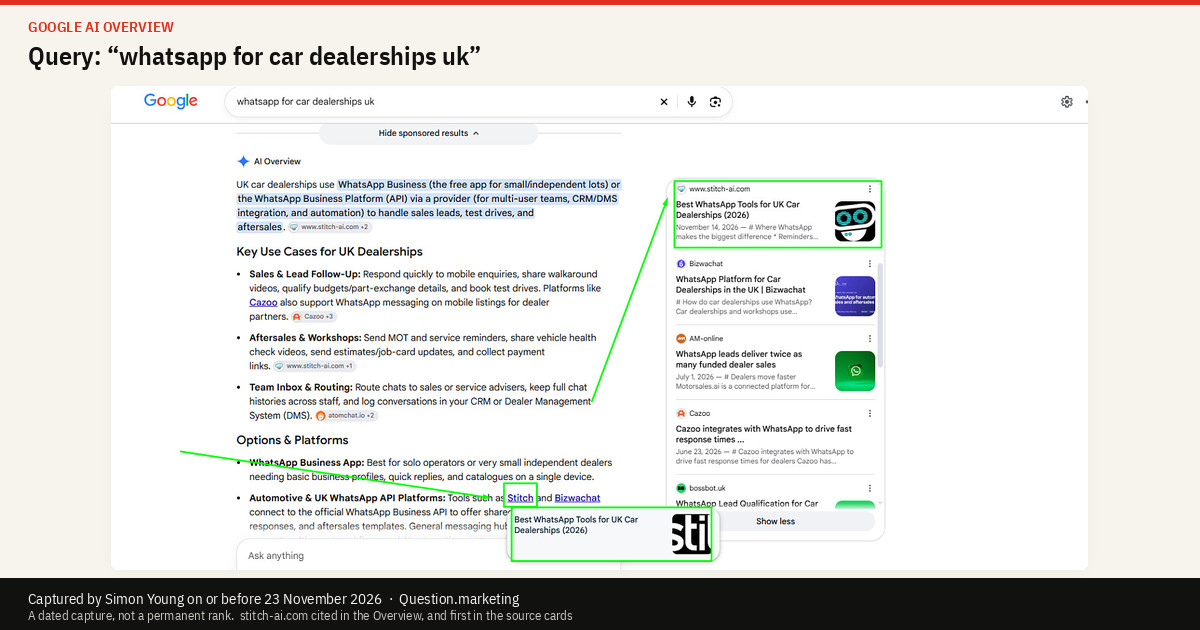
Track citations against a defined prompt set across several LLMs, with screenshot evidence and first-answer counts. Our own baseline tracking uses prompts across claim, entity, shortlist, education and clinical categories, with priority engines ChatGPT, Google AI and Perplexity. Name the platforms you cover in any report, because a result on one engine says nothing about the others.
How fast should I publish?
Publish your unique knowledge before somebody else does. Generative engines pick up that content and reference it, and you can then appear in People Also Ask, voice, AI Overviews and chat assistants. You also have to give the knowledge base something distinct, because trusted, unique content is what makes the difference.
Vetting suppliers before you commit
Splitting a budget only works if the new line goes to someone who can deliver.
What should I ask an AEO supplier before I sign?
Ask five questions:
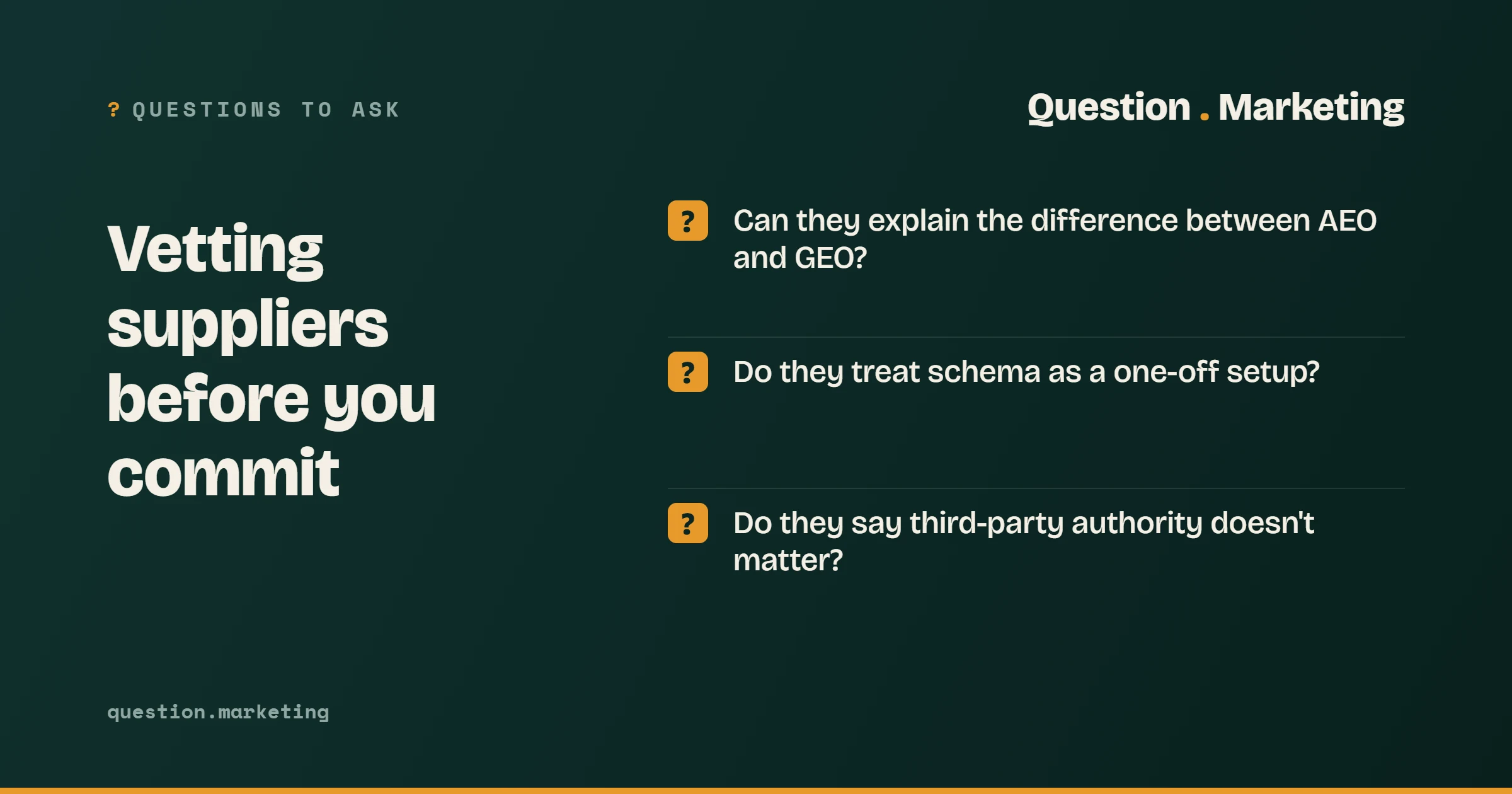
- Can they explain the difference between AEO and GEO?
- Can they produce screenshot evidence of multi-LLM citation tracking against a defined prompt set?
- Do they treat schema as a one-off setup? (The right answer is no.)
- Do they say third-party authority doesn't matter? (Usually because they can't do it.)
- In regulated sectors, will they publish claims with no named clinician or adviser, no review date and no regard for the regulator's advertising rules?
Is it too early to spend on AEO?
The cost of waiting is rising. Lots of industries have already lost 30 to 40% of their clicks, and that figure is set to increase. If you are not cited in AI results, which typically name only two, three or four sources, you are not part of the answer. A small, measured line lets you start without betting the whole budget.
The short answer
Do not choose between SEO and AEO. Keep SEO fundamentals funded, add a smaller AEO line, and make that line prove itself with a baseline audit, answer-shaped content and quarterly re-measurement. If you want to see how we run that baseline, ask us for the audit scope.
For where search fits now, read how AEO differs from SEO and GEO.