Insight
Where SEO, AEO and GEO overlap and where they differ
SEO, AEO and GEO share one foundation: content that machines can crawl, that readers can trust and that is structured well enough to be understood. The difference is the output each one is built to win. SEO competes for a position in a list of links. AEO and GEO compete for a place inside a single synthesised answer. That change in target alters how we write, how we measure and which third-party sites carry weight.
What AEO and GEO each mean
AEO (Answer Engine Optimisation) is the primary term. It means building marketing for the LLM and AI-search world, so that you are the trusted answer inside the chat window. GEO (Generative Engine Optimisation) is the mechanics: the plumbing that replaced SEO's plumbing. When we mean both, we write "AEO and GEO" or "AEO/GEO". We do not use one as a synonym for the other.
The terms have different origins. AEO was coined by Jason Barnard of Kalicube in January 2018. The term GEO comes from an academic paper published in November 2023. Our own view is that AEO is where the answers and questions will live, GEO is the work that gets you into that space, and SEO comes secondary to both.
Why the vocabulary matters
Many SEO agencies present AEO and GEO as a subset of SEO. That framing is convenient for anyone who wants to keep selling the existing retainer. We treat the three as related but separate, because the output being optimised is different, and so is the work required to win it.
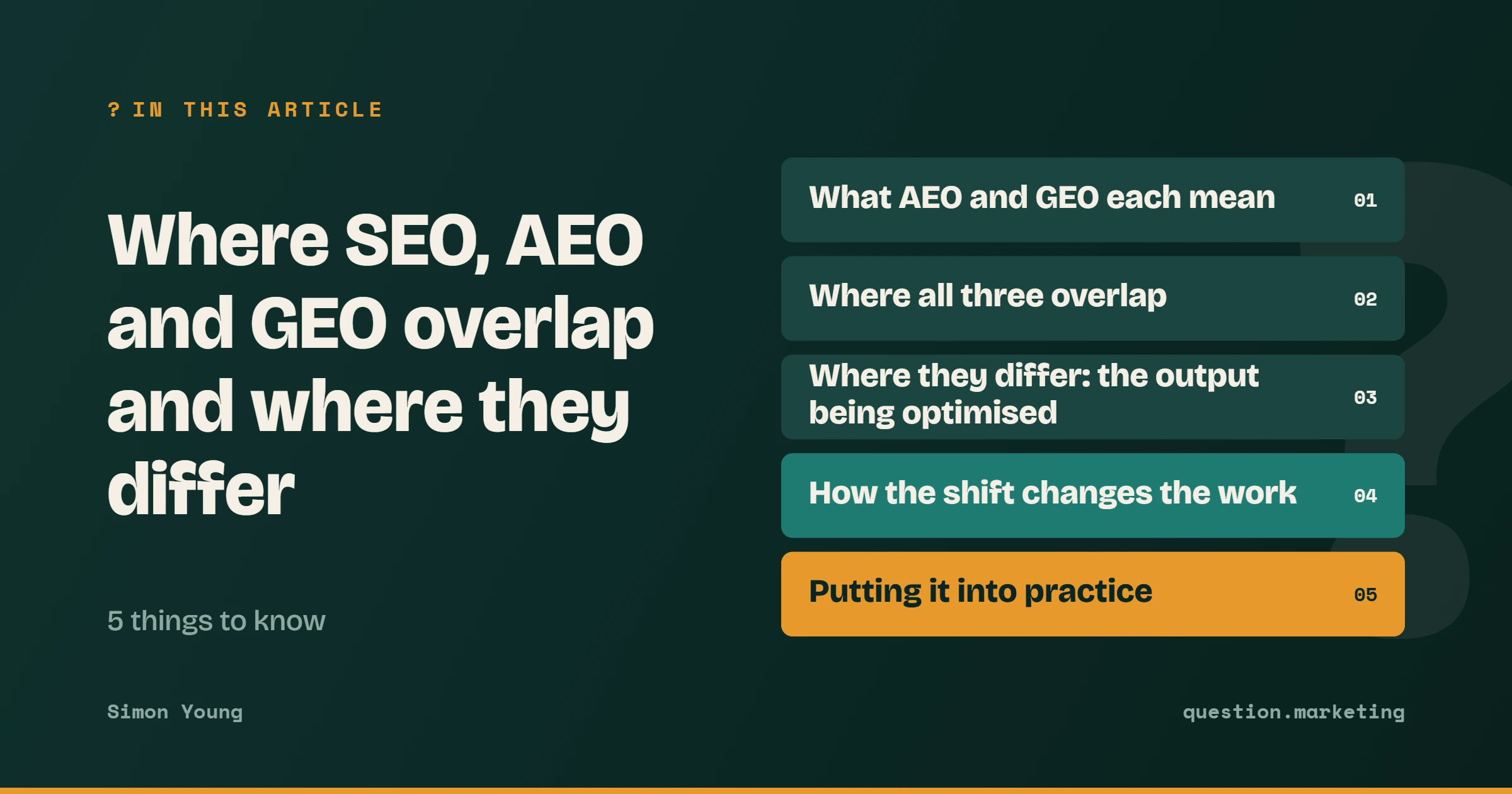
Where all three overlap
The shared ground is real, and it is worth stating plainly so nobody thinks we are discarding what already works.
All three depend on content that is crawlable, written by someone who knows the subject, and structured so a machine can extract meaning from it. Original content matters in every case: publishing proprietary knowledge earns AI citations, while AI-generated derivative content does not. Rankings also remain part of the picture. AEO/GEO work produces traditional search rankings as a by-product, not the other way around.
That last point shapes how we talk about SEO. The traditional SEO playbook of keyword density, backlink churn and monthly rank reports is finished as a business model, but rankings themselves are not dead. We celebrate ranking wins for clients too. SEO comes now as a consequence of doing things properly.
Where they differ: the output being optimised
SEO targets a position in a list
Classic SEO aims to rank a page in Google so that a searcher clicks through, lands on the site and does their research there. Success is a position, and the page earns its value after the click.
AEO and GEO target inclusion in a synthesised answer
With AEO and GEO the goal is to be retrievable, extractable and repeatable inside the answer itself. An AI Overview might cite two, three or four results, so being cited or being absent is close to a binary outcome. If you are the authority and you are cited, you are the winner.
The research now happens inside the answer engine. People get their information there, are pre-qualified, are exposed to your brand and then move down a funnel to an enquiry. We are finding that those visitors convert four or five times more efficiently than visitors who arrive after searching and comparing three or four websites.
How the shift changes the work
How content is written
Because the answer engine does the comparison work for the reader, thin content loses. Pages that left out the detail needed to solve a whole problem forced people to scour several sites. AI now does that scouring for them. The practical response is to write complete, specific answers to the questions your buyers actually ask, and to publish unique knowledge quickly, before someone else does.
Structure matters as much as substance. The deeper parts of the work include building schema and structured content, producing trusted content, disseminating it through public relations or PR publishing, and earning third-party citation of all of it. Many SEO providers never touch these areas.
How success is measured
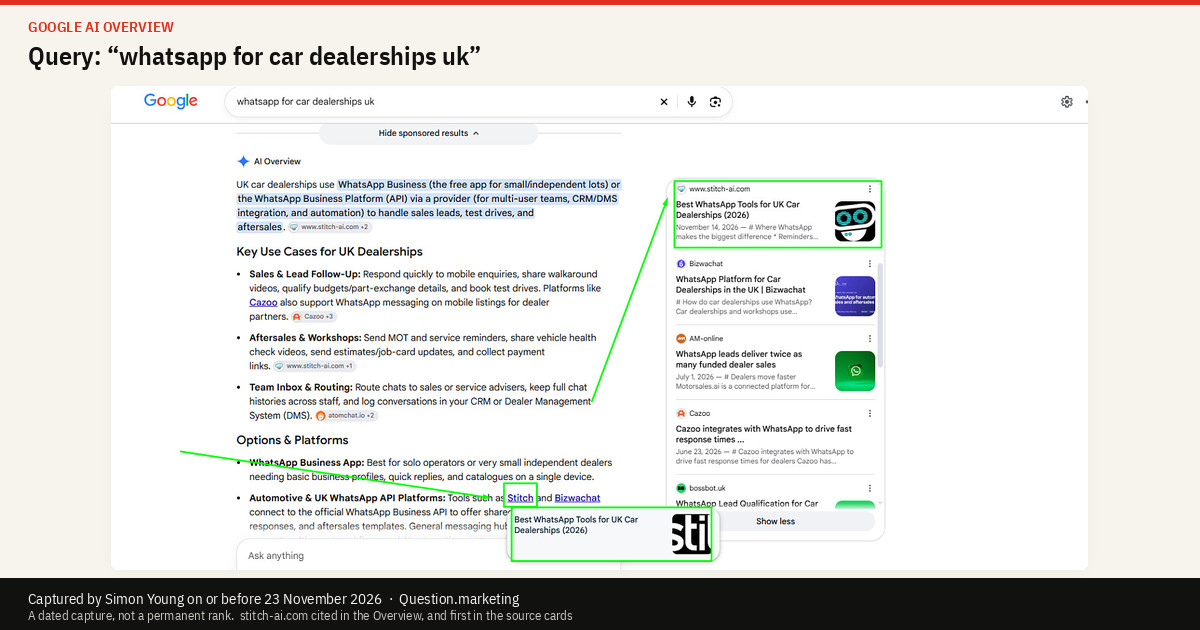
A rank report cannot describe an answer. The relevant question is whether your brand is named when a prospect asks a category question. A credible AEO supplier should be able to produce screenshot evidence of multi-LLM citation tracking against a defined prompt set. Referral clicks alone will not tell the story either, because the click has weakened. Google's AI Overviews now appear on roughly half of all queries, and when one appears, click-through on the top result falls by somewhere between a third and two thirds depending on query type. Around six in ten searches now end without anyone visiting a website. Rankings hold and impressions hold, while sessions collapse.
AI referral traffic is still around 1% of total web traffic, growing roughly a point a month. The clicks have not migrated to a new channel; they have stopped. That is why waiting to pick up AI traffic later is not a plan. The plan is to be inside the answer.
Which third-party sites matter
In SEO, third-party sites mostly mattered as sources of links. For AEO and GEO, third-party citation of your content is part of the work itself. Dissemination through PR and publishing, followed by independent citation, is what builds the trust an answer engine looks for. A supplier who says third-party authority does not matter is usually saying so because they cannot do it.
Putting it into practice
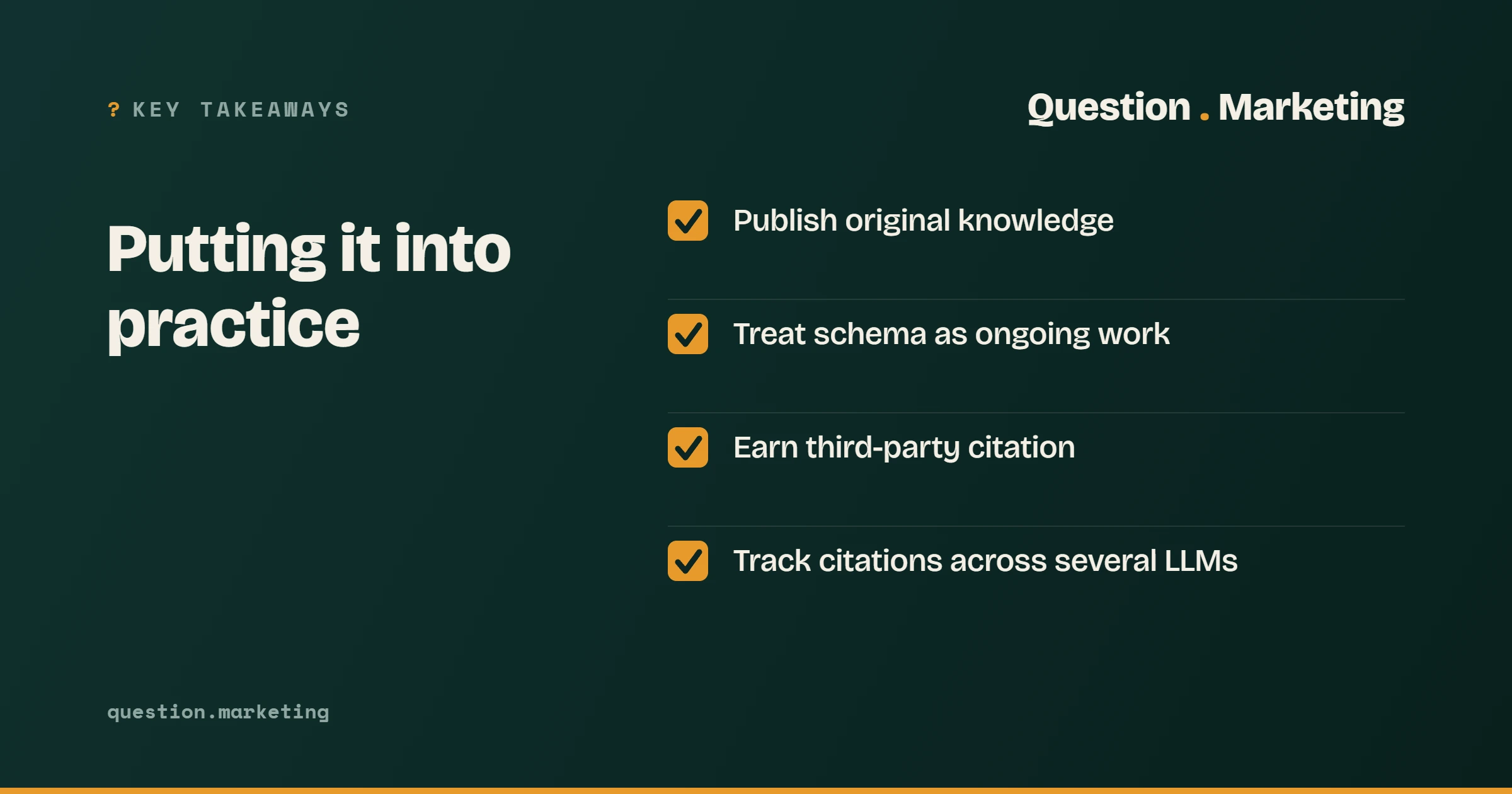
Start with what already works. Keep your crawlable, well-structured, expert content, then add the layers that answer engines reward. Use this short checklist to test where you stand.
- Publish original knowledge. Put proprietary insight on your site before anyone else does.
- Treat schema as ongoing work. A one-off setup is the wrong approach.
- Earn third-party citation. Disseminate your content through PR and publishing so independent sources reference it.
- Track citations across several LLMs. Use a defined prompt set and keep screenshot evidence.
When you review a supplier, ask whether they can explain the difference between AEO and GEO, and whether they can show multi-LLM citation evidence. Those two questions separate practitioners from agencies that have only relabelled an old retainer.
What to do next
SEO, AEO and GEO overlap on quality and structure, and they split on the prize: a ranked link versus a named place in the answer. Treating them as the same job leaves the second prize unclaimed. We have been publishing on this since 2019, and the dated record is public. If you want to know whether your brand is named when prospects ask ChatGPT, Gemini or Perplexity your category questions, we can show you how to find out and what to build in response. Visit our receipts page at question.marketing/about/simon/receipts to see the track record, then get in touch to talk through your own prompt set.
For where search fits now, read how AEO differs from SEO and GEO.