FAQ
Does good SEO automatically improve AI visibility?
Good SEO helps AI visibility but does not deliver it on its own. Answer engines reward a different set of signals, and a site can hold strong rankings while its clicks collapse and its brand goes unnamed in AI answers. The questions below cover where SEO carries over, where it stops, and what has to be added.
SEO and AI visibility: the overlap
SEO is a useful foundation for AI visibility, but it is only the starting point. Search and AI answers share some mechanics, and they diverge on several others.
Does strong SEO guarantee my brand will appear in AI answers?
No, strong SEO does not guarantee that your brand appears in AI answers, and we never claim any approach can. Rankings can hold while sessions fall, because search did not die, the click did. Around six in ten searches now end without anyone visiting a website. A page can rank well and still never be quoted, because answer engines select, quote and attribute knowledge inside a generated answer rather than ranking a link on a page of links.
What is the difference between SEO, AEO and GEO?
SEO is the long-standing practice of earning rankings in a list of links. AEO (Answer Engine Optimisation) is the marketing built for the LLM and AI-search world: being the trusted answer inside the chat window. GEO (Generative Engine Optimisation) is the mechanics, the plumbing that replaced SEO's plumbing. We use "AEO and GEO" as a pair when we mean both, and we do not treat one as a synonym for the other. For the full picture of how the three relate, our definitions content is the reference.
Which parts of SEO still matter for AI visibility?
Content quality, structured data and a crawlable site still matter, because they support indexing and retrieval. Schema and embedded metadata help indexing, but they rank behind text-based companion pages on domains you control. Basic access is a precondition too. Many sites sit behind Cloudflare, and by default AI crawlers cannot reach content behind it, so the setting must allow them in or you will never be listed.
Where does classic SEO stop short?
Classic SEO stops short wherever a tactic aims only at a rank position. We see most of the gap in three places:
- Schema, structured content and trusted content
- Dissemination of that content through PR and publishing
- Third-party citation of all of that content
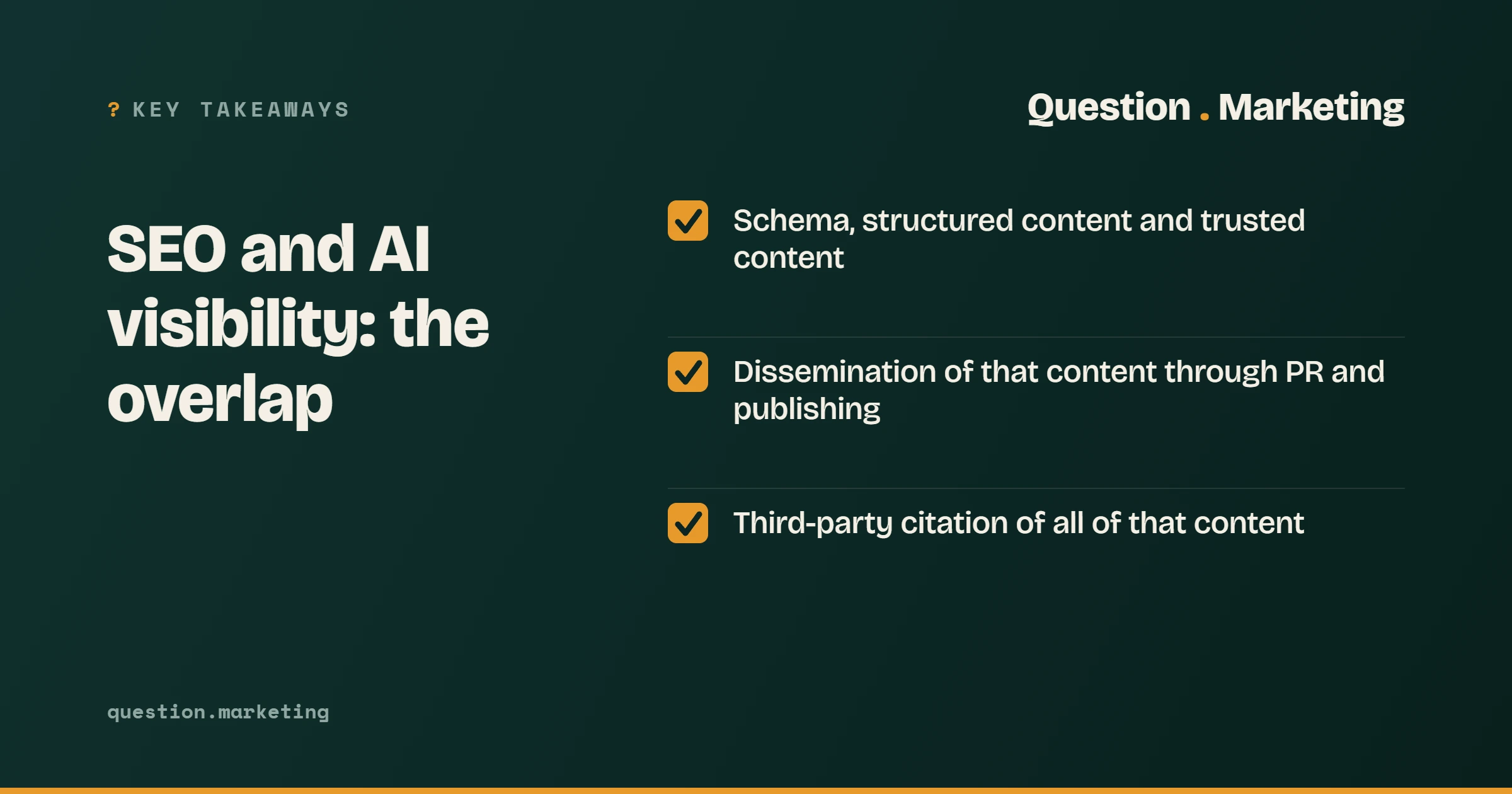
Many SEO programmes never touch these areas, yet they are the ones answer engines weigh. A keyword-and-backlink playbook does not cover them.
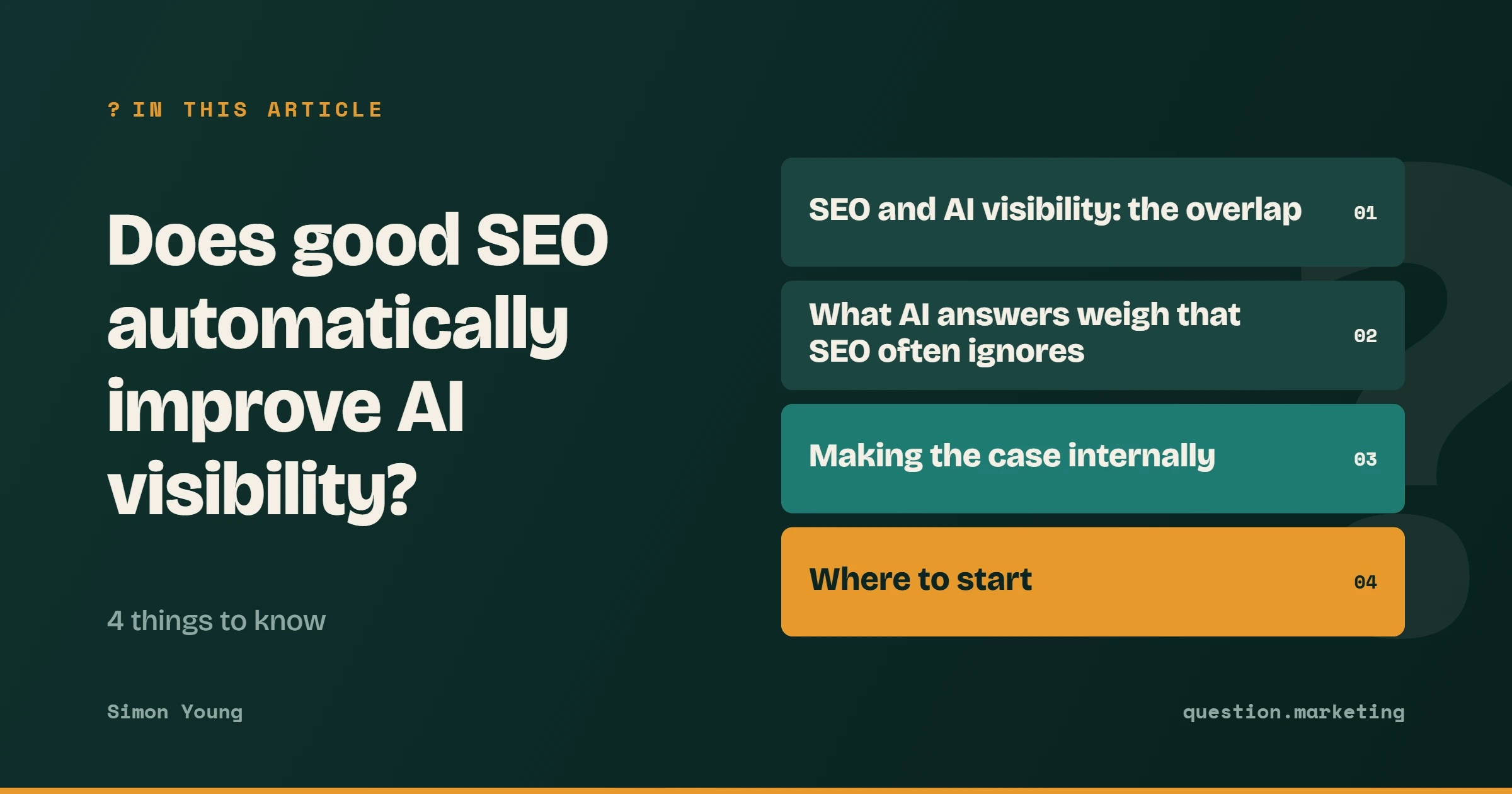
What AI answers weigh that SEO often ignores
LLMs favour content that can be lifted out and quoted. They also favour brands that appear consistently and are corroborated elsewhere on the web.
How should I structure a page so an AI engine can quote it?
Put the answer first and make every heading's opening sentence a complete, standalone statement. LLMs retrieve and cite content structured as self-contained, answer-first passages. Treat the heading as the question the reader typed, then publish the answer directly beneath it. Place it near the top of the page, normally the top third, because the models prefer it there and will not search through everything. Question-shaped H2 headings are a primary lever.
What is entity data and why does it affect AI visibility?
Entity data is the set of facts a model reads about you: your name, address, registration details, people and claims. Those facts must say the same thing everywhere a model can read them, including your site, regulators, directories, review platforms, professional bodies and Companies House. Contradictions are the single most common reason a model stays vague about a provider. A site can be well optimised for search and still fail here, because the inconsistency sits outside the website.
Do third-party mentions matter more than backlinks?
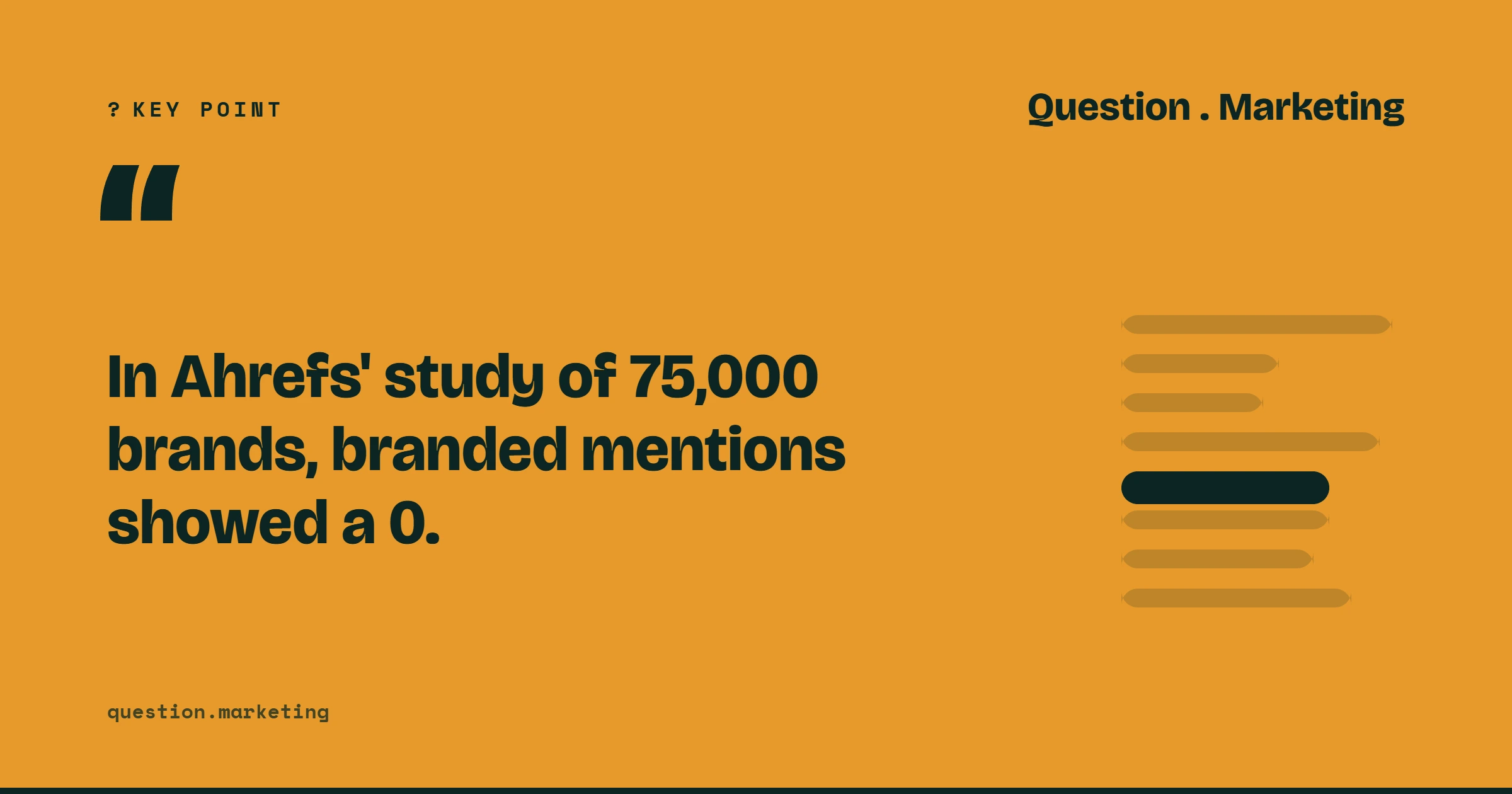
For AI citation, brand mentions across the web matter more than backlinks. In Ahrefs' study of 75,000 brands, branded mentions showed a 0.664 correlation with AI visibility, against 0.218 for backlinks. A link-building programme that ignores who talks about your brand, and where, optimises the weaker signal.
Does original content earn more citations than AI-generated content?
Yes, original proprietary knowledge earns citations, and AI-generated derivative content does not. The Princeton GEO paper found that information gain drives citation. We always pair that finding with the C-SEO Bench corrective, which shows the effect is smaller and more variable than the original paper suggested. Many teams are using AI to create the content that is meant to get them listed on the AI engines, and we expect that approach to fall short.
Does video content help, and what does it need?
Video and audio are invisible to models unless the full text lives on a domain you control. A video that ranks well and has no transcript on your own site gives an answer engine nothing to quote. The practical fix is to publish the full transcript on an owned domain alongside the video.
Making the case internally
The shift in click behaviour is what separates a ranking report from an AI-visibility report.
Why do my rankings hold while my traffic drops?
AI Overviews now appear on roughly half of all queries, and when one appears, click-through on the top result falls by somewhere between a third and two thirds depending on query type. Rankings hold, impressions hold, and sessions collapse. The clicks stopped rather than moved to another channel. AI referral traffic is still around 1% of total web traffic, growing roughly a point a month, according to two sources with different methods, Semrush and Conductor. Waiting to pick up that traffic later is not a plan, because the plan is to be inside the answer.
Why is it worth being cited in an AI answer if clicks are falling?
Visitors who arrive after researching inside an answer engine are more qualified. In our experience they convert four or five times more efficiently than visitors who searched, compared three or four websites and then enquired. The answer engine pre-qualifies them and exposes them to your brand before they land. An AI Overview typically cites only two, three or four results. If your brand is not among them, you are absent from the part of the journey where the decision is shaped.
Does AEO and GEO work replace SEO?
AEO and GEO work does not replace SEO. It produces rankings as a by-product, and SEO comes as a consequence of doing things properly. What is finishing is the traditional SEO playbook of keyword density, backlink churn and monthly rank reports. We celebrate ranking wins for our clients as much as anyone.
Where to start
Start by confirming your content is reachable, then restructure your most important pages answer-first, and then fix entity consistency and third-party presence. A short sequence:
- Check that Cloudflare or any similar layer allows AI crawlers.
- Rewrite priority pages so each heading is a real question with a quotable answer beneath it.
- Publish full transcripts of video and audio on a domain you own.
- Audit how your name, address, people and claims appear across directories, regulators and review sites, and remove contradictions.
- Build proprietary knowledge worth citing, then earn mentions of it beyond your own site.
If you want a specialist to design and implement this for your category, that is the work we do.
For where search fits now, read how AEO differs from SEO and GEO.